

Covid-19 was ‘the mother of all challenges’ for real estate industry: CDL’s Chia Ngiang Hong
Pandemic changed way business is done, says former Redas president

THE Covid-19 pandemic was “the mother of all challenges”, but it also transformed the way business is done in the real estate industry, said Chia Ngiang Hong, group general manager of City Developments Limited.
In an interview with The Business Times, he said: “The market was so chaotic. When Covid-19 set in, the whole market was in (a) panic.”
Chia, who also served as president of the Real Estate Developers’ Association of Singapore (Redas) for the 2019-2020 and 2021-2022 terms, recalled how safe-distancing measures at construction sites were implemented to mitigate the spread of the coronavirus. However, they made it difficult for workers to work together.
“Teams were grouped into designated zones to limit cross-contact and relied on communication methods like phones, radios and hand signals to coordinate. Shifts were staggered and work was sequenced so that only essential workers were present at any time.”
He added: “Where possible, additional machinery was used to minimise the need for close physical teamwork, though this made the process slower and more complex. These measures enabled construction work to continue safely despite the restrictions.
“We went through a lot of pain, worked very hard with the Singapore Contractors Association Limited, consultants, the Building and Construction Authority, the Ministry of Manpower, and various agencies to overcome the strict restrictions imposed.”
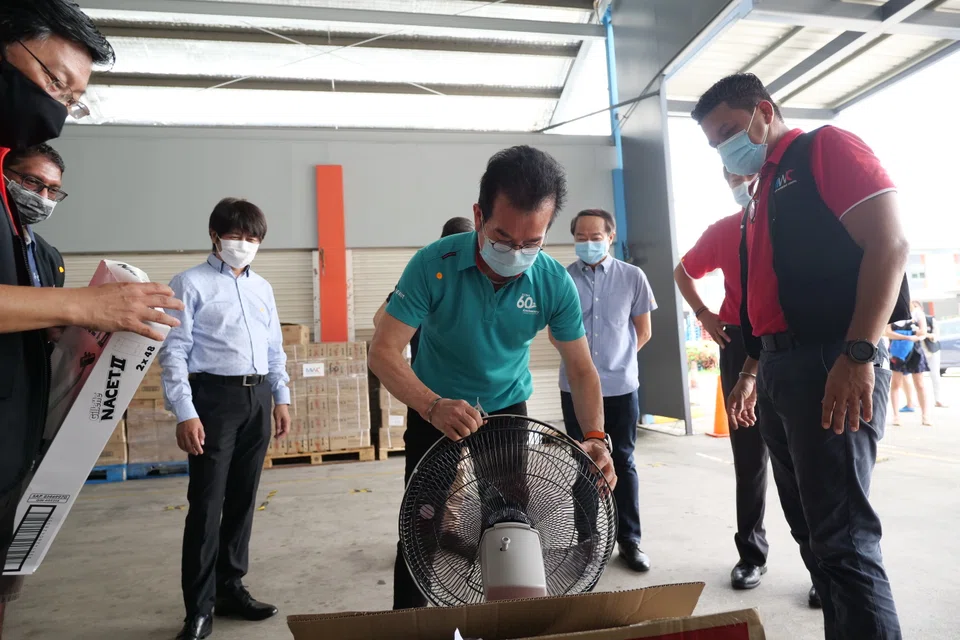
Recognising the impact of the Covid-19 pandemic on the industry, Chia led efforts to raise funds to support migrant and healthcare workers.
More than 80 Redas members raised a total of S$852,000. This went towards the purchase of 200,000 care packs and 800 standing fans for migrant workers as well as gift vouchers for 22,000 healthcare workers.
Developers such as Hong Leong Group donated funds so that foreign workers could top up their phone cards to contact their loved ones back home.
“During that period, many of them were so stressed because they could not call their families... their mental health was also badly affected,” said Chia.
Some contractors also ran into supply-chain problems and escalating costs during the pandemic.
“Our members are all very cooperative,” Chia said. “Nobody wants to see your project’s contractor collapse – to re-call the tender is very expensive. Some of us developers voluntarily negotiated with our contractors and helped them to increase... the contract price (a bit) to help them recover costs.”
Paving the way
Such industry practices eventually formed the basis for collaborative contracting, which involves the sharing of costs between project owners and construction companies.
In January, the government announced that the Standard Consultancy Agreement – the standard contract used for consultancy services for public-sector projects – will be amended to ensure a more balanced allocation of risks, such as the event of significant construction delays.
During his tenure as Redas president, Chia also advocated for the real estate industry to digitalise its operations.
In 2023, Redas launched the Real Estate Analytics and Performance Indicators Dashboard, which allows real estate developers, contractors and value-chain partners to have an integrated view of their projects as they are built. This is alongside key indicators that can be tracked such as costs, construction progress, and units sold.
Chia said: “We tried to work out a common platform where most of the developers can pay a small fee to digitalise their operations.There are many small or medium-sized developers which don’t have the resources or expertise to develop their own systems.”
He added: “Many of our operations are now digitalised. Developers have the choice of offering units via electronic balloting.”
This is in tandem with how the Singapore Land Authority (SLA) is coming up with a “very comprehensive system” where property titles can be transferred and payments can be made electronically, he said.
When fully implemented in 2026, SLA’s Digital Conveyancing Portal will be made available to both public and private housing, as well as commercial and industrial properties.
“I think it’s a very good move. The process will be very efficient and there will be fewer mistakes in the conveyancing process,” Chia said.
TRENDING NOW

Grab CEO’s wife Chloe Tong on life with Anthony Tan and finding her purpose

Brokers maintain ‘buy’ on CDL despite investor reservations over strategic review

Deal between tycoon friends sparks scrutiny of Philippine power sector

Hwa Seng Builder, two China companies win S$1.2 billion Tuas Road Viaduct phase two contracts

