
BEHIND THE NAME

In danger, there’s opportunity: How SingHaiyi’s 29-year-old scion is reshaping the property group’s next chapter

How a heart-pounding tender win and a baptism of fire during the pandemic moulded SingHaiyi’s new leadership

Summarise
Ry-Anne Lim
Published Mon, Dec 15, 2025 · 05:00 AM
    • Gallant Tang, group CEO of SingHaiyi Group, is keen to explore new asset classes in different markets.
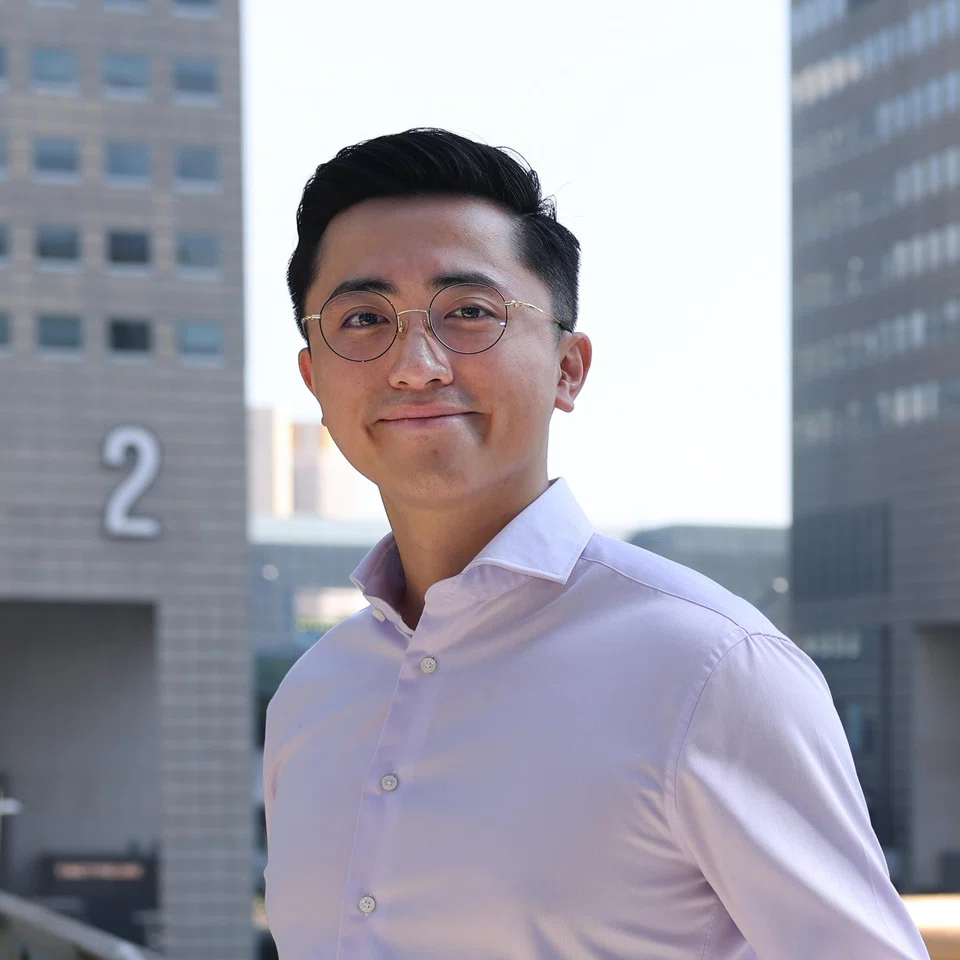
    • Gallant Tang, group CEO of SingHaiyi Group, is keen to explore new asset classes in different markets. PHOTO: TAY CHU YI, BT

    Inside Asia’s family empires: How they are transforming to seize the next stage of growth

    [SINGAPORE] Gallant Tang still remembers the quiet panic he felt on Mar 18, while participating in a land tender for a coveted Bayshore site. It was the SingHaiyi Group’s third try at bidding for government land sale sites since the beginning of the year, after two earlier bids missed the mark.

    The tender – for a 99-year-leasehold private housing site in a popular East Coast location – had just closed, and insiders had gathered to discuss bids. 

    Although Tang was standing still, listening in, his heart rate surged to 136 beats per minute. “I was just mildly hyperventilating,” he told The Business Times. “It was a very, very anxiety-inducing day for me.” 

    The win “was obviously a huge blessing… because it’s challenging to be a CEO when you don’t really have anything under your belt”, said the 29-year-old. “But in a way, it helped me a lot because it kept me very humble.”

    Lessons learnt

    Tang came on board at SingHaiyi Group two years ago. He was named group chief executive officer in April 2025, with company veteran Raymond Chia handing over the role. Chia continues to serve the group as adviser, and is also executive chairman of its listed construction arm GRC .

    The Bayshore tender came after two earlier, unsuccessful bids – for government land sale sites at Media Circle and River Valley – which Tang recalls as being “very off”.

    The Media Circle plot was eventually awarded to a Qingjian-Forsea consortium at S$315 million, about 7 per cent higher than SingHaiyi’s S$295 million bid. The River Valley Green (Parcel B) plot went to GuocoLand at S$627.8 million, roughly 9 per cent higher than SingHaiyi’s bid of S$576 million. 

    “What I learnt from those attempts was that I can’t do everything by myself,” said Tang, who returned to Singapore in 2023 after four years in Canada, where he went to business school.

    “I wasn’t asking enough questions and was almost trapped in this idea that I needed to be hyper-competent. But that was a failing strategy.” 

    Instead, he realised he needed to focus on his core strengths and lean on the team’s expertise – a pivotal lesson that reshaped his leadership approach. “Once I got over that mental hurdle of needing to do everything myself, that’s when I really started being able to get things done,” he said. 

    For the Bayshore tender, it also meant breaking from convention: involving more stakeholders in land-price discussions and creating a safe space for open feedback. This was a departure from the group’s usual bidding approach of giving knowledge of the price to just two or three senior staff.

    Tang cited the expertise of Raymond Chia, who expanded the business of Chip Eng Seng from purely construction to property development and investment, and had 30 years of experience handling everything from construction to site bidding.

    “(He’s done it) so many times he could do it with his eyes blindfolded,” he said. “I can’t pretend to have that expertise, so I rely a lot more on the team.” 

    The group clinched the Bayshore plot with its bid of S$658.9 million, outbidding seven others. The project is expected to launch in the second quarter of next year. 

    Working on the project has been a steep, but rewarding, learning curve. Unlike with previous projects, Tang is taking the project from inception, gaining hands-on exposure to site setup, contractors and design. It was also different from his previous stints in data analyst roles at tech outfits.

    “Everyone is so excited (for its launch) because there’s so much potential,” he said.

    He declined to share exact break-even figures, but noted that bid prices have tended to cluster within a range over the past few years, except for last year’s tenders. 

    Based on his observations, land costs typically account for 47 to 53 per cent of average per-square-foot prices. This can change depending on the construction environment and site attributes, such as car park requirements, which affect excavation costs, he said. 

    Challenges and opportunities

    The SingHaiyi empire in its current form was built through several acquisitions by his parents Gordon and Celine Tang.

    The Tangs, who originally hail from Guangdong, China, moved to Singapore in the 1990s. In 1995, they founded Tang Dynasty as a trading and investment company, before later setting up Haiyi Holdings in 2003 as an investment holding company.

    By 2012, Haiyi Holdings had accumulated a controlling interest in SingExpress Land, which was renamed SingHaiyi in 2013.

    In 2018, Celine Tang became the largest shareholder of Chip Eng Seng and was named chairman of the company. In 2021, the Tangs moved to privatise and delist SingHaiyi, and in the following year, took Chip Eng Seng private. The delisted entity was eventually tucked into the SingHaiyi fold.

    Gallant Tang recalls being brought to SingHaiyi Group's first project launch, The Vales executive condominium, as a 19-year-old by his mother Celine Tang (above). PHOTO: BT FILE
    Gordon Tang (left) is also the president of the Asian Mixed Martial Arts Association. In November this year, AMMA announced the founding of a global governing body for amateur MMA, with the goal of including the sport in the Olympic Games. PHOTO: BT FILE

    In 2024, the Tangs’ Acrophyte Asset Management arm, now overseen by Gallant’s sister Tang Jialei, acquired the manager of ARA US Hospitality Trust.

    In December that year, the Tangs made an offer to take over Suntec Real Estate Investment Trust , triggered after their holdings surpassed a 30 per cent threshold. The takeover bid eventually lapsed in February 2025, falling short of the 50 per cent required.

    SingHaiyi’s portfolio now encompasses diverse commercial assets, with holdings in Suntec City as well as 9 Penang Road, an office block built on the site of the former Park Mall, which now houses UBS’ entire Singapore operations.

    Its residential projects under construction include the mass-market Sora private condominium in Jurong and Grand Dunman in the east, and prime projects One Sophia and TMW Maxwell. It also has joint ventures with the Far East group and Perennial in a redevelopment of the iconic Golden Mile Complex; and with the Perennial group, building the high-end luxury Skywaters Residences in the Central Business District.

    Gallant Tang’s history with SingHaiyi goes back to his teenage years. He recalls witnessing the launch of its first project, The Vales executive condominium, in July 2015 as a 19-year-old. 

    “My mum brought me over to the showroom on opening day, and I got to see the absolute chaos of people running around,” he said. 

    What struck him was the delight of buyers receiving their ballot numbers, and the care the team put into ensuring buyers felt their investment was worthwhile. 

    “That is indicative of how important real estate is in a person’s life,” he said. “For most people, it’s the biggest purchase they’re ever going to make. How do (you help buyers) leave feeling like, ‘Yeah, I’m spending a million bucks, but I’ve got the winning ticket’. That part was interesting to me.”

    Joining SingHaiyi after the pandemic brought him face-to-face with the other side of the business: soaring costs, supply-chain dislocations and constant uncertainty brought on by Covid’s disruptions. 

    Tang’s parents had long told him that starting out in difficult conditions was the best way to learn. “Their sense is that growing up in easy times can lead you to overestimate your own ability,” he said. “If you’re able to do well in hard times, that’s when you truly know you’re doing well.”

    Some of those pressures persist today. Escalating costs and ongoing supply-chain issues continue to test the group’s operations.

    “Covid was a massive disrupter in ways that I don’t think people fully understand,” said Tang. “A lot of supply chains were torn apart, and then you have to restart them, while the environment continues to change.” 

    The prices of concrete, for instance, have climbed following recent major weather events in Vietnam, one of Singapore’s major suppliers. “That’s just one of many challenges,” he said. “Construction demand in Singapore is growing so fast that it’s sometimes hard to keep up. There aren’t enough crane operators, excavators, or piling rigs – the list goes on.” 

    At the same time, SingHaiyi’s operations have expanded since its delisting from the Singapore Exchange in January 2022. The group now has eight projects underway – seven in Singapore and one in the Maldives – with more in the pipeline being explored. 

    Some of the newer projects, particularly those in the Central Business District, have been more challenging due to construction and site constraints. “A lot of the infrastructure there is actually quite old, so we have to be very careful with how we approach it, and mindful of how we manage the different stakeholders.”

    “The problem scales with the number of projects in the market,” he added. “But nothing that can’t be managed when all is said and done.” 

    Even so, Tang reckoned there are plenty of opportunities in the market. “Now is a turbulent time, but my parents always preach the idea of a ‘dangerous opportunity’,” he said. “Whatever dangers you see, there’s always an opportunity there as well. That’s something we must maintain, or we start to stagnate.” 

    While residential developments remain SingHaiyi’s bread and butter, Tang said the team is exploring new types of developments and asset classes. “I have a brand new team looking at things like assisted living, active ageing, student accommodation, co-living and even long-stay serviced apartments.” 

    He recently travelled to the UK and Australia to study potentially new asset classes there. “Our group remains open to almost any new asset… (but) getting a net-new asset isn’t easy right now.” 

    Gallant Tang, Group CEO, SingHaiyi Group The Business Times

    Both the UK and Australia come with their own challenges, from shifting immigration sentiment to potential tax and housing policy changes, Tang noted. “This can make it hard to decide if we should proceed, and if we do, how.” 

    On the homefront, he said one of SingHaiyi’s goals in the next five to 10 years is to pursue mixed-development opportunities, and build capabilities to eventually own and operate such assets. 

    This was why the group entered joint ventures for projects such as Golden Mile Complex and Skywaters Residences – taking smaller stakes, playing more of a passive investor role and learning from partners with deeper expertise, Tang said. 

    He is equally keen on adaptive reuse projects, particularly for ageing buildings such as the former Peace Centre, where One Sophia now stands. Before construction began on One Sophia, SingHaiyi had collaborated with ground-up social movement PlayPan to transform the vacant complex into a temporary arts, community and events space.

    Tang said he hopes to replicate this approach as SingHaiyi’s commercial and retail footprint expands. “Real estate is a data business – that’s one part. The other is about the actual use of space: making it great by using it well.”



