Lower consent hurdle among changes proposed for en bloc sales to spur redevelopment, protect minority owners
The Bill also proposes to extend collective sale regime to large older government-built developments such as Neptune Court



[SINGAPORE] A slew of changes designed to nudge along collective sales of ageing properties are on the cards, with the government on Tuesday (Aug 4) proposing amendments to the Land Titles (Strata) Act.
A key hurdle at the start of the en bloc sale process – the consent threshold needed to proceed – could go down to as low as 65 per cent for developments that are more than 60 years old.
Developments that are between 40 and 59 years old will need at least 70 per cent of owners to agree to go ahead, a level lower than the current 80 per cent.
Safeguards are being added to ensure non-consenting owners are not pressured, such as a much shorter window for signature collection and a longer restriction period after a failed bid.
The Bill also proposes to extend the collective sale regime to non-strata-titled private residential developments, where the flat owners have long leases but do not own the underlying land.
These include large developments such as Neptune Court, One Tree Hill Mansions, Paterson Court, Orchard Court and Townhouse Apartments.
If passed, the amendments will update the collective sales regime to better support the renewal of ageing developments and optimise land use in land-scarce Singapore, said the Ministry of Law (MinLaw).
Currently, there are around 20,000 private non-landed residential units more than 40 years old, official government records showed. This number will rise as Singapore’s private housing stock ages.
These older projects will require substantial investment for maintenance, repairs or upgrading works to remain safe and liveable, MinLaw noted.

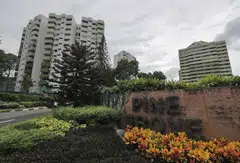

At present, a development more than 10 years old requires consensus from at least 80 per cent of owners by share value and strata area. For properties under 10 years old, 90 per cent consent is needed.
These will continue to apply for properties under 10 years old and those aged 10 to 39.
The Land Titles (Strata) (Amendment) Bill follows just-announced changes to the additional buyer’s stamp duty (ABSD) regime for buyers of large en bloc sites, that will give developers of large sites more time to complete construction and sell all units before having to fork out ABSD on the land cost.
The newly proposed recalibration of the consent thresholds is intended to give owners of older developments a more “practical option” to consider redevelopment, where there is broad support.
The proposal to expand the collective sale regime to non-strata-titled private residential developments could facilitate the redevelopment of estates such as Neptune Court – a 752-unit estate built in 1975. Its flat owners hold 99-year leasehold interests in their units, while the underlying land is owned by the Minister of Finance.
Under the existing framework for such developments where owners do not own the underlying land, only estates where owners have leases of at least 850 years can undergo collective sale by majority consent.
Safeguards will be put in place to protect the landowner’s interest. These include requiring the landowner’s agreement to the sale at a specific price, and ensuring the amount paid adequately reflects the value of its estate and interest in the land.
Stronger safeguards
Other amendments to the Act are to ensure stronger safeguards for non-consenting owners.
“The frequency and duration of collective sale exercises should also be minimised in developments where there is unlikely to be sufficient support,” said MinLaw.
Among key proposals is a higher threshold for launching an en bloc sale attempt in the first place.
Forming a collective sale committee would require the support of at least 35 per cent of owners by share value or number of units, up from the current thresholds of 20 per cent and 25 per cent, respectively.
This ensures that collective sale exercises are initiated only where there is sufficient support, said the ministry.
The committee will also have six months to obtain signatures for the collective sale agreement, down from 12 months.
MinLaw said this will address concerns about prolonged pressure faced by non-consenting owners, while still providing sufficient time for signature collection.
Should owners fail in an en bloc sales attempt, they will face a three-year restriction period, up from the existing two years. During this period, they must obtain a majority consensus of 50 per cent for another go, and 65 per cent to 80 per cent for a subsequent try, depending on the development’s age.
These heightened requisition thresholds prohibit repeated attempts when support remains insufficient among owners, said the ministry.
Additionally, the Bill proposes raising the cap on court-ordered proceeds payable to objecting owners to 0.5 per cent of each unit’s sale proceeds or S$2,000 per unit, whichever is higher, from the current 0.25 per cent, to increase the pool of proceeds available for distribution to non-consenting owners.
The new collective sale framework, if passed, will only apply to en bloc attempts that have not yet collected their first collective sale agreement signature by the commencement date.
Those that have already done so may either continue under the existing rules or convene a general meeting to terminate the agreement and restart the process under the new framework.
They will then have seven months from the commencement date to meet the new threshold.
The proposed amendments were shaped by feedback from the public, including individual property owners, and multiple rounds of consultations held with various stakeholders since 2023. These include academics, lawyers, property consultants, industry associations, developers and representatives from the Strata Titles Boards.
In November 2025, The Business Times reported that the government was reviewing policy and regulation of the collective sale regime under the Land Titles (Strata) Act.
The ministry said then that it continuously reviews policies and regulations to support the optimal use of land resources.
This includes the collective sales regime, which aims to facilitate urban rejuvenation while ensuring appropriate safeguards are in place to protect property owners’ rights.
Decoding Asia newsletter: your guide to navigating Asia in a new global order. Sign up here to get Decoding Asia newsletter. Delivered to your inbox. Free.
Copyright SPH Media. All rights reserved.