

As luxury retail goes big, can Singapore’s Orchard Road keep up?
Rival cities with stronger tourist pull and more real estate are drawing larger stores and more investment

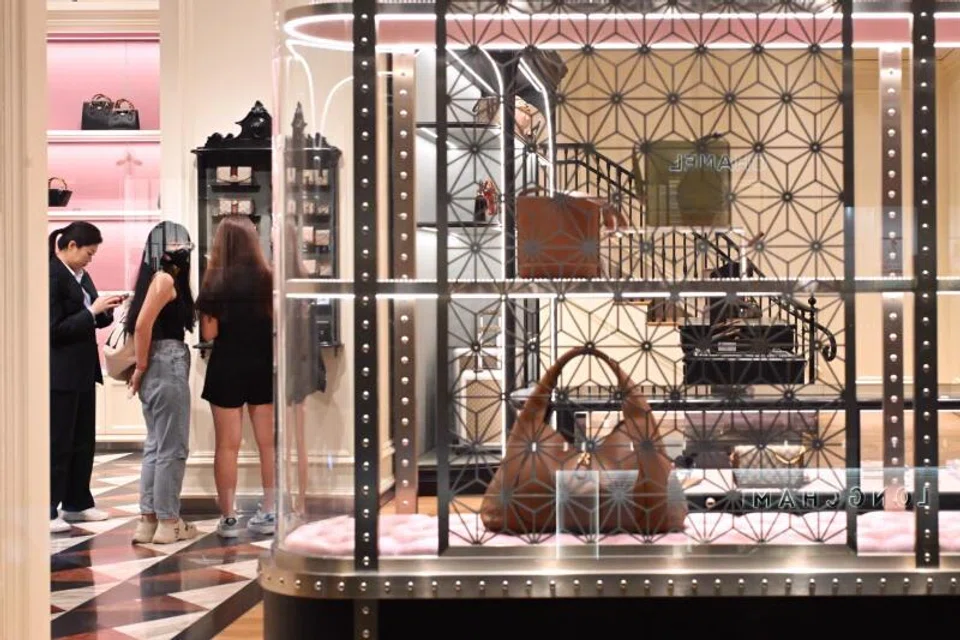
[SINGAPORE] Orchard Road remains Singapore’s go-to luxury shopping district and home to flagship stores of the world’s biggest fashion houses.
However, top brands are increasingly planning larger stores and experience-led concepts that are harder to accommodate in land-scarce Singapore.
According to the Savills Global Luxury Retail Outlook 2026 report, the Republic ranked 10th globally for new luxury store openings in 2025.
This is down from sixth place a year earlier – reflecting a combination of occupier appetite and the availability of prime retail space to accommodate demand, noted the real estate services provider.
Savills’ Global Alpha Cities ranking measures market expansion activity by luxury brands, whose strategies close in on “cities that combine scale, depth of wealth and long‑term strategic relevance within global luxury networks”.
In the latest rankings, Singapore trailed other Asian luxury shopping hubs.
Beijing ranked second, Bangkok placed fourth, Tokyo came in seventh place, Shanghai was eighth and Hong Kong ninth.
New York topped Savills’ rankings with the biggest increase in new luxury openings last year.
European cities that are the world’s top tourist destinations – Paris, Milan, London – and two other high-net-worth (HNW) magnets, Los Angeles and Miami, made up the rest of the top 10.
Within Asia, “cities like Tokyo and Shanghai are much bigger than Singapore, have much bigger populations and market sizes. The availability of space and population of both cities naturally support a bigger luxury retail footprint”, said Sulian Tan-Wijaya, Savills Singapore’s executive director of retail and lifestyle.
She added that Singapore’s space constraints make it difficult to accommodate concepts such as Louis Vuitton’s ship-shaped concept store in Shanghai and large-scale experiential activations such as Bangkok’s LV hotel-themed pop-up, Dior Gold House and Cafe Dior.
Ethan Hsu, CEO at boutique retail consultancy and real estate firm Catbird Singapore, said: “Even where land is available, the opportunity cost of dedicating an entire plot to a single brand rather than a yield-maximising mall is more than most institutional asset owners on the street will absorb.”
Still, Singapore continues to be an important market for big luxury houses, such as Hermes and Chanel, supported by the city-state’s growing HNW population, he added.
According to Knight Frank’s Wealth Report released in April, the number of ultra-HNW individuals in Singapore rose 54.5 per cent to 7,171 in 2026 from 4,642 in 2021.
But mid-tier and accessible luxury brands are increasingly deploying capital elsewhere, including in Bangkok, Ho Chi Minh City, Jakarta, secondary Chinese cities and the Middle East.
Singapore has become a “maintenance market” for these brands, with retailers focusing on refreshing existing stores rather than opening new flagships, noted Hsu.
Orchard Road vs MBS
Within Singapore, luxury retail is no longer concentrated solely along Orchard Road, with destinations such as The Shoppes at Marina Bay Sands also attracting shoppers, said Joan Chen, CBRE Singapore’s head of retail.
“These offer differentiated and a wide variety of shopping experiences to both locals and tourists with diverse destination shopping choices which could resonate with evolving consumer tastes.”
Tan-Wijaya pointed out that Marina Bay Sands and Orchard Road play different roles within Singapore’s retail landscape.
MBS’ concentration of luxury brands under one roof makes it a compelling destination for affluent tourists and HNW individuals.
Orchard Road, however, offers a broader mix of luxury, premium and mass-market brands – from Louis Vuitton and Van Cleef & Arpels to Zara, Uniqlo and Nike – spread across various malls within walking distance, she said.
While Orchard Road benefits from its proximity to affluent residential neighbourhoods, Hsu said that its longer-term challenge will be retaining local luxury spending as more HNW migrants choose to live around Marina Bay.
“If that happens, Orchard Road loses its quiet but valuable luxury volume on top of the tourist share it has already ceded,” he noted.
“That is the dynamic to watch over the next five years, and it is one of the reasons the rejuvenation work on Orchard Road is not just about footfall but about anchoring the precinct in the lives of the people who actually live in Singapore.”
More experiential retail
Luxury brands are also adapting to changing consumer preferences.
While Singapore remains a draw for some HNW individuals, it ranked fifth among such individuals from the US and fourth among those from Germany.
It also did not make the top five preferred luxury shopping destinations for respondents from China, the UK and Italy, according to Savills.
Today’s ultra-rich are spending more on travel experiences, wellness and longevity treatments, as well as collecting art, wine and whiskies, said Tan-Wijaya.
Larger cities such as Tokyo and Shanghai are better able to support experience-led luxury concepts because of their larger markets and greater availability of standalone sites, she added.
Orchard Road, by contrast, hosts luxury brands within larger mall developments such as Ngee Ann City, Paragon and Ion Orchard.
Hsu said: “This matters because the direction of global luxury is moving the other way. The most ambitious flagship formats of the last decade have been standalone buildings under the brand’s complete creative control.”
Savills noted that 70 per cent of luxury leaders identify experience-led luxury as the defining trend for 2026, followed by wellness-focused luxury.
Brands are increasingly investing in larger and more immersive stores, integrated dining concepts and expanded private environments for very important clients.
LV’s Shanghai cruise ship-shaped installation St Louis, for instance, combines exhibition, hospitality and retail – speaking directly to “the growing emotional pull of travel and unique experiences”.
Hsu also observed that brands are focusing more on clienteling, private salons, hotel-based experiences and by-appointment formats.
“The result is that luxury investment in Singapore is real, but increasingly less of it is happening on the street where the public can see it, feeding straight into the perception that Orchard is not getting more exciting.”
Still, the Republic retains important advantages as a luxury destination, including safety, infrastructure, the ease of moving wealth and a sophisticated ecosystem catering to HNW individuals, Hsu added.
But he cautioned that such strengths have become table stakes at the top end of the market.
“Orchard Road can continue to host extremely good mall-format flagships and the top houses will continue to take them, because Singapore is too important a market to skip.
“But it will struggle to host the most ambitious next-generation concepts unless landlords are willing to redevelop and reimagine portions of their portfolios, and unless the Urban Redevelopment Authority is willing to support more creative reuses of the precinct’s older and smaller assets.”
Decoding Asia newsletter: your guide to navigating Asia in a new global order. Sign up here to get Decoding Asia newsletter. Delivered to your inbox. Free.
Copyright SPH Media. All rights reserved.
TRENDING NOW

DBS, OCBC, UOB rout lops billions off STI as inflation, rate concerns spook investors

Grab CEO’s wife Chloe Tong on life with Anthony Tan and finding her purpose

OCBC sheds S$8 billion in value as shares close nearly 6% down; analysts cautious on banks

Deal between tycoon friends sparks scrutiny of Philippine power sector

