

More layoffs, higher productivity or a bust? How Singapore’s prime office market could take to AI trends
Industry players have yet to see widespread artificial intelligence-driven downsizing

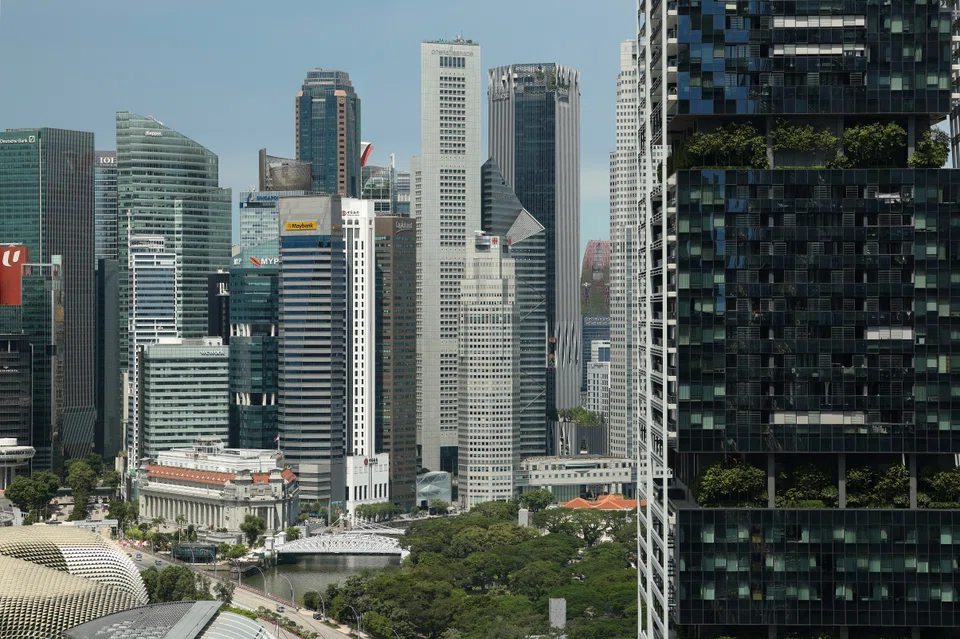
[SINGAPORE] Artificial intelligence adoption could start cutting into Singapore’s office-using workforce from 2027 under a downside scenario modelled by Cushman & Wakefield (C&W), but Grade A offices may still draw demand as companies move out of older buildings.
Under the consultancy’s worst-case “labour-displacement” scenario, to which it assigns a 5 per cent probability, the net take-up of Grade A office space could fall to 3.6 million square feet (sq ft) from 2026 to 2030.
That is below C&W’s baseline forecast of 4.7 million sq ft, but still leaves prime office demand in positive territory even as overall office employment weakens.
The labour-displacement case is the weakest of four scenarios presented by C&W, where employment will shrink from next year, with job losses deepening through to 2030.
The consultancy projects office-using employment to rise by 9,900 in 2026, before swinging to a net loss of 6,100 jobs in 2027. Annual job losses would then widen to 12,600 in 2028, 21,900 in 2029 and 28,400 in 2030.
In that scenario, C&W expects Grade A vacancy in the Central Business District to rise from 3.8 per cent in 2027 to 5.6 per cent in 2028 when new supply comes onstream, before easing to 4.9 per cent by 2030. It also forecasts rent declines from 2028 through 2030, including a 5.7 per cent fall in 2029.
Singapore’s prime office rents have risen steadily for seven quarters since the first quarter of 2025, amid tight supply which has continued to give landlords pricing power today.
A baseline scenario, for which C&W sees 50-50 likelihood, assumes more gradual AI adoption and continued growth in office-using jobs.
Its projection of a near future where AI brings significant productivity gains puts Grade A net take-up at 4.8 million sq ft, while an AI investment bust would cut take-up to 4.3 million sq ft.


Companies could also reduce their overall office footprint while relocating from older premises to Grade A buildings, said C&W senior economist Heron Lim. “Grade A absorption holds up while weakness shows up in Grade B and older buildings.”
Leasing demand holds up
Industry players believe that AI has yet to trigger broad-based office downsizing, with leasing demand still holding up for quality space.
Where some occupiers may have given up space as they trim jobs, the slack is also being taken up by AI companies setting up operations in Singapore.
CBRE’s latest quarterly data pointed to the leasing market tightening further in Q3, with core CBD Grade A vacancy falling to 2.6 per cent from 3.3 per cent in the previous quarter, despite steadily rising rents.
Prime rents rose 2 per cent quarter-on-quarter to S$12.75 per square foot (psf) in Q3, marking the strongest quarterly increase since Q3 2022, CBRE data showed.
Overall, rental growth for the first three quarters of 2026 came in at 3.7 per cent.
Tricia Song, CBRE’s head of research for Singapore and South-east Asia, said that vacancy has compressed from 7.8 per cent in less than two years following the completion of IOI Central Boulevard Towers, leaving occupiers with a “rapidly diminishing pool of options” as several prime buildings are fully occupied or nearing full occupancy.
JLL’s preliminary tracking puts AI companies’ Singapore office footprint at about 0.5 million sq ft this year, up from about 0.3 million sq ft in 2025. AI-related technology companies and banking and finance firms, including quantitative investment funds, are among the most active in the market, said Michael Glancy, JLL’s country CEO for Singapore and South-east Asia.
C&W continues to see occupiers expanding or upgrading into better-quality offices. Jeryl Teoh, the consultancy’s senior director of commercial leasing, noted that the “clearer trend is flight-to-quality rather than a reduction in office demand”.
Song, meanwhile, noted that AI is “more likely to change the composition of office demand than cause a broad-based reduction in office space”. Technology, data and quantitative teams are expected to grow, while some routine back-office functions may become more space-efficient over time.
JLL’s Glancy said that AI is appearing more often in property planning discussions, but “concrete adjustments to leasing strategies remain limited”.
Savills Singapore also recorded more leasing activity and transactions in 2026 than in 2025. Co-working operators are showing greater interest in expanding as startups and technology firms grow within their centres, said Ashley Swan, its executive director of commercial and industrial.
Older offices feel the strain
The divide between newer and older offices is already widening, even before AI’s impact on leasing demand becomes clearer.
C&W estimates the Grade A rental premium over Grade B at 48 per cent this year, up from 34 per cent in 2019. Occupiers would “continue to prioritise workplace quality for talent attraction, retention and corporate brand equity”, said Wong Xian Yang, C&W’s head of research for Singapore and South-east Asia.
Still, Lim said that affordability could act as a “natural check”. “As the gap widens, some cost-sensitive occupiers will weigh Grade A rents against well-located, refurbished Grade B space.”
Some tenants are also looking beyond conventional office towers. Glancy cited Deloitte’s move to Orchard Central, an older retail building whose upper floors are being repurposed as offices, as an example of a tenant looking beyond conventional office premises when the space provides modern functionality.
New supply from 2028
The next test for the market will come in 2028, when a fresh wave of Grade A supply is expected to open. Under C&W’s baseline scenario, CBD Grade A vacancy would fall to 2.5 per cent in 2027, then rise to 3.5 per cent when new supply enters the market in 2028, before tightening to 1.6 per cent by 2030.
An AI investment bust would bring a sharper but shorter setback. In that scenario, CBD Grade A vacancy would reach 6.4 per cent in 2028, while rents would fall 8.1 per cent that year before recovering.
Under the worst-case labour-displacement scenario, vacancy would stay elevated for longer, rising to 5.6 per cent in 2028 and 5.2 per cent in 2029 before easing to 4.9 per cent in 2030. Rents would fall for three straight years from 2028, C&W's projection showed. Lim said vacancy would exceed C&W’s downside scenarios only under “a more severe demand shock than currently assumed”, such as sharper-than-anticipated AI-driven displacement of white-collar jobs, or a loss of Singapore’s attractiveness as a regional headquarters hub.
Decoding Asia newsletter: your guide to navigating Asia in a new global order. Sign up here to get Decoding Asia newsletter. Delivered to your inbox. Free.
Copyright SPH Media. All rights reserved.






