SINGAPORE PROPERTY

New Woodlands Gateway industrial hub takes shape as RTS Link nears completion

Taiwanese tech group FIC Global to open facility at Woodlands node while retaining manufacturing in Johor in ‘twinning’ model analysts expect more to adopt

Summarise
Chong Xin Wei
Published Tue, Aug 25, 2026 · 06:19 PM
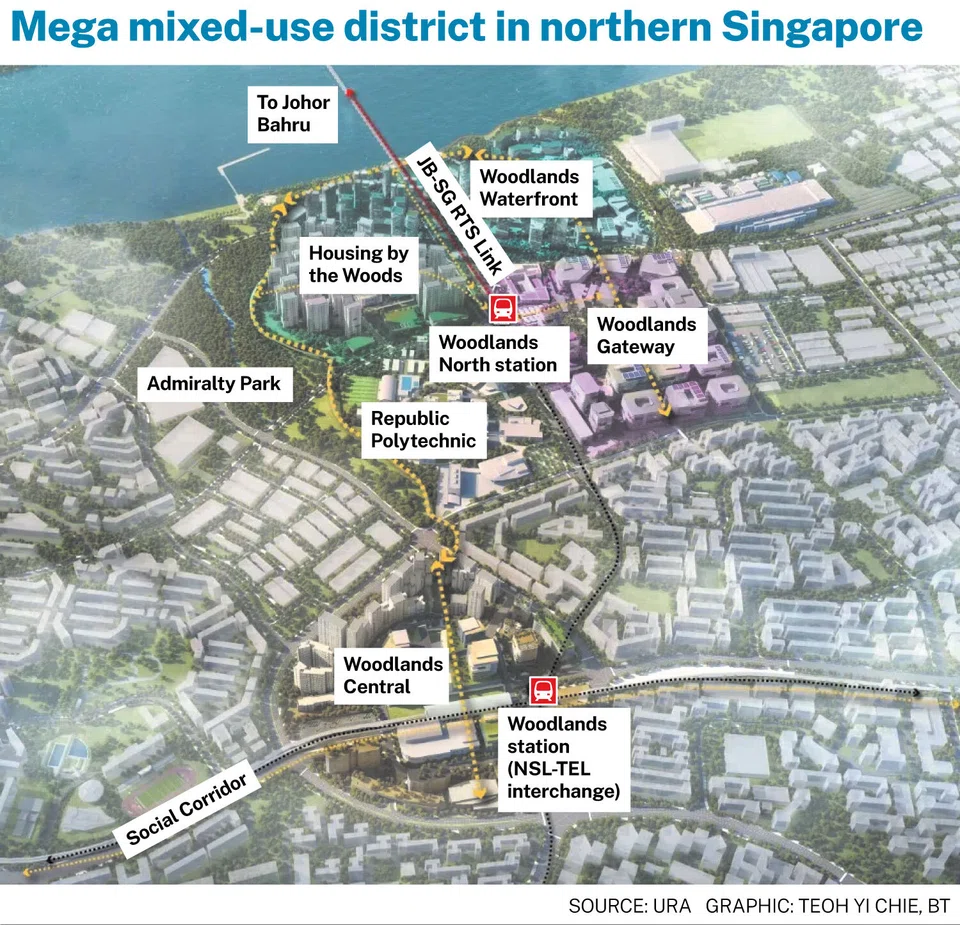
    • Woodlands Gateway, unveiled earlier this year, is a 35 ha mixed-use district in northern Singapore.
    • Woodlands Gateway, unveiled earlier this year, is a 35 ha mixed-use district in northern Singapore. GRAPHIC: BT VISUAL

    [SINGAPORE] A new business hub planned in the north of Singapore, designed to connect directly with the Johor Bahru-Singapore Rapid Transit System (RTS) Link, is beginning to take shape with Taiwanese technology group FIC Global’s (FICG) move into the Woodlands Gateway district.

    FICG plans to open its first regional innovation and supply chain centre there, while retaining its manufacturing and operational base across the border in Johor.

    The group is said to be taking up a “substantial amount of space” in the 35-hectare (ha) mixed-use district. The facility is expected to house functions such as regional innovation, strategic sourcing, supply chain management and coordination, and customer and partner engagement.

    Explaining its choice of Woodlands Gateway, FICG told The Business Times: “It provides an ideal platform for (us) to connect our manufacturing operations in Malaysia with Singapore’s strengths in innovation, talent, global connectivity, financial services and supply chain management.”

    Woodlands Gateway, unveiled earlier this year, is a 35 ha mixed-use district in northern Singapore, catering to firms that site manufacturing in Johor while maintaining regional headquarters functions in Singapore.

    Capitalising on an easy commute via the RTS Link, which is scheduled to begin operations in 2027, its development could also strengthen Woodlands’ place as a decentralised business and industrial node, with potential spillovers for occupier and investment demand in the northern region.

    The integrated development will offer around 200,000 square metres (sq m) of gross floor area, comprising flexible industrial and office space, about 90,000 sq m of which is within the existing buildings 1 and 7 North Coast.

    A transport hub will connect to the RTS Link station and Woodlands North MRT station, as well as commercial and lifestyle amenities.

    The office space, retail mall, bus interchange and car park are expected to be completed around 2030.

    JTC is targeting sectors including advanced manufacturing, electronics, artificial intelligence, digital solutions and precision engineering, with business functions spanning regional headquarters, R&D, product design, prototyping and supply chain management.

    “Companies have expressed interest in Woodlands Gateway for its ability to consolidate different business functions, provide convenient commuting options for employees and offer flexibility as operations expand or evolve. Cross-border accessibility adds to these wider business advantages,” JTC said.

    The integrated development will offer around 200,000 sq m of gross floor area. ILLUSTRATION: JTC

    Chua Yang Liang, head of research and advisory at JLL South-east Asia, said: “Manufacturing relocation (has) already (been) happening over the years as Singapore moved from low-cost labour-intensive production to higher value-add activities.

    “The question isn’t whether manufacturing shifts, but whether Singapore is still able to capture the high-value elements generating disproportionate economic returns.”

    Singapore will have to continue moving up the value chain to mitigate the risk of economic hollowing-out by pivoting towards deep-tech and advanced manufacturing, said Catherine He, head of research at Colliers Singapore.

    She added: “Developments like Woodlands Gateway can help Singapore in this ‘defence strategy’ by providing purpose-built, highly connected environments that physically tether Johor’s production lines to Singapore.”

    For FICG, Singapore will serve as a regional coordination and customer-facing platform, while Johor will remain a major manufacturing and operational base.

    “Together these two locations will enable FICG to respond more quickly to customers, improve supply chain resilience and support our continued growth across Asean and global markets,” it said.

    Colliers’ He expects such a twinning model to become “highly prevalent”, as firms seek to combine Singapore’s financial ecosystem, connectivity and research and development talent with Johor’s abundant land, lower operating costs and competitive labour for manufacturing and large-scale logistics.

    Chua added that as geopolitical tensions reshape global trade routes and expose supply chain vulnerabilities, multinational companies are diversifying their manufacturing footprints and establishing strategic regional hubs.

    Still, transport constraints could persist despite the RTS Link and proximity to Johor, he noted. “Cross-border operations still involve immigration procedures and complex goods movement logistics, and remain subject to frequent Causeway congestion.”

    Decentralisation?

    Beyond facilitating cross-border operations, Woodlands Gateway could also strengthen the area’s role as a decentralised business and industrial node.

    Colliers’ He described the development as an “economic engine for the Woodlands Regional Centre”, adding that it aligns with Singapore’s broader strategy of bringing jobs closer to homes.

    While Woodlands Gateway is planned to evolve into a mixed-use hub with HQ functions, Chua expects the transformation to take time. “Attracting corporate tenants from the Central Business District remains challenging due to CBD’s established ecosystem, prestige, connectivity and business networks,” he said.

    “Woodlands Gateway’s strategic location makes it important for anchoring high-value components of cross-border industrial operations, but it serves a more specialised function than broader mixed-use business centres.

    “It is a functional piece of Singapore’s decentralisation strategy, differentiating from other decentralised nodes such as Paya Lebar, one-north or Jurong Lake District (JLD).”

    While JLD and Jurong Innovation District focus broadly on becoming Singapore’s second CBD for business operations and professional services, Woodlands Gateway’s occupier profile is “specifically tailored for logistics, supply-chain management and advanced manufacturing that require high-frequency physical and operational connectivity to Malaysia”, said Colliers’ He.

    Potential property spillovers

    The development of the Johor-Singapore Special Economic Zone (JS-SEZ) could also have spillover effects on the wider industrial property market in the north, particularly as greater cross-border activity drives new occupier requirements.

    Citing Enterprise Singapore, He pointed to more than 1,000 enquiries logged by the joint project office and its Malaysian counterparts since the JS-SEZ agreement was signed.

    Chua added that JLL’s business lines have seen “significant interest and queries regarding Johor”, particularly from logistics and third-party logistics players.

    “Enhanced cross-border flow drives demand for warehousing, distribution centres and logistics coordination facilities as companies managing goods movement between jurisdictions require staging infrastructure on both sides,” Chua noted.

    This also increases demand for flexible industrial space supporting activities such as prototyping and small-batch production, as well as final assembly, customisation, quality control and packaging operations, he said.

    Such demand could eventually translate into higher rents and capital values for industrial properties in Woodlands.

    “As companies compete for proximity to the RTS Link and the JS-SEZ corridor, owners of modern, well-positioned assets should experience increased transaction activity and higher rents/prices,” said He.

    Chua expects any gains to accrue first to higher-quality assets. Existing properties with redevelopment potential for higher-specification uses could also attract investor interest.

    Additional supply from Woodlands Gateway and other developments, however, could moderate rental growth if it outpaces demand, he noted.

    For now, evidence of a JS-SEZ-driven uplift in Woodlands industrial rents remains mixed.

    Multi-user factories have shown the clearest signs of stronger rental growth.

    Median rents in District 25, which includes Woodlands, have risen 86 per cent since the RTS Link resumed construction in the third quarter of 2020, outpacing the 47 per cent increase island-wide, according to JLL data.

    Since the JS-SEZ was first announced in the fourth quarter of 2023, multi-user factory rents in Woodlands have increased 13 per cent, compared with 9 per cent islandwide.

    However, single-user factory rents in Woodlands lagged, rising more slowly than island-wide rents.

    Median warehouse rents in Woodlands rose 58 per cent from Q3 2020, compared with 29 per cent islandwide. Since Q4 2023, however, Woodlands warehouse rents have increased 6 per cent, lagging the 9 per cent growth island-wide.