Property players pessimistic on suburban residential in Q2 with affordability strained
A global slowdown and rising rates remain key risks in the next half-year, NUS survey shows

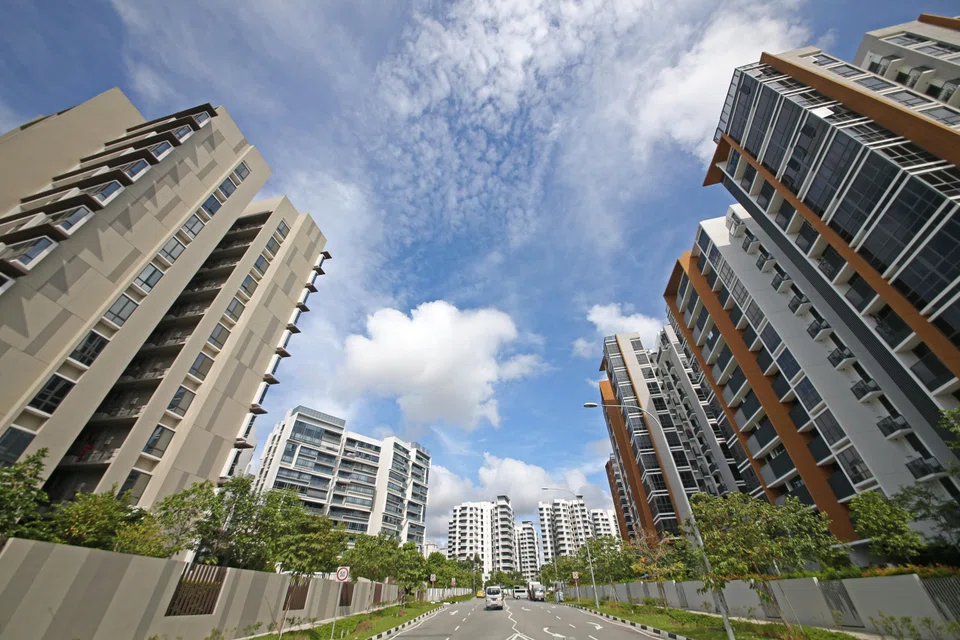
[SINGAPORE] Property players are growing gloomy on the suburban residential sector, a mass-market segment, with sentiment turning negative on affordability concerns.
According to a quarterly survey released on Thursday (Sep 24) by the National University of Singapore’s (NUS) Institute of Real Estate and Urban Studies (Ireus), industry sentiment on suburban residential reversed sharply in the second quarter, with its current net balance falling from 15 per cent previously to minus 14 per cent.
This is its first negative figure in more than a year, Ireus director Qian Wenlan noted. Future net balance stood at minus 5 per cent.
In contrast, the prime residential sector saw more optimism, with current net balance inching up to 9 per cent, though future net balance was minus 14 per cent. The net balance represents the difference between the proportion of respondents with positive and negative sentiment.
Prof Qian said that the divergence between the prime and suburban residential markets reflects a combination of “demand resistance, supply pressures and policy dynamics”.
Mass-market suburban homes are predominantly driven by local owner-occupiers and Housing & Development Board upgraders. But affordability has become a “more onerous constraint” as new launch prices reach new highs amid tight supply, she noted.
The higher monthly income ceilings for Build-To-Order flats and executive condominiums also widen the pool of government-subsidised options, which may moderate “urgency” in the suburban private market, Prof Qian added.
Further, she reckoned that the government’s removal of the 15-month wait-out period for private homeowners looking to buy public homes could lead to a surge in private resale listings. This would expand the supply of suburban homes as “owners rush to meet the mandatory six-month disposal window”.
“In contrast, prime residential has held up, supported by a distinct buyer demographic and a clear flight to safety,” explained Prof Qian. “While the mass market grapples with affordability ceilings, prime and luxury sales are anchored by well-capitalised buyers who are seeking a good asset class as investment and reliable store of wealth.”

Despite the weakness in the suburban residential market, overall sentiment among Singapore’s real estate honchos brightened in Q2.
Prof Qian attributed the improvement to a more “sanguine economic outlook propped up by a better-than-expected performance” in the first half of this year.
The economy had expanded by 6.1 per cent year on year. In Q2 alone, gross domestic product grew 5.9 per cent, just a tad lower than the 6.3 per cent increase in the first quarter. The government in August also upgraded its 2026 economic growth forecast to a range of 4.5 to 5.5 per cent, up from 2 to 4 per cent previously, amid a global boom driven by artificial intelligence investments.
This “robust economic performance” lifted the Composite Sentiment Index – a barometer of general prevailing sentiment – up to 5.6 in Q2, from 4.9 the prior quarter.
The Current Sentiment Index – which follows changes in sentiment over the past six months – rose to 5.6, from 4.9 in the quarter before. The Future Sentiment Index – which tracks sentiment changes in the next six months – similarly climbed up to 5.5 in Q2, from a neutral 5.0 in Q1.
The rebound followed a slight dip in sentiment in Q1 amid heightened geopolitical tensions over the conflict in the Middle East. Much of the previously optimistic sentiment in Singapore was overtaken by “an anticipation of dire exogenous risks”, Prof Qian said then.
Commercial sectors
Commercial real estate led the broader recovery. The office sector, in particular, saw its current net balance jump to 36 per cent – its highest in several years – and future net balance to 27 per cent.
A survey respondent cited the market’s limited pipeline supply and stronger economic outlook.
Other commercial sectors that fared well include business parks and hi-tech space, hotel and serviced apartments, and industrial and logistics properties.
Even with the generally brighter outlook, 81.8 per cent of survey respondents flagged a slowing global economy as one of the top risks facing the market over the next six months. This is up from 75 per cent in the previous quarter.
Mounting inflationary pressures and borrowing costs were also top of mind, with 81.8 per cent of survey respondents citing them as a concern in Q2, up from 80 per cent in Q1.
Other risks included job losses, identified by 59.1 per cent of the respondents; increased supply of new development land, cited by 22.7 per cent; and excessive supply of new property launches, pointed out by 18.2 per cent.
Decoding Asia newsletter: your guide to navigating Asia in a new global order. Sign up here to get Decoding Asia newsletter. Delivered to your inbox. Free.
Copyright SPH Media. All rights reserved.