

Shopping spree: Why investors are after Singapore retail assets
Positive yield story shapes S$8 billion in deals so far this year despite continuing pressures on retail tenants

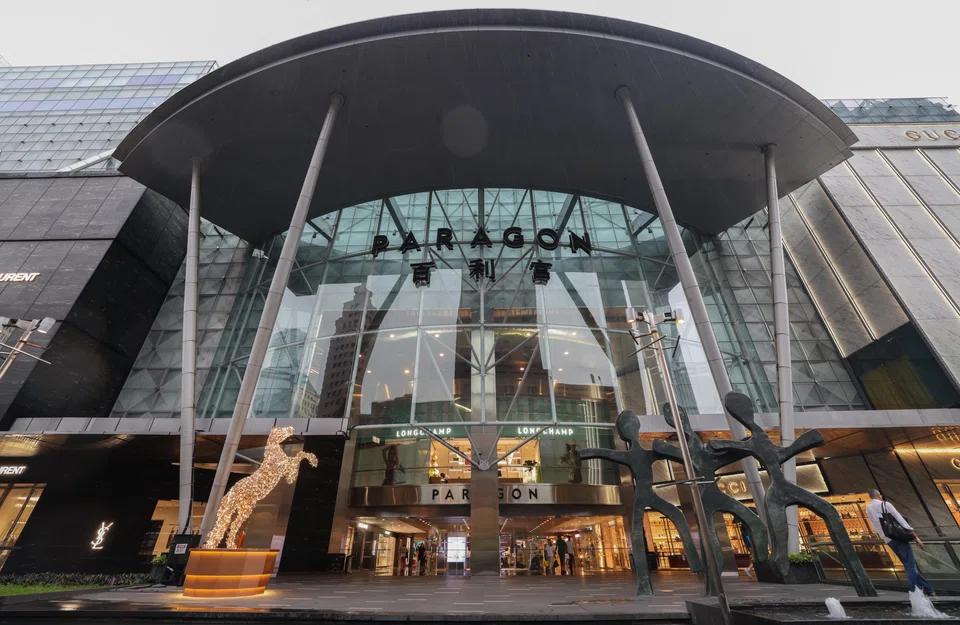
[SINGAPORE] Even as more retailers bite the dust, investors have gone shopping – for the malls that house them.
Property consultancies estimated that up to S$8 billion in retail assets have changed hands so far this year.
Savills’ S$7.9 billion tally of major retail transactions was more than four times the S$1.7 billion it recorded in the year-ago period. CBRE, whose data covers private retail investments worth more than S$10 million per unit, recorded S$7.4 billion as at Sep 22 – nearly double the S$3.8 billion transacted in the whole of 2025.
Among the biggest deals were Cuscaden Peak’s S$3.9 billion sale of Paragon to CapitaLand Integrated Commercial Trust (CICT), Wharf’s S$1.1 billion disposal of Wheelock Place to Hongkong Land’s private fund, and Frasers Centrepoint Trust’s S$467 million divestment of White Sands mall to Growth Capital, an entity linked to Han Chee Juan’s Jack Investment.
While store closures continue to grab headlines as tenants contend with rising wages, high rents and fickle consumers, retail’s asset yields remain over borrowing costs.
Terry Wong, head of capital markets and investment services at Colliers Singapore, summed up the divide: “The asset-level economics and the shop-level economics have diverged.”
The investment case rests less on every tenant surviving than on a mall’s ability to replace those that leave and keep rental income flowing.
“They are betting on durable, defensive income plus scarcity value, not a retail sales recovery,” said Wong.
Revival, not euphoria
The increase in activity extends beyond the year’s billion-dollar deals.


Savills has recorded 42 retail transactions worth at least S$10 million each so far in 2026. This already exceeds the 40 completed in the whole of last year. The tally spans HDB shops, conservation shophouses, strata-retail units and malls.
Alan Cheong, executive director of research and consultancy at Savills Singapore, said the figures indicate “a notable revival” in the retail investment market.
Jeremy Lake, managing director of investment sales and capital markets at Savills Singapore, said the firm remained “very positive” on retail investment property, pointing to the number of transactions completed over the past year. “The retail market is definitely stronger this year,” he said.
Still, “the market has not become euphoric”, said Clemence Lee, executive director of capital markets at CBRE Singapore. “It has become realistic.”
Buyers have become more comfortable with the interest-rate outlook and retail cash flows, while sellers have become more pragmatic about pricing, he said.
A wider yield cushion
Retail’s higher yields relative to offices, together with lower borrowing costs, have drawn buyers.
Property consultants broadly estimated that retail assets transact at net yields of about 4 to 5 per cent, compared with around 3 to 4 per cent for Grade A offices.
Lake estimated that borrowing costs had, until recently, been around 2 to 2.5 per cent.
Wong said: “Lower rates restored positive carry and widened yield spreads beyond historical averages, which simultaneously improved buyer underwriting and lifted selling intentions, bringing more stock to the market.”
Retail’s premium over offices, meanwhile, partly compensates investors for additional risk and management work.
Compared with Grade A offices, retail landlords typically face shorter tenant leases, greater exposure to consumer spending and more active asset-management requirements, said CBRE’s Lee.
One tenant out, another in
For investors, the key is whether a mall can sustain its income even as individual tenants come and go.
Departing tenants are nearly always followed by others seeking space, particularly in popular suburban malls, said Lake. “You lose one, but two or three want to come in and replace it.”
Cheong similarly said near-full occupancy and a healthy pipeline of prospective tenants allow prime-mall owners to accept greater churn in pursuit of rental growth.
Retail rents in Singapore’s central region rose 0.6 per cent in the second quarter of 2026, swinging up from the 0.6 per cent decrease in Q1, as islandwide vacancy crept upwards to 6.5 per cent in Q2, from 6.3 per cent. The central region rental index was 1.5 per cent up year on year, with rental growth positive over the past two years.
Tricia Song, CBRE’s head of research for Singapore and South-east Asia, said prime Orchard Road and suburban malls continue to outperform.
“For the strongest retail assets, sales productivity remains healthy enough to support current rents and, in many cases, moderate rental growth.”
More levers to pull
Colliers’ Wong cited CICT’s purchase of Paragon as a clear example: a rare freehold Orchard Road asset in a tightly held location with limited new supply, acquired at a 3.9 per cent entry yield. Its medical suites also enhance its appeal.
Lake noted that investors generally expect modest annual rental growth, supplemented by asset improvements and operating-cost savings. “The rental uplifts are not huge. They’re probably 2 to 3 per cent per annum.”
Some malls may be under-rented, particularly where leases signed several years ago have yet to be adjusted to current market levels, said Wong Xian Yang, Cushman & Wakefield’s (C&W) head of research for Singapore and South-east Asia.
The departure of anchor tenants such as department stores and cinema operators may also give rise to new opportunities. Landlords can unlock value by subdividing larger units, changing the trade mix, reconfiguring space or relocating tenants to improve footfall and leasing performance, he added.
“Most investors who buy a shopping mall will tinker with it,” said Lake. “Retail typically has many levers you can pull and push to improve the property performance than offices.”
Suburban malls, led by necessity spending, have more defensive characteristics, said C&W’s Wong, while prime malls may have strong value-add potential from international retailers and destination brands.
“Major heavy lifting”
Value creation can involve a substantial turnaround rather than incremental improvements – as Scotts Square illustrates.
The freehold mall was marketed at S$450 million in 2024, subsequently offered at S$380 million and eventually sold to RB Capital and Royal Holdings for S$310 million this year.
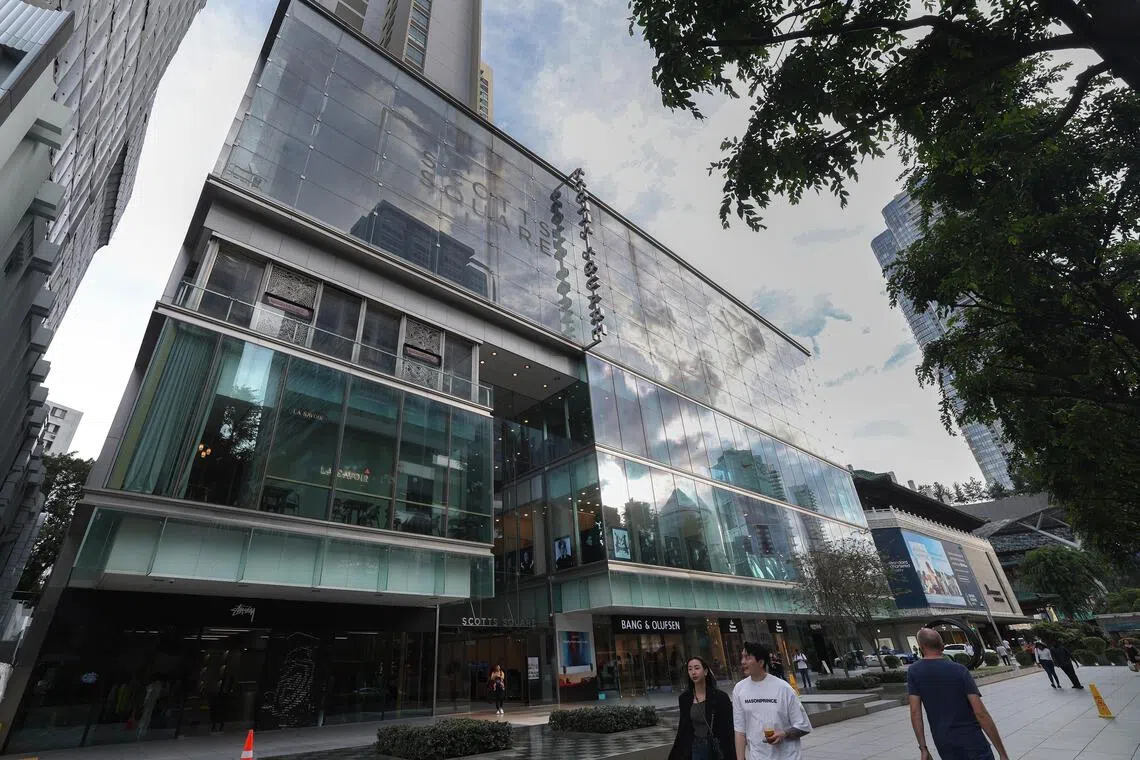
Lake said Scotts Square initially traded well but suffered particularly during the pandemic when several large tenants departed. An inadequate replacement mix weakened its appeal to shoppers, contributing to a downward spiral.
“You have to have conviction that you can turn it around, and this is not tinkering – this is major heavy lifting,” said Lake.
Colliers’ Wong described RB Capital’s acquisition as a “repositioning play”.
“RB Capital has a track record of rejuvenating prime commercial assets and is expected to overhaul the mall,” he said. “Crucially, passing rents had slipped below market so there is potential for positive rental reversions with a tenant revamp.”
Who gets the last laugh?
Owners selling into the revival need not be betting against retail.
“In most cases, sellers are making portfolio decisions rather than making a directional call on the sector,” said Lee.
Some are taking profit, reducing concentration or freeing up capital, he added.
Colliers’ Wong pointed to FCT’s sale of White Sands to reduce leverage, while Keppel monetised i12 Katong to redeploy funds into higher-return opportunities. Wharf’s exit reflected a strategic withdrawal from Singapore property.
Still, attractive entry yields and plans for asset enhancement do not guarantee the expected returns, especially with financing costs now on the rise.
“Should interest rates rise meaningfully or become more volatile and uncertain, investor appetite is likely to moderate as borrowing costs increase and the spread between property yields and financing costs narrows,” said C&W’s Wong.
Cheong believes that familiar risks – higher tenant turnover, softer tourism spending and the possible diversion of spending to Johor after the RTS Link opens – have largely been factored into retail deal prices.
“What is less certain, and arguably less reflected in current valuations, are the longer-term structural risks.”
An ageing population, rising structural unemployment and a growing pool of underemployed workers could together cause a sustained decline in retail spending, weakening purchasing power and tenant viability. Retailers’ persistently high labour, utility and operating costs present another concern, particularly when competition limits their ability to pass these costs on to consumers, he warned.
Decoding Asia newsletter: your guide to navigating Asia in a new global order. Sign up here to get Decoding Asia newsletter. Delivered to your inbox. Free.
Copyright SPH Media. All rights reserved.
TRENDING NOW
World’s largest offshore wind platform by Seatrium consortium on track to be completed by 2028

Is stamp collecting enjoying an analogue revival or are its best days over?

GovTech retrenches another 38 staff in second round of layoffs
MBS adjusted property Ebitda falls 20.6% in Q3 with fewer high-roller visits, weaker hold

