Singapore industrial space rents, prices up in Q1; likely to remain stable for 2021
Lisa Kriwangko
RENTALS of industrial spaces in Singapore are likely to remain stable, as the low supply brought about by the pandemic's interruption of construction activities is catching up to the market's growing demand.
According to data released by JTC on Thursday, prices of industrial properties increased by 0.9 per cent quarter on quarter (qoq), while rentals rose 0.6 per cent in Q1 2021, following the upward trend in Q4 2020. This came as delayed completion of new structures continue to persist from last year.
While one million square metres (sq m) of industrial space was originally expected to be completed in Q1 2021, only about 131,000 sq m were completed in the three months.
Compared to the same period last year, prices and rents are still down 1.3 per cent and 0.9 per cent respectively.
Most segments saw a qoq drop in occupancy rates. Business parks took the lead with a 0.7 per cent fall, followed by single-use factories and warehouses, which slipped 0.1 per cent each. However, this was offset by multiple-user factories, which grew 0.5 per cent in the three months. This segment managed to pull overall occupancy rates to a positive turn, edging up 0.1 percentage point to 90 per cent from last quarter's 89.9 per cent.
Nearly all submarkets reported year-on-year (yoy) growth, except business parks, which fell 0.9 per cent. Overall occupancy rates increased 0.8 percentage point compared to the previous year, continuing last quarter's upward trend.
In Q1 2021, JTC allocated a total of 87,000 sq m of ready-built facilities (RBF) space to industrialists, which included 61,000 sq m of high-rise space and 18,700 sq m of land-based factory space.
Total RBF returns for the quarter were 53,700 sq m, of which 27,700 sq m was high-rise space and 19,300 sq m was land-based factory space. According to the industrial land and infrastructure agency, about 57 per cent of the total returns were due to natural expiries or companies consolidating their operations.
Looking ahead, JTC is projecting demand for industrial space to increase as the economy recovers further in 2021.
"Any potential rise in occupancy is likely to be tempered by new completions and the increase in supply into the market. As such, prices and rentals are likely to remain stable," it said.
As at the end of March this year, there was a total of 50.1 million sq m of industrial space. JTC is expecting 2.4 million sq m of new industrial space to be completed by the end of the year, with another 1.6 million sq m in 2022. This comprises 1.4 million sq m of multiple-user factory space, 1.6 million sq m of single-user factory space, 800,000 sq m of warehouse space, and 200,000 sq m of space for business parks.
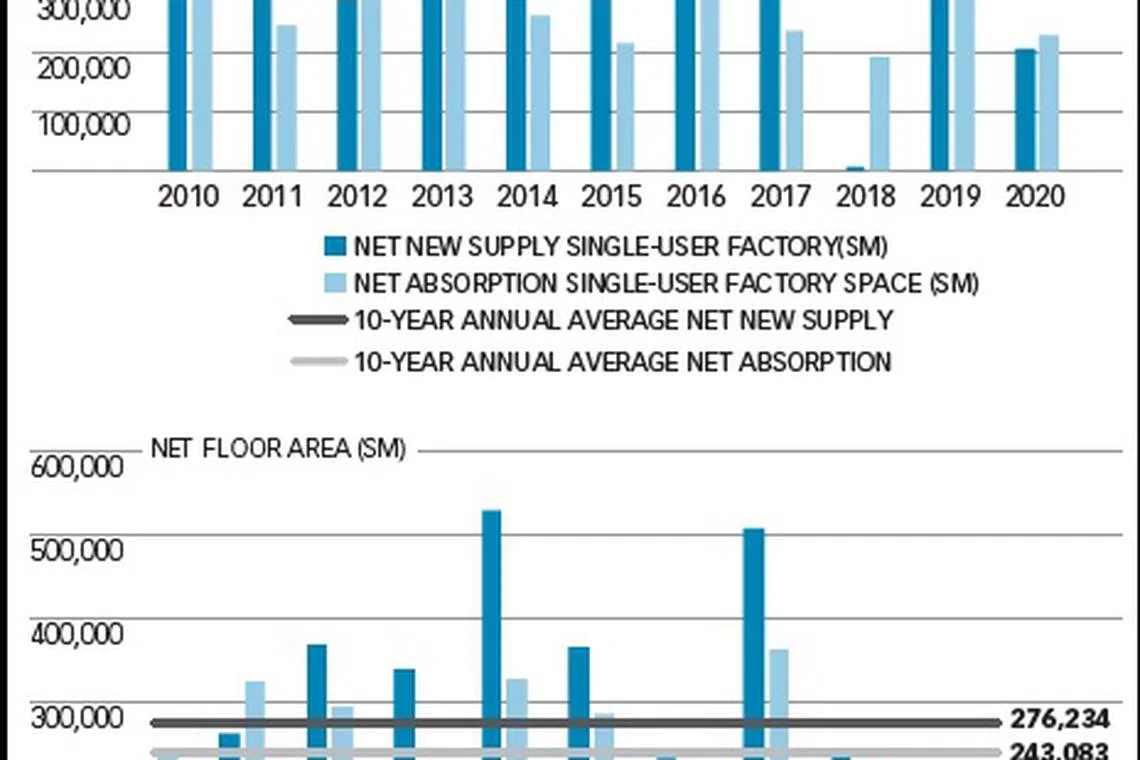
Data from the National University of Singapore's Institute of Real Estate and Urban Studies (IREUS) also showed that factory space rents are expected to remain stable this year, as tempered by new supply.
IREUS deputy director Lee Nai Jia told BT earlier: "While the manufacturing sector has been improving and the economic outlook appears more optimistic, we do not expect rental growth or yields of multiple-user and single-user factory space to go up significantly. Rather, we expect rents to stay largely stable."
As growth remains uneven in the manufacturing sector, Dr Lee reckoned that the net new supply of single- and multiple-user spaces this year will take longer to be absorbed in the market than in previous years. The government could also tweak supply to keep industrial rents stable, he added.
With more factory space being completed this year, Knight Frank's head of research Leonard Tay also said that price and rental growth will be "kept in check" for the next 12 months.
However, Mr Tay foresees Singapore manufacturers expanding in light of the global chip shortage and heightened demand for 5G technologies. He also noted the possible turnaround in the transport engineering cluster as controlled travel is likely in the second half of 2021. "Should the combination of these factors stay the course without being thrown off by unexpected mutations of Covid-19 or recurring community infections, more firms should expand headcounts and the size of their facilities to cater for increased output production, and factory rents might even record a marginal increase of between 1 per cent and 3 per cent in 2021," he said.
Alongside growth in the manufacturing sector, Tay Huey Ying, head of research and consultancy at JLL, added that stockpiling, e-commerce, food and vaccine storage requirements amid the pandemic will drive demand logistics and warehousing space.
She adopted a slightly more bullish view, predicting a growth of 3-5 per cent in overall industrial prices and rents this year.
That being said, she noted that the potential upsurge in new supply from delayed projects, the lingering Covid-19 and geopolitical uncertainties, as well as the trend towards hybrid work models are downside risks which could temper occupier demand and keep rent growth at bay.
Meanwhile, CBRE research believes that the overall outlook for the industrial sector appears "sanguine" in line with the economic recovery, with both factory and warehouse rents poised to remain resilient and even exhibit some growth. The real estate services company expects full-year growth for logistics rents.
READ MORE: Stable rents expected for single- and multiple-user factory space this year