

Singapore office rents climb higher in Q2 as limited CBD supply keeps market tight
Rents at CBD Grade A buildings have risen for six straight quarters

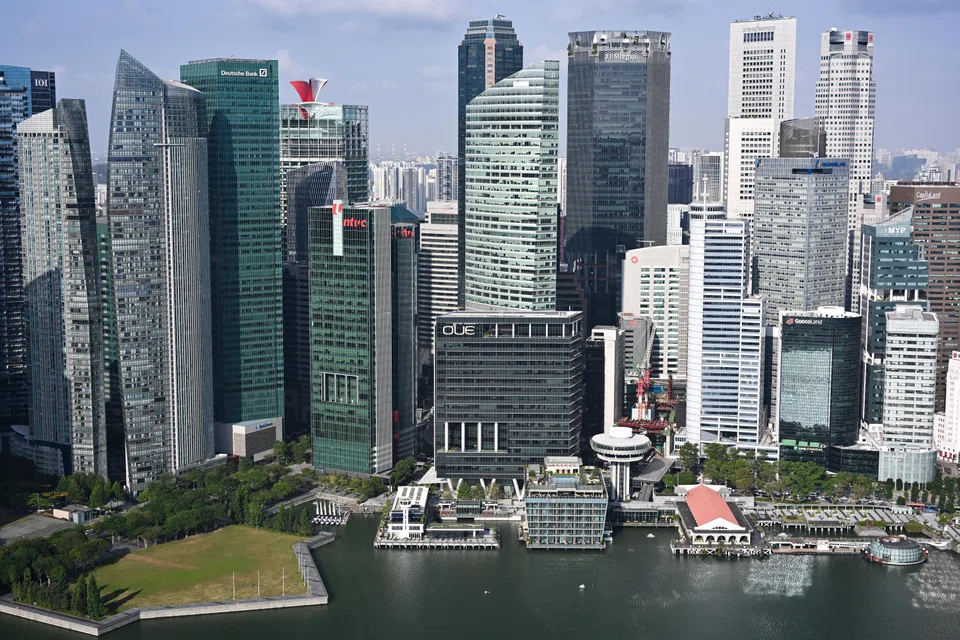
[SINGAPORE] Singapore’s office rents continued to rise in the second quarter of 2026 as limited supply in the central business district and demand from artificial intelligence and financial services firms kept the market tight.
“The underlying market dynamic remains firmly supply-constrained, with Marina Bay remaining the primary demand driver as IOI Central Boulevard Towers and other prime buildings near full occupancy,” said JLL in its Q2 report on the office sector.
Tricia Song, CBRE Singapore and South-east Asia head of research, said: “The absence of new completions through 2027 means that the structural undersupply underpinning this rental cycle is not a short-term phenomenon.”
Rents for core CBD Grade A office spaces rose 0.8 per cent quarter on quarter to S$12.50 per square foot (psf) per month in Q2, marking the sixth consecutive quarter of growth, according to CBRE data. In the first half of 2026, rents have risen 1.6 per cent.
In JLL’s basket, gross effective rents for CBD Grade A offices increased 1.1 per cent on quarter to S$12.19 psf per month in Q2, accelerating from the 0.5 per cent growth in Q1.
Savills’ flash estimates showed rents for its basket of CBD Grade A office buildings rose about 0.5 per cent in Q2, with much of the increase “concentrated in the Grade-AAA buildings”.
According to Knight Frank’s data, rents of prime grade office space in the Raffles Place/Marina Bay precinct grew 1 per cent on quarter in Q2 and 1.7 per cent in the first half of 2026 to average S$11.69 psf per month. Occupancy levels in the Raffles Place/Marina Bay precinct dipped to 96.7 per cent in Q2 from 97 per cent in the previous quarter.
Overall CBD vacancy edged up from 6.3 per cent to 6.7 per cent following Shaw Tower’s completion. However, excluding new supply, vacancy fell to 5.6 per cent – the lowest in nine quarters, as sustained occupier demand absorbed quality space faster than landlords could deliver it, said JLL.
Shaw Tower is the only major Grade A completion in 2026, with global insurer Allianz, payments technology firm Adyen and pharmaceutical company Sanofi-Aventis as its anchor and corporate tenants.
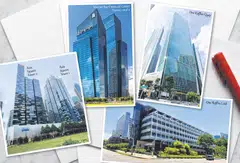
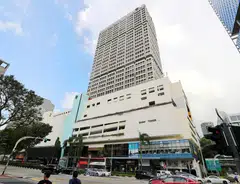
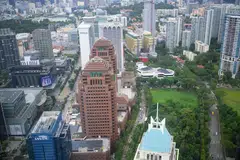
Newport Tower will be the sole non-strata development due for completion in 2027, with the next meaningful wave of supply – The Skywaters, The Clifford, One Comcentre and Union Square Central – expected only in 2028.
Resilient demand
Tenants across sectors from AI and fintech to professional services and insurance are increasingly committing to premium, well-located spaces ahead of need, said JLL country CEO of Singapore and South-east Asia Michael Glancy, pointing to Shell’s pre-commitment of about 100,000 sq ft at Asia Square Tower 1 and Databrick’s expansion at IOI Central Boulevard Towers.
AI firms that have been predominantly occupying co-working environments are also moving into permanent office space, observed CBRE Singapore head of leasing David McKellar.
This signals “their commitment to Singapore for the medium to long term, and with that comes a desire for operational certainty, brand presence, and the ability to customise their space”.
Alan Cheong, executive director of research and consultancy at Savills Singapore, also said tenants are mostly rightsizing either within the same building or relocating and taking up smaller spaces.
“However, should they relocate, they would want the rental savings achieved through taking a smaller area to offset their office fit-out costs. The companies that are expanding are those in the fintech arena,” he added.
“Tenants still prefer CBD locations over decentralised ones. Unless the rents are significantly lower for the latter, which it isn’t for now, they are continuing to coalesce within the CBD.”
Flight to decentralised locations?
The tight supply in the CBD has prompted some companies to consider decentralised locations, said Knight Frank, citing ByteDance’s take-up of three floors at Mapletree Business City, after weighing more cost-effective alternatives versus accommodating growth.
With up to 145,000 sq ft of secondary space coming up at The Metropolis in Buona Vista by mid-2027 as Shell vacates the premises, “it remains to be seen whether other firms being squeezed in the CBD would join the decentralisation bandwagon, turning this into a trend”, said Knight Frank.
Analysts expect rents to rise by between 3 and 5 per cent year on year, supported by a limited pipeline of new Grade A office supply.
JLL South-east Asia head of research and advisory Chua Yang Liang said: “Singapore has long benefited from its safe-haven status, but that advantage is becoming increasingly tangible in the current environment.”
He added: “The latest Economic Strategy Review’s recommendations, particularly around AI adoption, supply chain resilience, and attracting high-capability investments, reinforce the structural case for continued office demand growth.”
Savills’ Cheong said that most tenants of premier grade buildings have pricing power in their businesses, which allows them to “extract concessions from their suppliers who often take up space in Grade B or C buildings in the CBD or outside of it”.
“Thus we see greater vacancy rates in the lower graded buildings as their tenants lean in towards their customer’s demands and they do this by shaving office space or relocating out of country.”
Decoding Asia newsletter: your guide to navigating Asia in a new global order. Sign up here to get Decoding Asia newsletter. Delivered to your inbox. Free.
Copyright SPH Media. All rights reserved.
TRENDING NOW

DBS, OCBC, UOB rout lops billions off STI as inflation, rate concerns spook investors

Grab CEO’s wife Chloe Tong on life with Anthony Tan and finding her purpose

OCBC sheds S$8 billion in value as shares close nearly 6% down; analysts cautious on banks

Deal between tycoon friends sparks scrutiny of Philippine power sector

