

Steven Pan’s Silks Hotel Group looks beyond hotels for next phase of growth
It is exploring a broader holding-company model, while pursuing acquisitions and selective expansion overseas

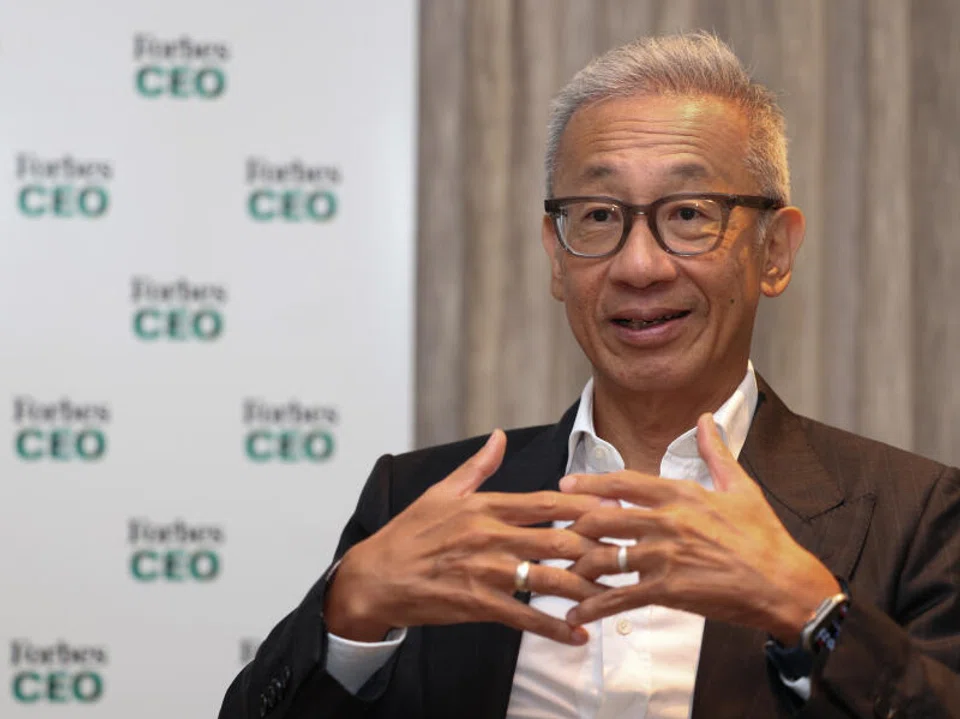
[SINGAPORE] Taiwan’s Silks Hotel Group is looking beyond hotels for its next phase of growth, as it explores building a broader hospitality-holding company spanning businesses in the value chain.
“We’re actively looking into creating a holding company that encompasses the whole supply chain – not just hotels, but also digital travel agencies, transportation, restaurants,” chairman Steven Pan told The Business Times on Thursday (Oct 8) at the sidelines of the Forbes Global CEO Conference held from Oct 7 to 8.
He added: “We are expanding in basically hospitality-related adjacent categories, and through mergers and acquisitions.”
Pan is eyeing opportunities both within and outside its home market.
In the US, the group is negotiating to acquire a historic hotel in San Francisco, which he hopes can be completed by the end of 2026.
As for Asia, Silks Hotel Group acquired the Regent hotel brand in 2010 before selling a 51 per cent stake to InterContinental Hotels Group (IHG) in 2018 for US$39 million, and is actively looking at opportunities in Bangkok and Singapore for the luxury brand.
For Pan, however, expansion is not about adding as many hotels and brands as possible.
“We’re into growth in quality and quality of earnings, sustainable earnings,” said the veteran hotelier, whose late father SR Pan co-founded the group.
Listed on the Taiwan Stock Exchange, Silks Hotel Group posted NT$7 billion (US$220 million) in consolidated operating and non-operating revenue in 2025, while net profit rose 8.1 per cent to NT$1.5 billion from NT$1.4 billion a year earlier.

The group has three hotels in Linkou, Taiwan and Osaka, Japan under development for opening in 2027, additions that will take its portfolio to 18 hotels and more than 2,800 rooms.
“Our biggest opportunity is in our transformation into a hospitality-holding company,” he said.
The group is looking at a “number of undervalued assets” in Taiwan and overseas, he added, including opportunities to “expand both vertically in the hotel industry and horizontally in the adjacent businesses”.
“Instead of being a small fish in a big ocean, we want to be the biggest fish in a small pond,” Pan said.
The group owns and operates the international luxury hotel Regent Taipei, alongside five hotel brands: Silks Place, Wellspring by Silks, Silks Club, Silks X and Just Sleep. It also has food-and-beverage operations, including restaurants at Taiwan’s National Palace Museum and other tourist attractions.
Looking for value in the US
In the US, Pan is seeking out historic hotels in major US cities, looking to take over “really beautiful historic” hotels and “bring them back to glory”, including what he described as “semi-stressed properties”.
Referring to the San Francisco deal, he said the roughly century-old property would cost significantly less than developing a comparable hotel from scratch today. “If you were to build a hotel today, it might cost you three or four times more.”
The property would still require substantial refurbishment and restoration. “But it’s still cheaper than building a new hotel,” he added.
He described it as an Art Deco-style property, with features that would be difficult to replicate in a new development.
Regent eyes Singapore return
Asked which of Silks Hotel Group’s brands he would most like to bring to Singapore, Pan replied: “Regent.”
Regent is central to Silks Hotel Group’s international ambitions. It acquired the luxury hotel brand in 2010. Eight years later, it partnered IHG, which acquired a 51 per cent stake in Regent as the two companies sought to expand the brand globally.
Regent is now “actively looking to come back to Singapore”, he said, while also assessing opportunities in Bangkok. The brand previously had a presence in Singapore through Regent Singapore at Cuscaden Road, and the hotel is now known as Conrad Singapore Orchard.
But Pan said the economics of developing a luxury hotel in Singapore remain challenging.
While the city-state has relatively low interest rates and a stable currency, its property market is “really at a peak”.
Luxury hotels can also take “years, if not a decade” to deliver returns, even when a project is properly executed, he added.
“I wouldn’t do a luxury hotel today in Singapore without a lot of branded residences,” he said.
He noted that selling enough branded residences alongside a hotel could allow a developer to recover its capital earlier.
Pan cited Vietnam’s Regent Phu Quoc and said villas in the development were sold during the pandemic, helping its owner recover capital invested in the project.
“It really requires the right project and a great location. Everything has to be right. It’s not easy.”
In contrast, residential and office developments are simpler, he said. Hotels require teams of people and specialists to operate them and provide services, while offering “much lower and slower” returns than residential or office projects.
A people business in the age of AI
Despite the rise of artificial intelligence, Pan is positive about the outlook for hospitality, seeing hotels increasingly as a “third space” where people can meet, gather and hold events outside their homes and workplaces.
“I joke that hotels are usually hit first at every natural disaster or economic crisis. But in the age of AI, human personal service and human interaction will be the last line. Finally, we get our day,” he quipped.
Travellers are also placing greater value on distinctive experiences, different forms of accommodation and personal space.
But the industry’s ability to capture that demand will depend heavily on talent. Pan described the labour and talent shortage as the group’s “biggest challenge” in the next five to 10 years.
Recent changes to Taiwan’s hiring rules should make it easier for hospitality companies to recruit foreign workers and mid-level managers, he said.
Technology could help fill some of the gaps. Silks Hotel Group is considering how hotels can be designed to accommodate robots for some back-of-house functions, although he does not see them replacing the human element of service.
His emphasis on talent is also rooted in the group’s experience during Covid-19.
Pan said Silks Hotel Group chose not to lay off employees when international travel ground to a halt. Instead, it sought new ways to draw domestic guests, including cruise-inspired programmes at its hotels.
Retaining its employees meant the group did not have to rebuild its workforce when travel demand returned, helping it recover more quickly, he said.
“That illogical business decision turned out to be one of the best business decisions in my life,” he added.
Decoding Asia newsletter: your guide to navigating Asia in a new global order. Sign up here to get Decoding Asia newsletter. Delivered to your inbox. Free.
Copyright SPH Media. All rights reserved.
TRENDING NOW

Mooted COE changes will solve category issues, but higher premiums likely: observers

Grab CEO’s wife Chloe Tong on life with Anthony Tan and finding her purpose

Once staunchly pro-China, Malaysian Chinese businesses are now distancing themselves from Beijing
Cliff Tan has 7 million followers and a 4-month waitlist. Why won’t he expand his business?

