Australian housing poised to woo Singapore property investors again

DEMAND for real estate Down Under from investors in Singapore and the rest of Asia could revive in the coming months, primarily spurred by the upcoming full reopening of Australia's borders.
Singapore's new cooling measures, coupled with buoyant property values and rents in Australia, could also prompt more purchases by individuals from the city-state, analysts and consultants said.
Knight Frank foresees an increasing number of Singaporean and other international buyers "actively" returning to Australia from mid to late 2022.
The country will reopen its borders to tourists from Feb 21. It had gradually relaxed rules in late 2021 for returning residents, working visa holders and international students. The latest decision will see almost all remaining caps lifted.
Michelle Ciesielski, Knight Frank Australia head of residential research, said enquiries from Asian countries for Australian property have generally remained steady throughout the pandemic. But "converting enquiries into sales has proven more difficult given the international border closure, as buyers often incorporate their purchases with travelling to Australia to visit family, friends and educational facilities", she said.
CBRE's managing director for residential projects in Victoria, Andrew Leoncelli, has not seen a resurgence in buyer enquiry or activity from Asia during the last part of 2021 and early 2022, although he reckons the pace will pick up when international travel and overseas migration resumes.
In Australia, non-resident international buyers are generally limited to purchasing from the primary-sale market.
About 7 per cent of new properties transacted in the months leading up to the pandemic had gone to international buyers. This sank to a low of 2.3 per cent in June 2021, but rebounded to 4.4 per cent by September, according to a survey by the National Australia Bank. Foreign buying activity in Q3 2021 rose in most states and was the highest in Victoria (5.6 per cent), followed by Queensland (5 per cent) and New South Wales (3.9 per cent), the quarterly survey showed.
Singapore is often among the top sources of capital for real estate investments Down Under. The Foreign Investment Review Board (FIRB) approved A$9.54 billion (S$9.14 billion) in property investments from Singapore in the year ended June 2020. That put the city-state in second place by value, behind the US with A$13.09 billion in approvals and eclipsing China's A$7.11 billion.
Luxury property agency One Global Australia told The Business Times that demand from Asia-based buyers appears to be regaining momentum, fuelled also by low interest rates, easier access to mortgage finance, improving economic drivers, and new projects coming to the market.
"We have seen a surge in investor interest over the few months leading into Christmas 2021," said Darien Bradshaw, One Global Australia executive director. The agency, part of One Global Group, promotes property Down Under to buyers in Singapore, Hong Kong and Malaysia.
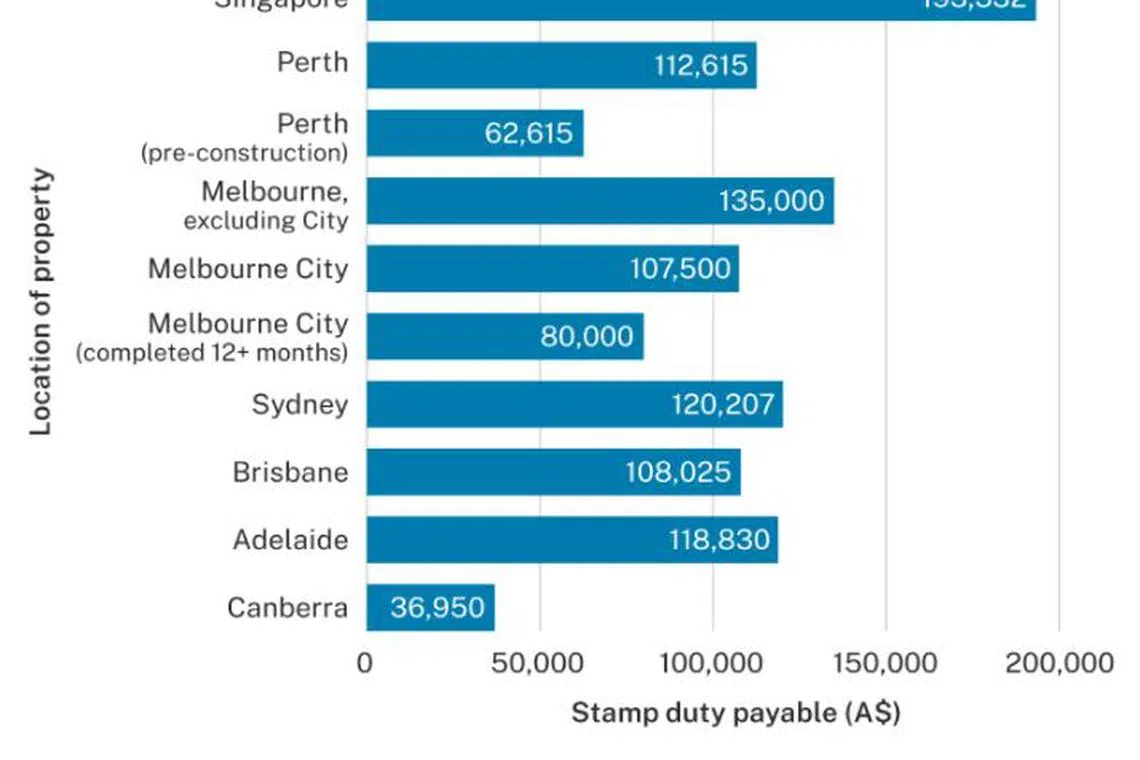
Specifically for Singapore-based buyers, the Dec 16 cooling measures, which included hikes in additional buyer's stamp duty (ABSD), is also expected to shift a slice of demand to overseas markets that offer a potentially lower cost of purchasing. One such market is Australia, given its lower stamp duty rates, Bradshaw said; the country applies a 7 or 8 per cent blanket stamp duty on foreign buyers, plus standard local stamp duty rates.
Singapore citizens now face 17 per cent ABSD when buying their second residential property in the city-state, and 25 per cent ABSD for a subsequent purchase. This is on top of the buyer's stamp duty (BSD) of 1 to 4 per cent.
For illustration purposes, One Global Group's proptech arm One Global Labs cited a scenario of a Singaporean wanting to buy a S$1 million apartment. Buying it locally attracts nearly S$195,000 in BSD and ABSD if it is the second residential property, or almost S$275,000 if it is their third. In Australia, if the buyer acquires a property at the same price, they may fork out about S$36,408 to S$131,068 in stamp duties, depending on which state it is located in.
The savings in stamp duties can thus be significant, and Australia's rates also do not increase with the number of properties owned, Bradshaw said.
To be sure, federal and state taxes are not the only costs payable when buying in Australia. For instance, in seeking the FIRB's approval, international buyers must shell out an application fee which starts at A$6,350.
Ciesielski pointed out that new cooling measures in any market will slow the momentum of investors making choices, and when there is no emotional attachment in a purchase, "this can create a detour towards the relative value of another city or country".
But while international enquiries have risen since Singapore imposed its property curbs, this did not happen in isolation, as it coincided with Australia's staggered border reopening, she said.
Meanwhile, home prices in Australian capital cities and major regional centres have strengthened in the last 2 years despite the pandemic. National housing values soared 22.1 per cent in 2021 from 2020, data and analytics provider CoreLogic's figures showed. In the same period, rents of residential properties across Australia jumped 9.4 per cent, marking the biggest annual growth in about 13 years.
Sydney
Knight Frank noted that housing prices in Sydney have climbed 21.9 per cent since March 2020, faster than the 18.4 per cent increase in the national market.
Even before the pandemic, the Sydney market had been poised for growth, due to the loosening of tight lending restrictions, the distraction of a federal election, and an emerging shortage of new homes being built, Ciesielski said.
For apartments in Australia, close to three-quarters of foreign buyers want a price point below A$1 million. But it is "increasingly challenging to fulfil this requirement in the expensive city of Sydney", which is why more international investment sales tend to occur in Melbourne, the Gold Coast and Brisbane, she said.
Bradshaw estimated that average house prices can easily touch at least A$3 million in Sydney's more affluent neighbourhoods: "Some per-square-foot prices in Sydney's Eastern Suburbs, Lower North Shore and City range from A$2,500 to A$10,000."
Melbourne
Leoncelli from CBRE noted that in Melbourne, Asia-based buyers typically scoop up properties in the Central Business District or anywhere closely connected to the universities.
The city continues to record the highest proportion of new sales to foreign buyers, followed by the Gold Coast, Brisbane and Sydney.
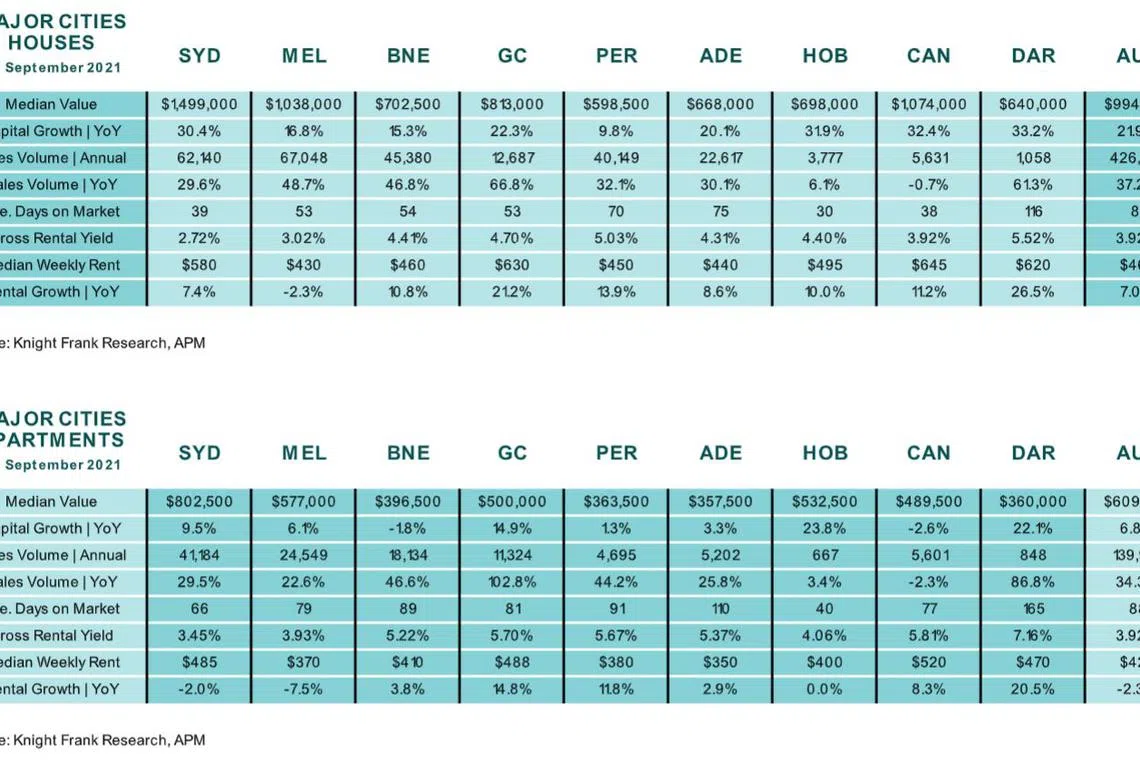
However, as at Sep 30, 2021, rents in Melbourne fell for both landed and non-landed homes, with year-on-year declines of 2.3 per cent and 7.5 per cent respectively, going by data from Knight Frank Research and Australian Property Monitors.
Houses in the city had a median value of about A$1.04 million as at Sep 30, with year-on-year capital growth of 16.8 per cent and a gross rental yield of some 3 per cent. Apartments fetched a median value of A$577,000, capital growth of 6.1 per cent, and nearly 4 per cent in gross rental yield.
Perth
Another major city drawing foreign buyers is Perth. Bradshaw sees "a lot of value and affordability" in the city, where home prices are roughly a third of those in Sydney.
Rental demand is also robust in Perth. Its average vacancy rate stood at 0.6 per cent in December, inching up from 0.5 per cent in November but still lower than previous years, according to a Jan 6 research report by the Domain property listings portal.
Moreover, Perth has topped the nation for rental yields for both houses and units. Gross rental yields in the city rose to 5.2 per cent for houses and 5.8 per cent for units in December 2021, helped by a boom in rental prices, a separate Domain report showed.
READ MORE:
- Singaporean investors in Australia residential property favour capital appreciation
- Australia reopens to international visitors after two years
- For Singapore property investors, overseas lure will continue
Decoding Asia newsletter: your guide to navigating Asia in a new global order. Sign up here to get Decoding Asia newsletter. Delivered to your inbox. Free.
Copyright SPH Media. All rights reserved.