WeWork says no plans to exit Singapore but landlords watching closely

Jessie Lim
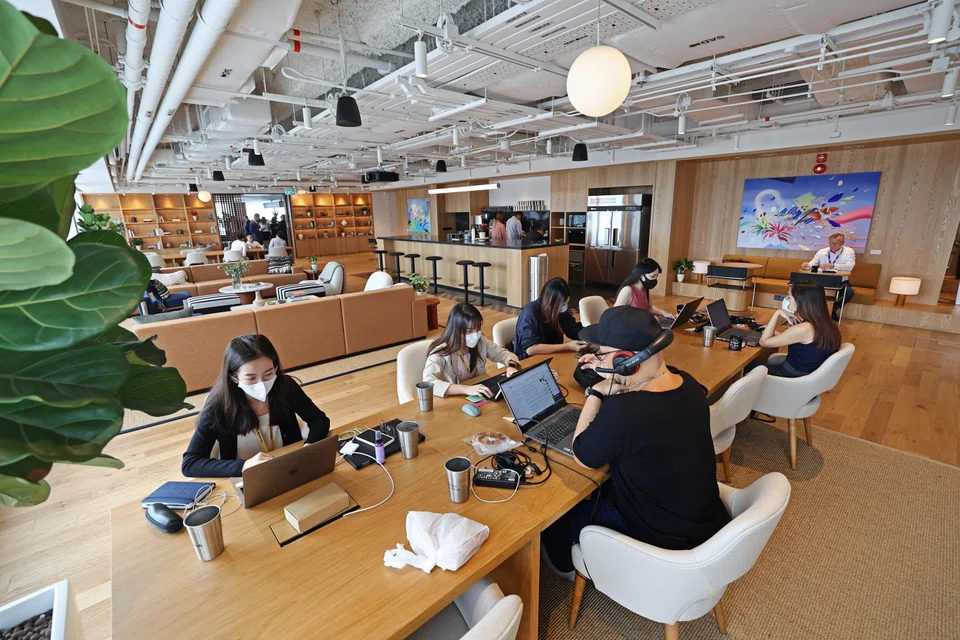
TROUBLED co-working giant WeWork has no plans to exit any of its 14 locations in Singapore, but its landlords here are watching carefully after the New York Stock Exchange-listed company said on Tuesday (Aug 8) that there is “substantial doubt” about its ability to continue operating.
“Singapore is and remains a key market for WeWork. We have no plans to exit any of our 14 locations, which continue to track high occupancy,” a WeWork spokesman told The Business Times on Thursday.
In a filing with the US Securities and Exchange Commission on Tuesday, WeWork said its ability to continue as a going concern depends on whether it can improve liquidity and profitability over the next 12 months. It will focus on reducing rental costs, negotiating more favourable leases, increasing revenue and raising capital, it said.
WeWork recorded a net loss of US$696 million for the first half of 2023, narrowing its losses from US$1.1 billion in the year-ago period.
In Singapore, most of its spaces are in prime Central Business District office locations, where rents have trended upwards for seven quarters.
Its largest space by far is a 21-storey building at 21 Collyer Quay, where it holds some 213,000 square feet (sq ft) of space leased from CapitaLand Integrated Commercial Trust (CICT). The seven-year lease started in Q4 2021. It also has three floors of space at Funan on North Bridge Road, leased from CICT.
A CapitaLand spokesman said WeWork remains a tenant at 21 Collyer Quay and Funan. WeWork accounted for 2.4 per cent of total gross rental income at CICT in June 2023, and is the Reit’s second biggest tenant.
Asked if WeWork was in the process of renegotiating rents or reducing its space at CapitaLand properties, a CICT spokesman said: “As the largest landlord of commercial space in Singapore’s CBD, CICT maintains close engagements with an extensive network of prospects and existing tenants to understand their business space requirements and remain attuned to prevailing market trends.”
The CICT spokesman added: “In cases where a tenant defaults on its lease agreement, CICT will follow established procedures to regain possession of the space including retention of the security deposit. Depending on the circumstances, CICT may explore options such as re-letting the space or collaborating with other operators to continue operations smoothly.”
A CDL spokesman said WeWork has been prompt in paying its rent so far at two CDL properties – City House in Singapore and St Katharine Docks in London.
Although WeWork is a major tenant at City House, it constitutes approximately 2 per cent to 3 per cent of gross rental income out of CDL’s entire Singapore office portfolio. BT understands WeWork takes up about 28 per cent of the 157,717 sq ft of net lettable area at City House.
In the United Kingdom, WeWork constitutes approximately 9 per cent of gross rental income out of CDL’s entire UK office portfolio.
CDL said: “We are comfortable with our exposure for the time being. With the latest news, we will continue to closely monitor the situation.”
WeWork also has a significant amount of space at MYP Centre at 9 Battery Road where it occupies 14 floors, according to its website.
The co-working operator is also a tenant at Suntec Office Tower 5, where it occupies 60,000 sq ft of space across the 17th and 18th floors. Suntec City is managed by ARA Trust Management, which is the manager of Suntec Reit.
ARA Trust Management said: “We understand that WeWork’s offices at Suntec have very high utilisation, and are performing well. We will continue to watch closely their future developments.”
On Thursday, the WeWork spokesman said: “WeWork’s performance in Singapore has always been aligned with Singapore’s economic momentum. As compared to other markets, we saw an earlier and faster return to work and inbound investments, which translates to demand for flexible workspace.”
Across its Singapore locations, WeWork achieved 82 per cent occupancy last year, the spokesman said, without providing current occupancy levels. Asked how that compared to occupancy in previous years, the spokesman said “the data will not be accurate for comparison as we have scaled our presence with more locations”.
“Based on Q1 2023 results, Asia-Pacific’s (South-east Asia, Australia and South Korea) occupancy stands at 83 per cent, the highest across WeWork, excluding franchised markets,” the spokesman said.
“Singapore is our strongest market in this region and one of the key cities globally.”
The co-working operator said it has always been in close communication with its landlords, when asked whether it is in the process of negotiating its leases.