
What would it take for Singapore’s office decentralisation to succeed?

The city-state’s push to relocate commercial offices outside the CBD comes with several challenges

Ry-Anne Lim
Published Tue, Nov 26, 2024 · 09:45 AM
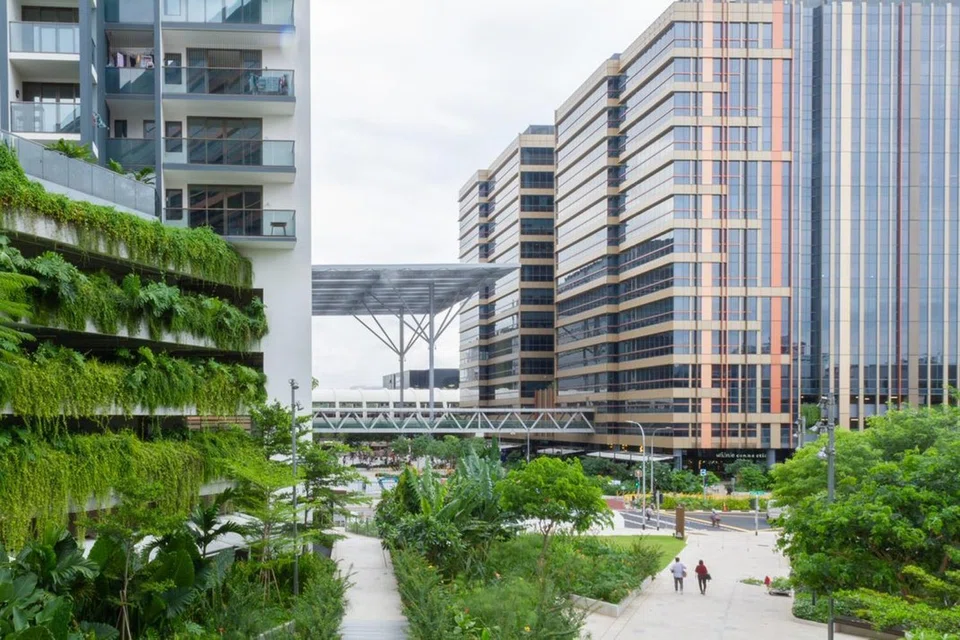
    • David Blasco of Randstad Singapore notes that business hubs such as Paya Lebar Quarter (above), Mapletree Business City and The Metropolis are becoming increasingly popular among businesses.
    • David Blasco of Randstad Singapore notes that business hubs such as Paya Lebar Quarter (above), Mapletree Business City and The Metropolis are becoming increasingly popular among businesses. PHOTO: LENDLEASE

    DESPITE Singapore’s more than three decades of efforts to move business activity outside the Central Business District (CBD), around 66.3 per cent of office space remains located in the city-state’s central area – scarcely any different from the 66.5 per cent in 1993.

    Industry experts cite a cocktail of challenges for developers, companies and employees alike, from the lack of profitability and confidence in suburban commercial developments, to the prestige and convenience the CBD continues to hold. 

    To be fair, Tricia Song, CBRE head of research for South-east Asia, highlighted that not all locations and micro-markets within decentralised areas are equal. 

    Areas such as Paya Lebar, Thomson/Novena, and Buona Vista/one-north are closer to the CBD, being typically within a 10 to 15 minute drive, and benefit from excellent amenities and transport infrastructure, said Song. This results in lower vacancy rates. 

    This could be why business hubs such as Paya Lebar Quarter, Mapletree Business City and The Metropolis are becoming increasingly popular among businesses, said David Blasco, Randstad Singapore country director.  

    But even within the same micro-market, vacancy rates can vary, noted Song, depending on the building’s accessibility and other attributes.  

    What then would it take for decentralisation to work in Singapore? 

    In Savills Singapore executive director of research and consultancy Alan Cheong’s opinion, the CBD has to decline for the shift outwards to take hold. “For instance, if the High Speed Rail were to finally materialise, offices in the CBD would shrink or move to Jurong Lake District, and send their backroom to Kuala Lumpur, only for the heads of departments to physically report back to Singapore periodically.”

    Mini-hubs around the Kallang-Kolam Ayer, the Singapore Sports Hub, Paya Lebar and Harbourfront areas may also have better potential of being decentralised commercial nodes, due to their vicinity to the CBD, said Cheong. He added that the decentralisation is more likely to work if the country’s population is growing and there is a sudden spike in the working population, which can be housed in the millions of square feet of new office spaces. 

    But given an ageing population, Singapore may not be going in that direction, explained Cheong. “(And) if we adopt the simplistic idea of importing more foreign processionals to fill the gaps in the economy, we will be complexifying the social-economic-productivity dynamics.”

    Considering the enormous uncertainties, Leonard Tay, research head at Knight Frank, said: “Could the government not share some of this risk with the private sector, especially when the authorities appear to be more confident of office decentralisation than private developers?”

    ManpowerGroup Singapore’s country manager Linda Teo said that landlords can encourage companies and employees to embrace decentralisation by attracting anchor tenants with strong brand image to their properties, which can then draw other businesses and talent. “Additionally, ensuring that commercial properties in decentralised areas have a diverse range of lifestyle options… can significantly enhance the appeal of these locations for employees,” said Teo. “Investing in a strong employer brand and offering attractive incentives can help (companies) attract and retain top talent, even in decentralised locations.”



