Ample liquidity drives pricier landed-home deals, stock trading in Q1
However, recent increase in Covid-19 cases and tightened restrictions could put a dent in sentiment

Singapore
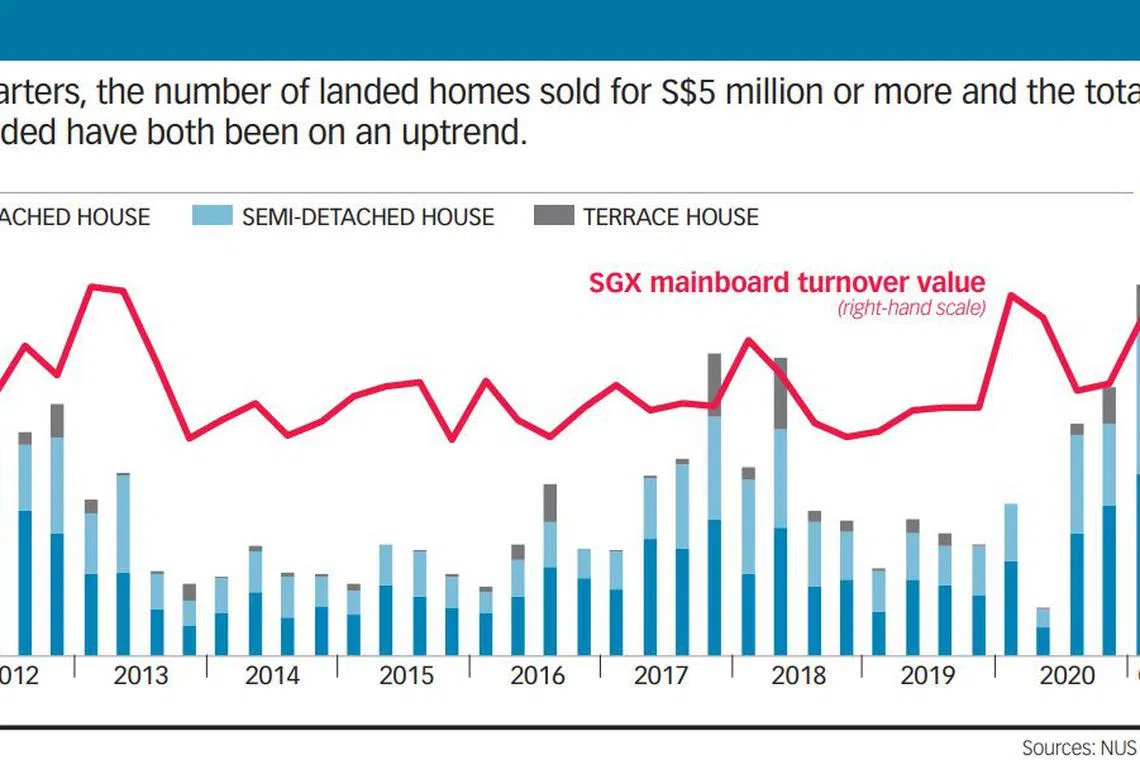
THE number of landed homes transacted at S$5 million and above in the first quarter this year again rose in tandem with the surge in trading activity on the Singapore stock exchange's mainboard.
This correlation between big-ticket purchases and turnover in the equity market was driven by increased liquidity and an improvement in overall sentiment at the time, said Lee Nai Jia, deputy director of the Institute of Real Estate and Urban Studies (IREUS) at the National University of Singapore.
However, the city-state's recent increase in Covid-19 cases and tightened restrictions could put a dent in sentiment, slowing sales in the landed-home segment as well as equity investments on the Singapore Exchange (SGX), he noted. "Buyers are likely to adopt a wait-and-see attitude until there are clearer signs that the Covid-19 situation is controlled."
A total of 822 landed residential properties - detached, semi-detached and terrace houses - changed hands in Q1 this year, showed data from the Urban Redevelopment Authority's Realis platform downloaded on May 17. That was a tad fewer than the 868 houses purchased in Q4 2020, but slightly surpassed the 809 in Q2 2018 - which was during the last en-bloc sales boom, when many unit owners went on to buy landed housing with their windfall gains.
Specifically, for landed homes that fetched S$5 million or more, there were 200 deals in Q1 2021, up from 145 in the prior quarter. It is also more than the 161 houses that changed hands in Q2 2018 at S$5 million and above, and 136 of such pricier transactions in Q4 2012, before cooling measures including the total debt servicing ratio were introduced in 2013.
Meanwhile, the total value of mainboard-listed shares traded during Q1 2021 grew 25 per cent to about S$87.86 billion, from S$70.44 billion in Q4 2020, showed SGX data.
Year on year, the mainboard turnover value had also been "slowly inching back" to the S$93.36 billion recorded for Q1 2020, before Singapore's "circuit breaker" started last April in response to the Covid-19 pandemic, Dr Lee noted.
Those who earned returns from the stock market may use part of the proceeds to fund their purchases of landed residential properties, he said.
For well-heeled equity investors, the amount they are able to earn from the stock market can be "quite substantial" and thus "trigger them to act" and buy such assets, he added. Landed homes are typically seen as a proxy of the highest percentile of wealth among Singaporeans.
In addition, wealthy prospective homebuyers, flush with capital, may have found the past few quarters a "favourable" time to purchase the landed properties they want, given the current low interest-rate environment. The low rates also encouraged existing owners of landed properties to take up home-equity loans or term loans to invest in Singapore-listed equities, thus adding to the SGX mainboard turnover, Dr Lee said.
The bourse operator said last month that global markets were buoyed by investor optimism on the strength of the economic recovery, with Singapore's stock market "ranking amongst the strongest of the global benchmarks". That drove SGX's total securities market turnover, including mainboard and Catalist equities, to grow 12 per cent quarter on quarter to S$94.2 billion in January-March this year, while the securities daily average value rose 18 per cent to S$1.52 million.
READ MORE: