Bloomberg defamation: Publication, reporter to pay S$290k in legal costs to Shanmugam, Tan See Leng
The defendants are also ordered to pay S$50,000 in pre-trial costs and S$30,000 in post-trial costs
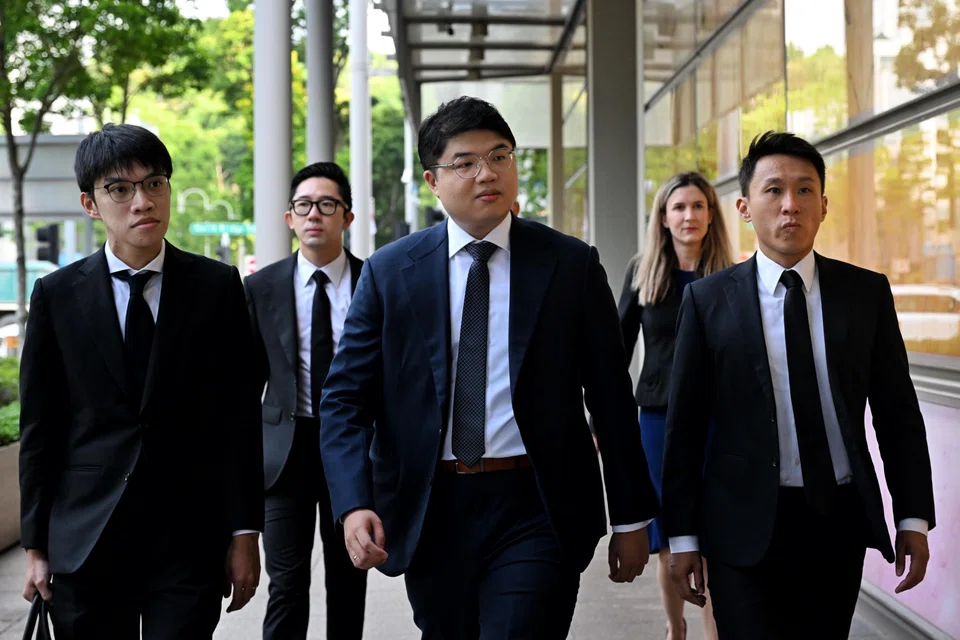
[SINGAPORE] Financial news provider Bloomberg and its journalist have been ordered to pay a total of S$290,000 in legal costs to Cabinet ministers K Shanmugam and Tan See Leng after losing a defamation suit.
It followed a closed-door hearing in chambers on Thursday (Jul 30). The hearing was held about two weeks after the High Court awarded the ministers S$230,000 each in damages.
In response to queries from The Straits Times, a spokesperson for the judiciary said that Justice Audrey Lim took guidance from the costs guidelines for trials and awarded S$145,000 to each minister.
The sum comprised trial costs at S$10,000 for 6½ days, amounting to S$65,000.
The defendants were also ordered to pay S$50,000 in pre-trial costs and S$30,000 in post-trial costs, which are for work in preparation of written submissions and a half-day hearing on May 22.
Shanmugam, who is Senior Minister and Coordinating Minister for National Security, and Tan, who is Minister for Trade and Industry (Energy and Industry), had sued Bloomberg over an article on transactions involving good class bungalows (GCBs) in Singapore.
In judgment dated Jul 14, Lim found that real estate reporter Low De Wei, who wrote the piece headlined “Singapore mansion deals are increasingly shrouded in secrecy”, knew certain information used was false, or had published without caring whether it was true.
The judge said Bloomberg’s conduct in removing the paywall for the article also demonstrated malice, adding that it was done to make the article accessible to the broader public.
The article, published on Dec 12, 2024, mentioned the ministers’ property deals in 2023 – the sale of Shanmugam’s former home in the Queen Astrid Park area to UBS Trustees for S$88 million and Tan’s non-caveated purchase of a bungalow in Brizay Park for nearly S$27.3 million.


It stated that the ultra-rich in Singapore are increasingly cloaking their purchases of mansions in secrecy, such as by using trusts to keep their identities private.
It also stated that deals made without the filing of caveats are “harder to track” because they do not show up in a database maintained by the Urban Redevelopment Authority.
A caveat is a legal document that a person can lodge with the Singapore Land Authority to prevent others from buying a property.
The judge found that readers’ understanding of the article would be that the ministers had taken advantage of the absence of checks and balances or disclosure requirements to conduct their property transactions in a non-transparent manner.
She said the article conveyed to the reader that there are GCB deals being kept hidden from even the government, and that there is a regulatory gap which buyers can exploit.
They would also understand the article to mean that the ministers had done so to hide their transactions and avoid scrutiny – acts that might extend to the possibility of money laundering.
In assessing the amount of damages to be awarded to Shanmugam and Tan, the judge considered the defendants’ conduct.
“I find there was malice on the defendants’ part,” she said, adding that malice in defamation means “any ill-will, spite or some wrong or improper motive”. THE STRAITS TIMES
Decoding Asia newsletter: your guide to navigating Asia in a new global order. Sign up here to get Decoding Asia newsletter. Delivered to your inbox. Free.
Share with us your feedback on BT's products and services