Bloomberg defamation suit: Court finds news provider maliciously defamed Shanmugam, Tan See Leng
Bloomberg’s conduct in removing the paywall made the article accessible to the broader public
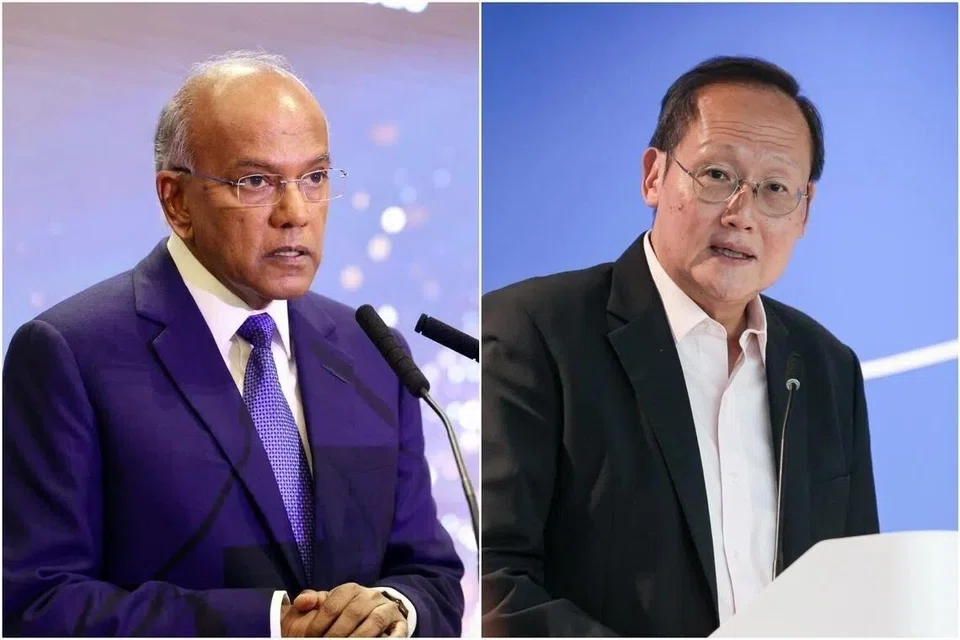
[SINGAPORE] The High Court on Tuesday (July 14) awarded Cabinet ministers K Shanmugam and Tan See Leng each S$230,000 in damages after ruling that they had been maliciously defamed by financial news provider Bloomberg and its journalist.
Justice Audrey Lim found that real estate reporter Low De Wei, who wrote the article headlined “Singapore mansion deals are increasingly shrouded in secrecy” knew certain information used were false, or had published without caring whether they were true.
The judge said that Bloomberg’s conduct in removing the paywall for the article also demonstrated malice, adding that it was done to make the article accessible to the broader public.
Shanmugam, who is Coordinating Minister for National Security, and Tan, who is Manpower Minister, had sued Bloomberg for defamation over the article on transactions involving Good Class Bungalows (GCBs) in Singapore.
The article, published on Dec 12, 2024, mentioned the ministers’ property deals in 2023 – the sale of Shanmugam’s former home in the Queen Astrid Park area to UBS Trustees for S$88 million and Tan’s non-caveated purchase of a bungalow in Brizay Park for nearly S$27.3 million.
It stated that the ultra-rich in Singapore are increasingly cloaking their purchases of mansions in secrecy, such as by using trusts to keep their identities private.
It also stated that deals made without the filing of caveats are “harder to track” because they do not show up in a database maintained by the Urban Redevelopment Authority (URA).
A caveat is a legal document that a person can lodge with the Singapore Land Authority (SLA) to prevent others from buying it.
In a written judgment, Justice Lim found that the readers’ understanding of the article would be that the ministers had taken advantage of the absence of checks and balances or disclosure requirements to conduct their property transactions in a non-transparent manner.


She said the article conveyed to the reader that there are GCB deals being kept hidden from even the government, and that there is a regulatory gap which buyers can exploit.
They would also understand the article to mean that the ministers had done so to hide their transactions and avoid scrutiny – acts that might extend to the possibility of money laundering.
The judge noted that the article mentioned money laundering and cited the high-profile S$3 billion money laundering scandal which saw 10 offenders convicted and jailed.
“The reader is therefore left to understand that the scrutiny the buyers wish to avoid is scrutiny for the very activity of money laundering,” she said.
The judge added: “An allegation that a person has deliberately structured his property dealings to escape examination for possible money laundering plainly tends to lower him in the estimation of right-thinking members of society.”
She found the article was defamatory of both claimants, rejecting the defendants’ arguments that it was concerned with trends in the purchase of GCBs in Singapore and not defamatory.
In assessing the amount of damages to be awarded to Shanmugam, who is also Home Affairs Minister, and Tan, the judge said the defendants had acted with malice.
She said Low knew it was untrue that non-caveated transactions were hidden from the government, and he knew that such deals are recorded in a separate database operated by the SLA.
The judge said the article conveyed a false impression that there was a regulatory gap which buyers can exploit, as non-caveated transactions and identities of ultimate beneficiaries in a transaction involving a trust can be kept hidden from the government and public.
The article also conveyed the falsehood that buyers pay “premiums” for non-caveated transactions.
She pointed out that Low was explicitly told by a real estate agency, before the article was published, that there was no difference between non-caveated and caveated transactions in terms of pricing.
Bloomberg’s internal correspondence had also revealed that the defendants’ dominant motive in publishing the article was to target the claimants, particularly Shanmugam.
“The genesis of the article lay not in a story about trends in the GCB market, as the defendants claim, but in an interest in the claimants,” the judge said.
During the trial, it emerged that Joyce Koh, who is Bloomberg’s finance team leader for Asia excluding China, had sent Low an e-mail on March 12, 2024 to say that she heard “from a source that our favourite minister Shan recently sold his GCB at Queen Astrid, probably for an eye-watering sum”.
Low replied that he had seen the property record, and pointed out that the sale was done a year ago.
He then added that Tan had also purchased a GCB that year, in Bukit Timah, adding that he was providing the information “in the spirit of minister GCB transactions”.
Low suggested a possible way to “get into it is to wrap it in a broader story on how rich (people) are using trusts to buy property in Singapore”.
The judge said the language suggested that the broader narrative about GCB market trends was merely a “vehicle” to present a politically sensitive story.
She said Bloomberg’s conduct in removing the paywall for the article on Dec 25, 2024, making it accessible to the broader public, also showed malice.
The judge rejected the defendants’ claim that this was done to comply with a correction direction under the Protection from Online Falsehoods and Manipulation Act issued on Dec 23.
She also rejected the defendants’ attempt to rely on the defence of responsible journalism, noting that this was not part of Singapore law.
Bloomberg and Low had argued that they were exercising their duty to communicate important information on a matter of public interest.
She said that constitutional free speech applied only to Singapore citizens, making it a “non-starter” for Bloomberg to rely on this defence.
The judge added that the defendants would not have passed the “responsible journalism” test even if the defence was part of Singapore law.
She said there was no urgency to publish the article because the transactions were not new, citing internal e-mails to show that Low was aware that the property deals were old news.
The judge said that the ministers were not given an adequate opportunity to comment on the actual context and severe money-laundering imputations made in the published article.
She also highlighted that the article was published in December 2024, in the period before the general election was held in May 2025.
During the trial, Low had conceded that there was an editorial decision to characterise Shanmugam’s transaction as “political fodder” in the article.
In a statement responding to the verdict, Bloomberg editor-in-chief John Micklethwait said: “We are very disappointed by this ruling but we will of course respect it.”
Micklethwait added: “We argued at trial that our reporting was accurate and served an important public interest, and we continue to believe that the ministers have imposed an extremely strained meaning on what was a solid story.
“Our newsroom – and our reporter – conducted themselves with integrity, and met all our editorial standards in preparing the story at the centre of this trial. We continue to stand by them.”
Defamation cases
In 2015, the High Court ordered blogger Roy Ngerng to pay then Prime Minister Lee Hsien Loong S$150,000 for defamation over a blog post. The sum comprised S$100,000 in general damages and S$50,000 in aggravated damages.
The judge found Ngerng had defamed Senior Minister Lee by alleging that he had misappropriated the Central Provident Fund savings of Singaporeans.
In a separate case in 2021, then PM Lee was awarded the sum of S$133,000 for defamation, which comprised S$100,000 in general damages and S$33,000 in aggravated damages.
The High Court found that blogger and financial adviser Leong Sze Hian had defamed then PM Lee over an article by the Malaysian news site The Coverage, which he shared on his Facebook page.
The article had falsely linked then PM Lee to the 1Malaysia Development Berhad corruption scandal in Malaysia. THE STRAITS TIMES
Decoding Asia newsletter: your guide to navigating Asia in a new global order. Sign up here to get Decoding Asia newsletter. Delivered to your inbox. Free.
Share with us your feedback on BT's products and services