Carminer uses AI and data to help consumers get better value when selling their cars
Its app has a proprietary model that uses AI and public data sources to calculate fair valuations

[SINGAPORE] Trying to sell a car yourself is a tricky business in Singapore. Trade-ins or selling to dealers might get evaluations that are too low, while pricing it yourself could be a slow process.
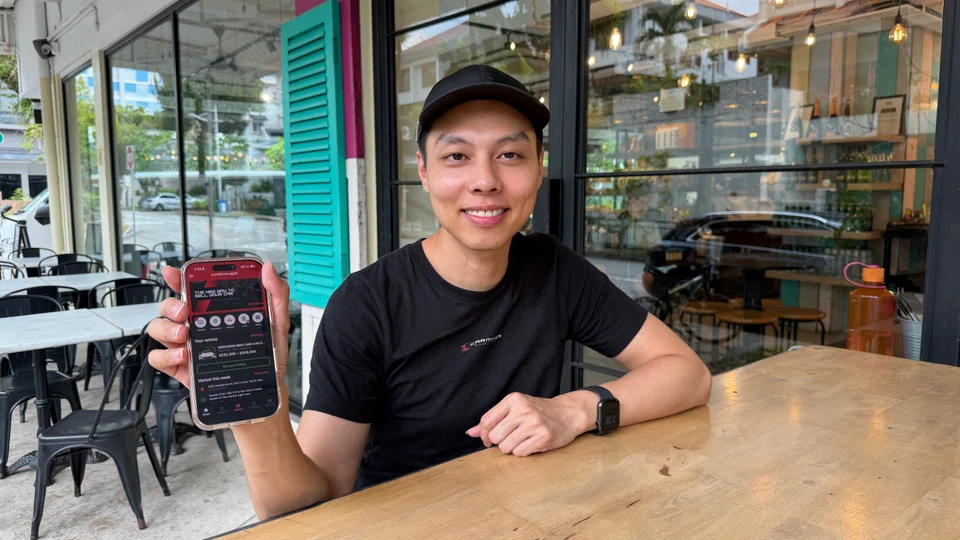
But a new company called Carminer, with a recently launched app of the same name, aims to take the guesswork out of this by providing owners with industry-standard data and artificial intelligence.
Founder Donovan Cho said that while car dealers have their own method of calculating used car values, there is no “trust and transparency” in this process.
“(We) aim to bridge that gap with data and AI. We are the first to help owners extract maximum value of sale by changing how they sell their cars, to either dealers or private buyers,” he told The Business Times.
Unlike existing used-car sales platforms, Carminer gives consumers data and advice on valuation directly. The app, which was launched on Sep 6, also allows users to sell their cars entirely online.
With the public debut of the app, Cho hopes to build the platform’s trust and credibility, while expanding its user base. Carminer is self-funded for now, but could explore external funding at a later stage when it has more traction, he said.
No one formula
Viewing and evaluation of the car’s condition can be booked through the app, while Carminer itself operates as a third-party dealer to support the sales transactions, ownership transfers and other processes.
“Tesla has been a pioneer in moving car transactions online, and we want to do something similar for used cars. For this, Carminer also operates as a dealer, and sellers can handle most of the sale process online,” Cho said.
Carminer does not levy a seller’s fee, but earns from insurance and financing commissions from the transaction. If the transaction is carried out as a full cash payment, an administration fee is charged.
Used-car pricing typically depends on a large number of factors. They range from more important ones, such as the make, model and engine variant, down to features such as paint colour or specific options, such as sunroofs.
But Singapore has other factors such as Certificate of Entitlement (COE) and de-registration rebates. That means cars of different ages may have very different valuations, while constantly changing COE premiums influence used car prices as often as twice a month.
“There is a formula for pricing a used car, including many different factors and data points. But if you go down to very specific things, there is no existing, full set of data for how this all plays out,” explained Cho.
“That’s where AI comes in. We have a proprietary model that uses machine learning and public data sources – like what ChatGPT does – to calculate fair valuations through the app.”
Before starting Carminer, Cho dealt in used cars since 2025 to gain experience in the sector. He estimated the model to be around 80 to 90 per cent accurate.
Users input the car’s details and can see its estimated value over time, demand for the model and other information. While users can set their preferred asking price, the app will advise them on this, including whether a price is too high or too low.
Lean machine
Cho has a background in information technology as a software engineer, including stints at Grab, financial platforms and in the automotive industry.
But why launch Carminer now, when Singapore has no shortage of used car apps and dealer auction services?
“This is the right time to launch a platform using AI because even a few years ago, people didn’t use the technology or trust it. With AI development and usage where it is today, it’s more mature and can deliver accurate valuations.”
AI will not just help users, it is also used extensively in development of the software. Carminer is a lean outfit with just five employees, including Cho as the sole developer.
The app took him just a month to develop with the help of AI, though it went through more than 60 iterations. The same process would have taken at least six months with a conventional software development team of around five people, he said.
“If you asked me a year ago if AI is usable for actual coding, I would have said no. But it is ready now,” he added.
Cho is something of a serial entrepreneur. At age 14, he was already drop-shipping products online. He started a printing business at 17, and went on to establish a software company and livestream commerce platform around 2018 and 2019.
The 35-year-old credits his interest in business, tech and software as a saving grace. After being involved with drugs and fighting in secondary school, he did a stint two-year at Singapore Boys’ Home.
This marked a turning point in his life as he went on to complete his N and O Levels, then entered polytechnic where he learnt to code for the first time and realised the possibilities of technology.
Cho said that technology can help turn ideas into real products without a large capital outlay. He finds the constant, fast pace engaging.
“There’s always something new to learn or a different way to build things,” he said. “The way we code with AI today, for example, is already very different from how we did it just six months ago. That constant change keeps me curious and excited about what’s possible.”
TRENDING NOW
Grab CEO’s wife Chloe Tong on life with Anthony Tan and finding her purpose
Hwa Seng Builder, two China companies win S$1.2 billion Tuas Road Viaduct phase two contracts
Deal between tycoon friends sparks scrutiny of Philippine power sector
Canada is upping oil flows to Asia, but South-east Asia’s refineries aren’t ready to handle them yet