

Cashless society? Singapore’s currency in circulation still hitting new highs at S$69 billion
MAS says growth driven mainly by higher-denomination notes for transactions, or held for contingencies

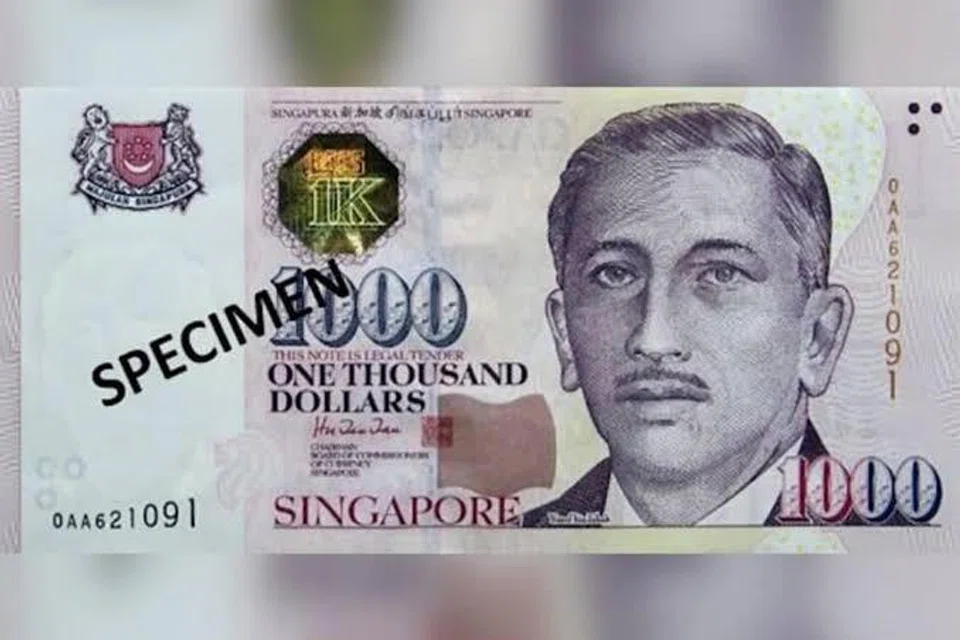
[SINGAPORE] The push for a cashless society appears to be not an easy task – with Singapore’s notes and coins in circulation continuing to grow.
According to Monetary Authority of Singapore (MAS) statistics, “currency in active circulation” for the past five years was S$60.3 billion, S$63.2 billion, S$64.6 billion, S$66.6 billion and S$69.6 billion – a new high.
However, an MAS spokesperson told The Business Times that the pace of money supply growth has slowed, averaging 3 per cent per year from 2023 to 2025, compared with an average of 7 per cent per year from 2020 to 2022.
It added: “CIC (currency in circulation) reflects the amount of cash held by the public and businesses, and does not directly represent the usage of cash for payments.”
MAS said recent CIC growth was driven mainly by higher-denomination notes, which may be used for transactions, or held as a store of value or for contingencies.
Interestingly, MAS stopped issuing the S$1,000 note in January 2021 as a pre-emptive measure, to mitigate “higher money laundering and terrorism financing risks” associated with large denomination notes.
Besides Singapore, many major jurisdictions have also ceased issuing large denominations in the face of similar concerns.
The US dollar, the world’s most accepted currency, only has a maximum denomination of US$100. It has previously issued US$500, US$1,000, US$5,000 and US$10,000 notes, all of which have ceased, although those already in circulation remain legal tender.
Likewise, MAS has stated that existing S$1,000 notes in circulation will remain legal tender and can continue to be used as a means of payment.


“Banks can continue to recirculate existing S$1,000 notes that are deposited with them,” the authority noted in a prior statement.
“MAS will make available sufficient quantities of other denominations – in particular the S$100 note – which is the next highest denomination after the S$1,000 note, to meet demand.”
According to a banknote and coins dealer, an estimated 40 million S$1,000 notes were printed, going by their serial numbers. This would mean a total face value of S$40 billion. He was quoted in a Today report in 2020. BT is unable to ascertain how many S$1,000 notes are still in circulation.
Why does the journey from cash to digital face such stickiness? Analysts weigh in on the ironic situation.
OCBC chief economist Selina Ling said paper money is still a store of value, and can be a useful contingency buffer.
This is especially so in the event of cyberattacks causing telecommunications outages, or disruptions to the electronic payments infrastructure.
Ling explained that people are more likely to hold a few notes of bigger denominations as insurance at home, than a stack of small denomination notes.
On big denomination notes being the unit of choice for nefarious purposes, Ling said: “The money laundering risk has always been present, but there are anti-money laundering safeguards in place befitting a financial centre like Singapore which are continually enhanced.”
The paradox of banknotes
A decade-long rise in CIC despite a digital payments push is not unique to Singapore, said former MAS regulator Claudia Hui, who now serves as head of compliance advisory, Asia-Pacific, at TRM Labs.
She said the European Central Bank calls this the “paradox of banknotes”. The stock of cash grows even as its transactional role shrinks, due to people holding them for precautionary measures, instead of spending.
Hui flagged how the stock of notes and coins in circulation did not fall even in the mid-2010s in Singapore – and kept rising since 2016. This period is considered as “the eve” of the Republic’s cashless drive.
Electronic funds transfer service PayNow was launched in 2017, the unified SGQR label followed in 2018, and e-payments became a Smart Nation priority around the same time.
Reto Marx, CEO of digital asset banking group Sygnum Singapore, said a digital finance transition is not necessarily about eliminating physical cash.
Rather, it concerns expanding the ways in which monetary value can be moved and settled, on top of being stored.
He added how regulated digital assets gaining traction in the city-state are very “fiat-referenced”.
“A tokenised Singapore dollar deposit is still Singapore dollars,” he said. “Tokenisation (just enhances) what fiat currency can do – by settling instantly, moving across borders efficiently, and being programmed.”
Beyond functionality, cash in circulation has a major environmental impact.
According to a prior BT report, currency-related operations are among the largest contributors to emissions by Singapore’s central bank for some years.
The introduction of polymer notes has helped since they last longer. A Bank of England study found that a polymer note lasts 2.5 times longer than a paper note.
Decoding Asia newsletter: your guide to navigating Asia in a new global order. Sign up here to get Decoding Asia newsletter. Delivered to your inbox. Free.
Copyright SPH Media. All rights reserved.
TRENDING NOW

Government to bring forward raising of retirement age, give employers more financial support to create flexi-load jobs

If Europe goes to war, the fallout will be felt in East Asia

Indonesia stocks suffer worst plunge in nearly 30 years as MSCI proposes standalone status

Vietnam’s northern provinces, not Hanoi or Ho Chi Minh City, are powering near 10% GDP growth

