

Coffee, milk powder among 5% of common household items hit by ‘shrinkflation’ in Singapore: Singstat
SingStat regularly monitors some 3,000 products for the compilation of the monthly consumer price index
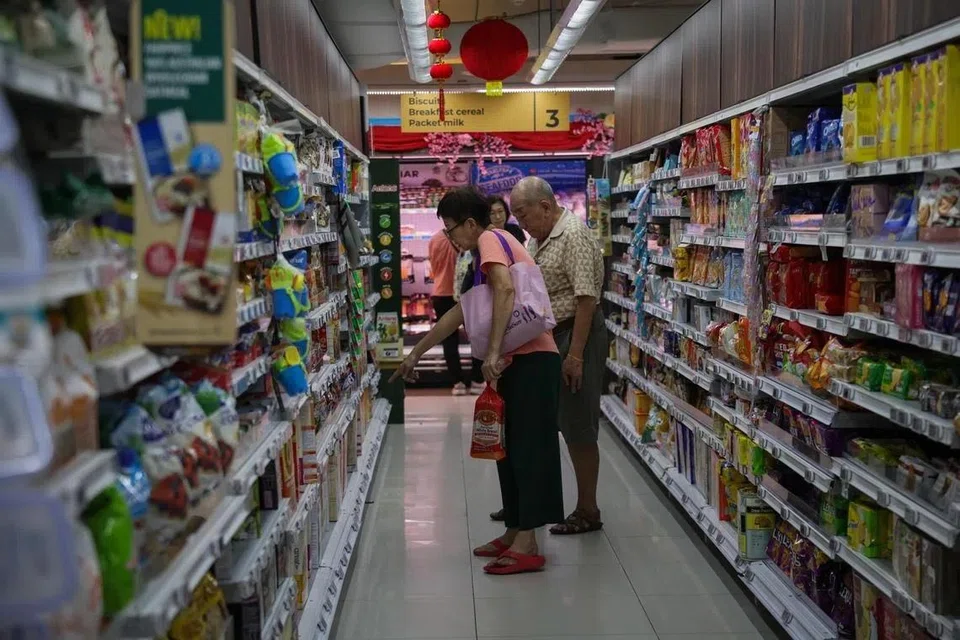
[SINGAPORE] Shoppers in Singapore may be paying the same – or more – for less when it comes to items such as instant coffee or tea, as well as cereal and juices, according to the Department of Statistics (SingStat).
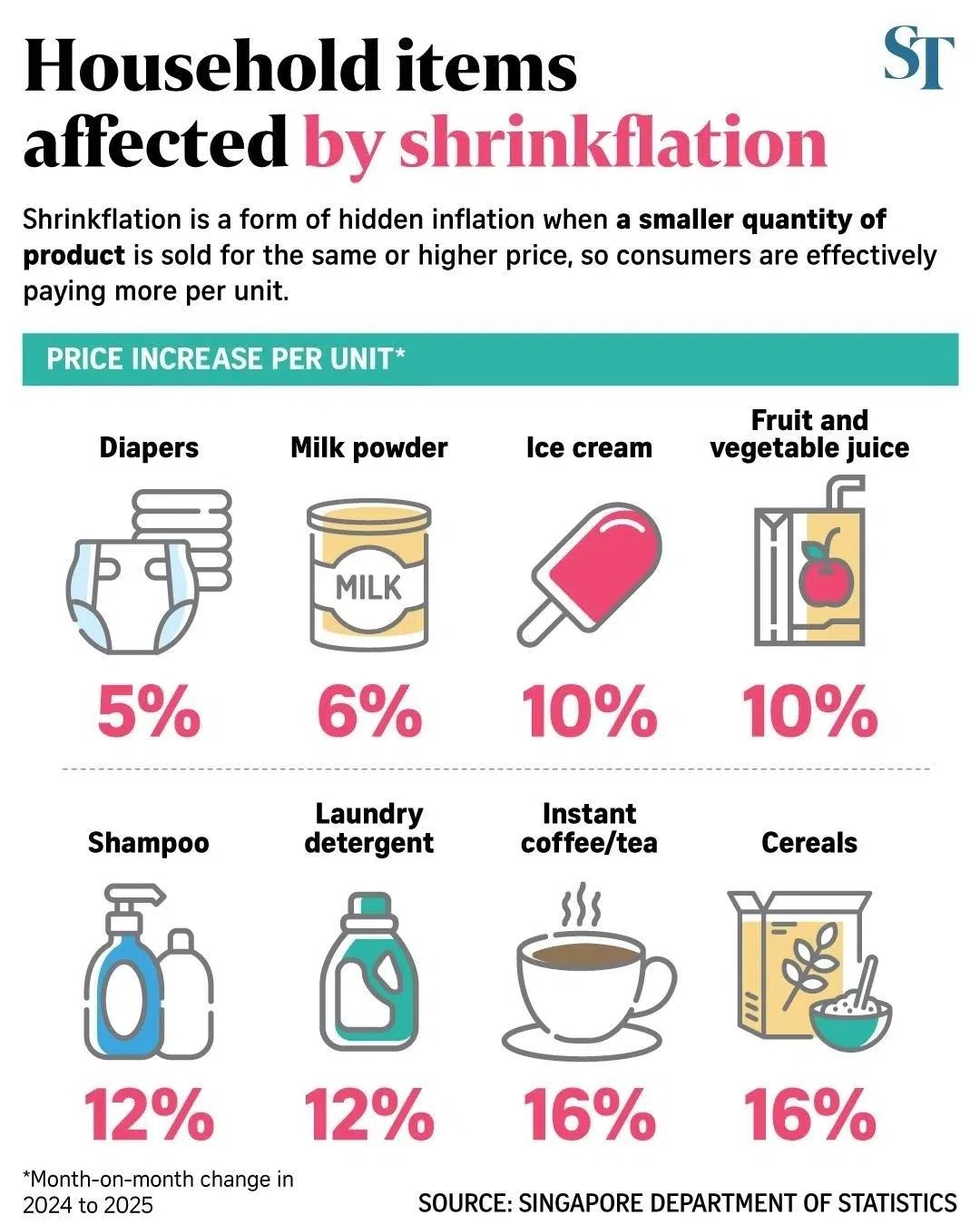
This is known as “shrinkflation”. It occurs when a product’s size or quantity is reduced, but the price stays the same or increases, so consumers effectively pay more per unit. This practice results in hidden price changes.
An analysis by SingStat on barcode data from major supermarkets found that, overall, less than 5 per cent of items commonly purchased by resident households here were hit by shrinkflation in 2025.
Among these, five fast-moving consumer goods were most affected by shrinkflation, based on how often size reductions were observed across the supermarkets.
The products are instant coffee or tea, laundry detergent, ice cream, milk powder and diapers, said SingStat, which released the findings in a newsletter on Apr 29.
SingStat regularly monitors some 3,000 products for the compilation of the monthly consumer price index (CPI).
Similar findings were observed internationally, it noted.
In Britain, the majority of products linked to shrinkflation were food products, with 1 to 2 per cent of such products shrinking in size.
SingStat added that in the US, shrinkflation was primarily observed in categories such as snacks, coffee, tea and diapers, in addition to household paper products.
SEE ALSO




However, it could take some effort for shoppers to detect shrinkflation.
Consumers who spoke to The Straits Times said they do not usually bother to find out the price per unit, which is a way of spotting shrinkflation.
Suriati, an art teacher in her 50s, bases some of her purchase decisions on the price tag she sees on the product. For example, she used to buy Dynamo detergent, but at S$18 per bottle, she found it too expensive and switched to Persil, which costs S$5 less.
For other products, though, price is not her deciding factor, she said.
When it comes to cooking staples, such as extra virgin olive oil and rice bran oil, Suriati said she will not look for alternatives and will keep buying the same brands even if prices rise.
Ang Jian Hui, a marketing manager in his 40s, said he does not actively watch for shrinkflation when shopping.
However, he is quick to switch brands if the final price of a product that he regularly buys goes up. “I am not very loyal,” he said.
Similarly, Leong Meng Sun, a civil engineer in his 50s, will consider cheaper brands or search online for more value for his buck if the product gets too expensive.
“The man in the street won’t bother about the percentage that a product has shrunk by,” he said. “You cannot avoid buying those products just because they are affected by shrinkflation.”
Sam Chang, in his 40s, noted that consumers will just have to cope with shrinkflation by stretching the value of their spending.
“I stick to a certain brand for a laundry detergent, which is effective and friendly to the washer,” said the co-founder of financial board game design studio, Capital Gains Studio, adding that “I get more of it during store promotions”.
What are the different forms of shrinkflation?
A common form of shrinkflation is when the product’s price remains the same but the quantity is reduced.
Take a 1-litre bottle of shampoo priced at S$8.
If the manufacturer reduces the bottle size to 0.8 litre but keeps the price at S$8, that same bottle of shampoo will now cost S$10 per litre.
This is an increase of 25 per cent in the unit price, even though the price tag did not change.
Another form of shrinkflation is where the price goes up and the quantity of the product is reduced.
Again, take a 1-litre bottle of shampoo that costs S$8. But this time, the manufacturer cuts the bottle size to 0.8 litre and raises the price to S$10. The shampoo now costs S$10 for 0.8 litre or S$12.50 per litre. Compared with the original S$8 per litre, this would be a 56 per cent increase.
Singapore University of Social Sciences economist Walter Theseira said shrinkflation will show up in products where there is no concept of a standard quantity or size.
For example, manufacturers can get away with reducing package sizes of a packet of biscuits or a tub of ice cream because “there is no common agreement on what unit it needs to be sold in, 500g versus 450g”, he said.
However, they will not be able to shrinkflate a pack of rice because people expect to buy a 1kg or 5kg pack of rice, he added.
“The fundamental purpose is to disguise price increases,” Associate Professor Theseira noted.
He added that there are other ways that manufacturers try to hide price increases, such as by offering consumers a lower-quality product.
“For many chocolate products, there has been a reduction in the cocoa content,” he said, adding that “cocoa is the expensive ingredient”.
“The idea is to substitute the expensive component with cheaper ingredients,” Prof Theseira noted.
SingStat’s analysis highlighted another example where manufacturers change their packaging to offer more of a product and raise the price at the same time.
It cited a package of cereal that weighs 0.4kg and costs S$5, which translates to S$12.50 per kg. After the update, the new cereal package weighs 0.42kg and costs S$6, which comes to S$14.29 per kg.
Consumers get 5 per cent more cereal content, but pay 14 per cent more per kg, SingStat noted.
Prof Theseira said this practice is a manufacturer’s response to a long chain of shrinkflation, adding: “How long can you keep up this whole practice of cutting portion size? You cannot do this forever.”
Hence, manufacturers change the packaging to offer larger sizes or greater quantities at higher prices instead.
But they are just “playing games” with the packaging, he noted.
Consumers can look out for the unit price
To help consumers compare the prices of products easily across different brands and package sizes, the Competition and Consumer Commission of Singapore and Consumers Association of Singapore partnered with major supermarket chains to pilot the display of unit prices from Sep 1, 2025.
This initiative covers grocery products such as rice, meat, milk powder, eggs, detergent and tissue paper.
Unit pricing is adopted in places such as Australia, the European Union and Britain, SingStat noted.
Based on ST checks at a major supermarket chain in Yishun on April 29, some products had the per unit pricing on display, while others did not.
Examples of products with per unit pricing:
- Milk powder – per 100g
- Tissue paper and toilet roll – per 100 sheets
- Detergent – some are in per 100g and some are in per 100ml
- Rice and sugar – per 100g
- Instant coffee – per sachet
Some products without per unit pricing are breakfast cereals, Milo and Ovaltine powders, fruit juices, ice creams, shampoos, adult and child diapers, and toothpaste.
For consumers who are concerned about shrinkflation, SingStat noted that the CPI numbers do account for this pricing tactic.
“In compiling the CPI, changes in product size are systematically tracked and adjusted when feasible, by computing the prices per a fixed unit of measurement, for example, price per kg.”
Any price changes are then reflected in the CPI, it added. THE STRAITS TIMES
Decoding Asia newsletter: your guide to navigating Asia in a new global order. Sign up here to get Decoding Asia newsletter. Delivered to your inbox. Free.
Share with us your feedback on BT's products and services
TRENDING NOW

KKR founders among investors buying 42% of Peter Lim’s Valencia; club valued at US$1.4 billion

Singapore’s central gas buyer affirms Indonesia’s role as ‘important partner’ amid export review warning

Why the biggest business decision about AI isn’t which model to choose

NEA issues notices to 10 Singapore-based companies, including Wilmar and APP, over haze

