

ComfortDelGro to consult associations before changing fares, commissions or rentals for drivers under new agreement
Taxi and private-hire drivers on its Zig platform will also get a clearer breakdown of their earnings

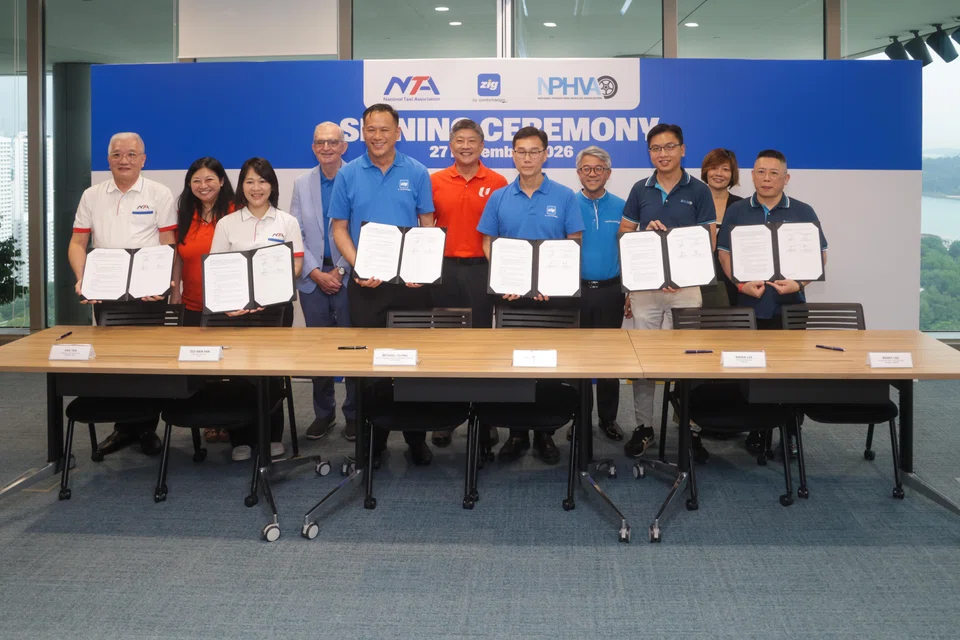
[SINGAPORE] ComfortDelGro (CDG) can no longer make significant decisions that affect drivers’ earnings on its taxi and private-hire Zig platform without first consulting the associations, under two collective agreements signed on Friday (Nov 27).
Changes to fares, rentals or commissions will go through a consultation with the National Private Hire Vehicles Association (NPHVA) and the National Taxi Association (NTA) before they are implemented,
CDG must give at least two weeks’ notice of adjustments to fares, the app or pilot programmes on Zig. Consultation can be skipped only in urgent cases, the National Trades Union Congress (NTUC) and CDG said in a joint statement.
The two associations are Platform Work Associations (PWAs) affiliated to the NTUC. The agreements, the first between a platform operator and PWAs in Singapore, take effect on Dec 1.
They build on CDG’s formal recognition of the NPHVA and NTA in February 2025, shortly after the Platform Workers Act took effect.
The agreements also formalise Zig’s practice of giving drivers an itemised statement for every trip and payout. It shows what each fare is comprised of, including surcharges and incentives. It also shows commission, payment processing fees, Central Provident Fund contributions and net earnings.

CDG’s Zig is the first platform operator in Singapore to commit in a collective agreement to share data on drivers’ work with the PWAs. It will provide aggregated figures on earnings, online hours and completed trips.
It will also provide further information to verify earnings, monitor job trends and handle grievances.
CDG head of point-to-point mobility business Michael Huang said the agreement should help drivers understand “how this work will move” in a rapidly changing environment.

“This whole platform economy is changing very fast, and we recognise that we need to change with the times as well.”
Greater transparency
Except in serious cases such as gross misconduct, CDG will warn or notify drivers before suspending or removing them from the platform.
Drivers can appeal through their association and receive a written outcome with reasons. Unresolved disputes can go to the Ministry of Manpower for conciliation and, if needed, to the Industrial Arbitration Court.
Drivers who rent vehicles from Zig will be entitled to preferential commission rates. Hirers of Zig vehicles will also be covered by benefits such as a personal accident scheme and rental incentives.
CDG will help eligible drivers apply for government-paid leave, including maternity, paternity, shared parental and childcare leave. It will also offer health screening at preferential rates.
Eligible drivers who suffer permanent incapacity from an accident while doing platform work, and who qualify for work injury compensation, will get up to S$2,000 in interim relief. This is on top of the compensation required by law.
A minimum fare of S$9 also applies to ComfortRide trips on Zig; it may be reviewed as operating costs and market conditions change.
Calling on other platform operators to follow suit, NTUC secretary-general Ng Chee Meng said: “I’m glad that the partnership looks beyond today’s bread and butter issues, the concerns to the longer-term development so that we can stay confident and capable as the industry evolves and covers.”
Ng added that CDG and NTUC have made a commitment to explore other development pathways for drivers under the collective agreement.
CDG managing director and group chief executive Cheng Siak Kian said the agreements give the company “a stronger way to navigate” changes in the industry together with the associations.
Beyond the agreement’s current provisions, NPHVA president Benny Lee said he hopes more can be done for fares to rise to improve drivers’ income – especially since some drivers are working 12 to 16 hours to make decent earnings.
NTA president Tan Yeo Hua said ComfortDelGro will talk to the association first when it plans changes that affect income, “so we have our say before it decides anything”.
The agreements cover NPHVA and NTA members. ComfortDelGro will sponsor six months of NTUC membership for drivers who qualify.
The company said it invests more than S$5.5 million a year in welfare programmes and incentives. When fuel prices rose after the Middle East conflict, it absorbed part of the increase.
It also introduced a temporary per-trip fee paid directly to drivers, and gave taxi drivers fuel credits.
Decoding Asia newsletter: your guide to navigating Asia in a new global order. Sign up here to get Decoding Asia newsletter. Delivered to your inbox. Free.
Copyright SPH Media. All rights reserved.
TRENDING NOW

JPMorgan, BlackRock among those making bid to manage CPF savings

GIC in talks to lease bulk of 88,000 sq ft CapitaSky space to be vacated by Allianz
BN-PN’s Melaka election landslide puts spotlight on jobs, investments and political divides

Why Singapore, Johor and Riau Islands should build a cross-border ecosystem for AI

