Economists keep strong NODX outlook after August’s 46.2% surge, led by AI boom

But key uncertainties remain, including further tariff or policy action in the US

Summarise
Elysia Tan
Published Thu, Sep 17, 2026 · 08:30 AM
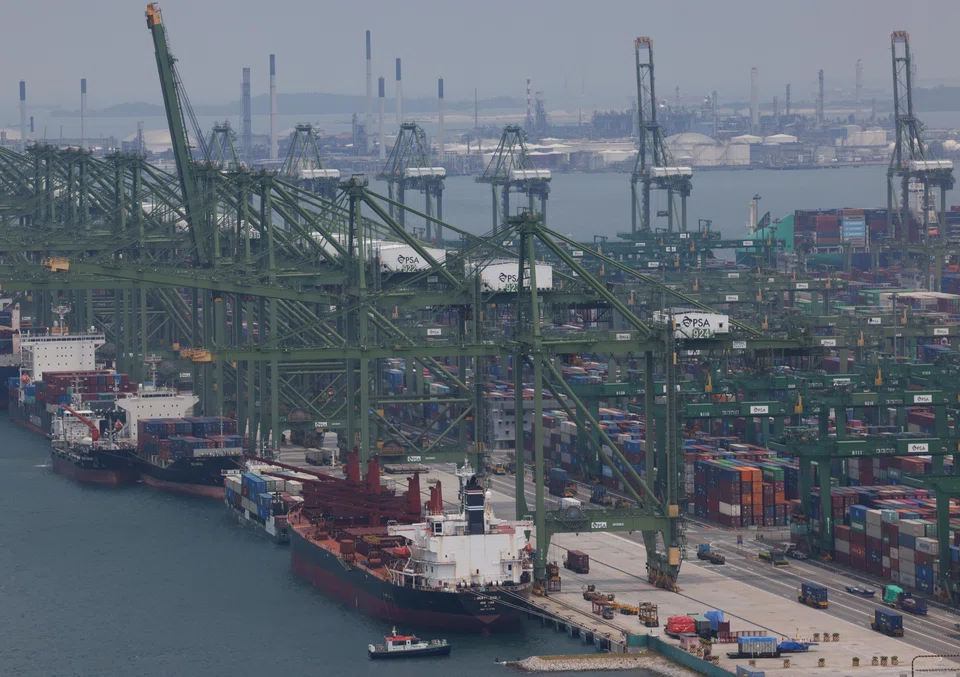
    • Key exports to most of Singapore’s top 10 markets grow year on year.
    • Key exports to most of Singapore’s top 10 markets grow year on year. PHOTO: YEN MENG JIIN, BT

    [SINGAPORE] Economists continue to see a strong non-oil domestic exports (NODX) outlook following the key exports’ 46.2 per cent jump year on year in August, with OCBC raising its full-year forecast.

    But economists remained watchful of risks, particularly of a normalisation of artificial intelligence-related demand and further moves in the external trade environment.

    The latest print extends July’s revised 24.1 per cent rise and surpasses the 35.1 per cent consensus forecast in a Bloomberg poll.


    This was driven by a continued AI-supported electronics surge, Enterprise Singapore (EnterpriseSG) data showed on Thursday (Sep 17).

    Electronics exports grew 131.8 per cent in August, up from 112 per cent the month before. Integrated circuits (90.9 per cent), disk media products (290.2 per cent) and PCs (237.9 per cent) contributed the most to the expansion.

    Meanwhile, non-electronics shipments bucked two straight months of falls. It rose 12 per cent, in a turnaround from July’s 2.4 per cent decline.

    August’s reversal was driven by increases in specialised machinery (57.7 per cent), non-monetary gold (67 per cent) and medical apparatus (22.1 per cent).

    In August, key exports to all but one of Singapore’s top 10 markets rose. NODX to the EU fell 1.7 per cent, but this moderated from the 36 per cent on-year decline recorded in July.

    In contrast, NODX to all other markets posted growth in August, led by the US (91 per cent), followed by South Korea (87.1 per cent) and China (70.3 per cent).

    An unsustainable pace?

    Maybank analysts Chua Hak Bin and Brian Lee noted that August’s NODX recorded the fastest pace of growth since October 1988.

    Like other economists, they noted that the outperformance was partly due to a low base. However, they also indicated robust sequential growth, which reached a four-month high.

    The bank anticipates upside risks to its 18 per cent NODX growth forecast, which surpasses EnterpriseSG’s 14 to 16 per cent projection.

    “The global AI infrastructure build-out will remain a durable tailwind for Singapore’s exports,” Maybank’s duo said.

    “China’s rising modern infrastructure spending is accelerating demand for specialised machinery and semiconductor chips. Demand for semiconductor equipment remains robust amid a global expansion in chip fabrication capacity.”

    RHB group chief economist Barnabas Gan and associate research analyst Laalitha Raveenthar said the latest electronics NODX performance is “consistent with global semiconductor sales, which rose 135.1 per cent year on year to US$137.9 billion in July, reflecting strong chip demand, particularly from AI-related data-centre investment”.

    Maybank’s team also noted strong manufacturing activity ahead, with the August Purchasing Managers’ Index (PMI) recording the highest reading since November 2018 amid stronger growth in new orders, new exports, factory output and input purchases.

    UOB associate economist Jester Koh said the broad-based improvement in August’s electronics PMI suggests that AI-related demand remains robust and companies are drawing down inventories to meet stronger new orders.

    He also highlighted strong electronics NODX to the US, Taiwan and South Korea – “markets deeply embedded in the semiconductor value chain” – and broadened growth in other markets.

    “This likely reflects strengthening demand, driven by the rising adoption of AI solutions by businesses,” he said.

    OCBC raised its full-year 2026 NODX growth forecast from 15.2 to 20 per cent.

    This takes into account the 22.4 per cent year-on-year growth for the first eight months of 2026, as well as the expected moderation to 15.6 per cent for the remaining months, given high-base effects.

    The bank’s chief economist Selena Ling agreed that cyclical momentum remains strong, but added that the pace of growth is likely unsustainable as base effects intensify.

    “Key to watch would be memory prices, advanced packaging demand and AI server orders, which may be a harbinger for Singapore’s export performance,” she said.

    She noted that major technology companies are currently still raising AI-related spending, while governments are increasingly treating AI infrastructure as strategic, with demand broadening from graphics processing units to the supporting ecosystem.

    But she believes the 2027 NODX outlook may become more tricky.

    “Global AI capex could slow, semiconductor inventory may correct, US growth may slow,” she said, adding that capacity limits may emerge if global AI demand grows faster than energy infrastructure.

    Meanwhile, UOB’s Koh flagged recent calls by major technology companies to slow the pace of frontier AI development, which he said could pose headwinds to the electronics and semiconductor upcycle.

    RHB’s team also sees AI investment normalisation as a “key risk” to electronics demand.

    “While AI remains an important technology-sector tailwind, pockets of price exuberance within the AI ecosystem warrant monitoring,” they said.

    Separately, they highlighted US trade policy as another key risk.

    Further tariff actions and policy uncertainty could weigh on business and household sentiment, investment and consumption, while disrupting global trade flows,” they said.

    The team added that the 12.5 per cent Section 301 US tariff, estimated to affect around one-third of Singapore’s exports, could put further pressure on the export-oriented economy.