

Budget 2026: HDB, private rental markets may take hit from higher foreigner work pass salary thresholds
Increased business costs may lead employers to trim hiring, market watchers say

[SINGAPORE] The increase in minimum qualifying salaries for Employment Pass (EP) and S Pass applicants may take a toll on rental demand, if higher business costs lead employers to trim hiring, market watchers said.
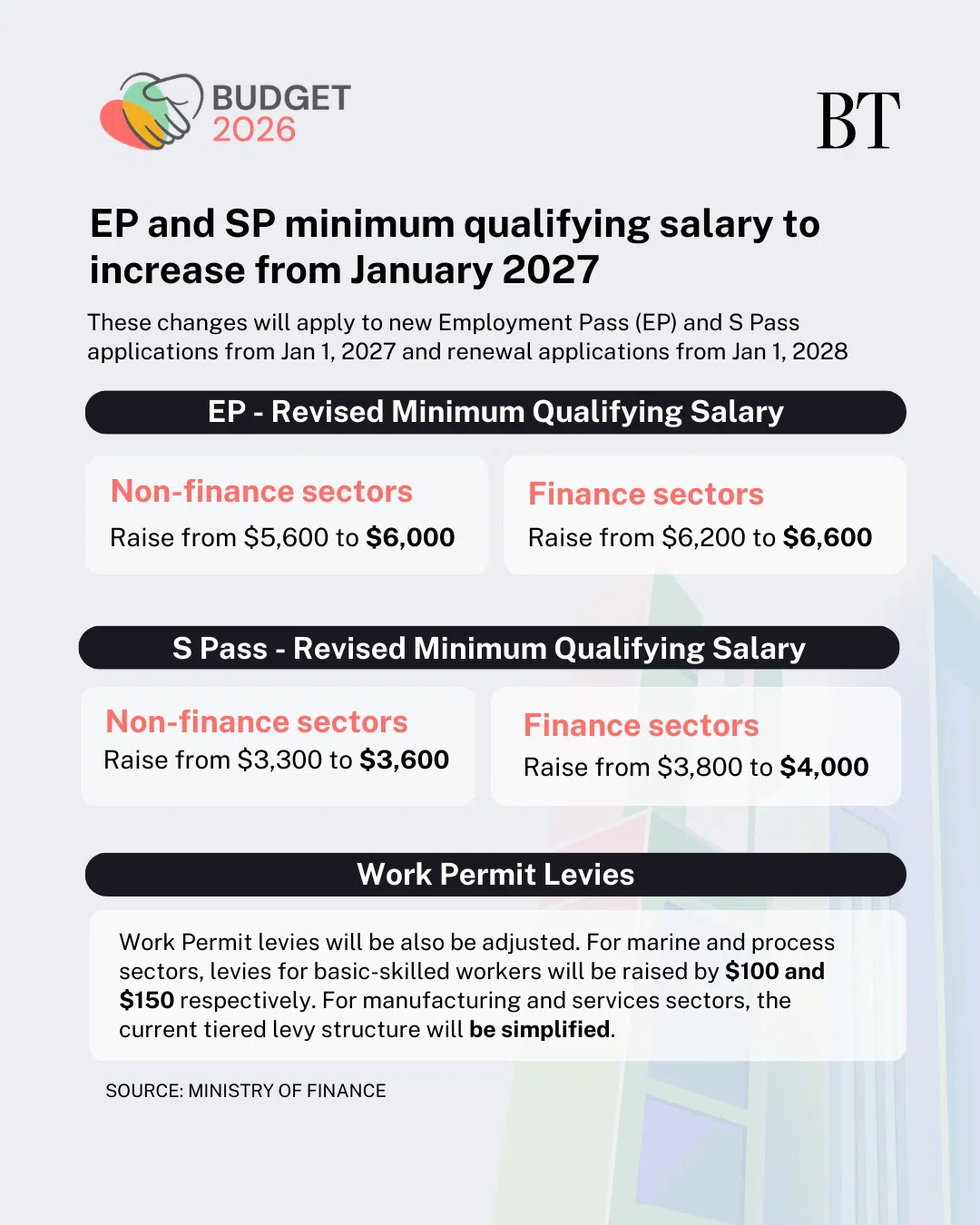
In his Budget speech on Thursday (Feb 12), Minister for Finance Lawrence Wong announced that the EP minimum qualifying salary for new applicants will be raised to S$6,000 from S$5,600 from January 2027. For the financial sector, the EP minimum qualifying salary will go up to S$6,600 from S$6,200.
For new S Pass applicants, the minimum qualifying salary will also be raised to S$3,600 from S$3,300, and to S$4,000 from S$3,800 for the financial sector.
Qualifying salaries for older EP and S Pass holders will be raised in tandem, with renewal applications affected from 2028.
Mark Yip, Huttons Asia’s chief executive officer, said the moves may influence foreign hiring, which could have a “knock-on impact” on tenant demand for both Housing & Development Board (HDB) flats and private residential properties.
This comes at a time when the supply of HDB flats available for rental and completed private residential properties is rising, he added.

Ding Suk Peng, PWC Singapore’s workforce tax leader, said: “Employers will become more selective at junior and mid bands, especially outside specialised roles, pushing job redesign and automation to raise productivity and expanding local training pipelines.”
Rental demand may soften at mass-market segments linked to S Pass and junior EP holders, while mid to upper tiers tied to specialist EP holders should stay resilient.
“Broader economic conditions and housing supply will be the primary determinants of rental moves, with the pass changes shaping the composition more than the headline level of demand,” Ding added.

Marcus Chu, ERA Singapore’s chief executive officer, said that while the latest changes may not immediately impact the Republic’s rental market, it could still weigh on sentiment among foreign workers.
“Landlords and property agents may also see more cautious enquiries, with some tenants potentially re-evaluating their housing choices or delaying rental decisions.”
However, this is expected to be a gradual adjustment, given the phased implementation timeline from 2027 and the continued need for foreign manpower in key sectors, Chu said.
Selena Ling, chief economist at OCBC Bank, expects the increase in qualifying salaries to have a “muted” impact on the housing sector and does not foresee a sharp drop in EP or S Pass holders.
The supply of private residential homes will rise to 8,354 units in 2027 from 6,067 units in 2026, an increase of 37.7 per cent, Huttons’ Yip said. This will further increase to 9,687 units in 2028.
In the HDB market, the number of flats fulfilling the five-year Minimum Occupation Period – and becoming available for rental – will rise 40.5 per cent to 18,939 flats in 2027, from 13,484 flats in 2026. Potential supply will further increase to 21,393 units in 2028.
In the fourth quarter of 2025, private residential rents dipped 0.5 per cent month on month after three straight quarters of growth. This brought rental growth to 1.9 per cent year on year for 2025, reversing a 1.9 per cent correction in 2024.
“Rents of HDB and private residential properties may face downward pressure of up to 3 per cent in 2027 and 2028 if demand fails to keep up with supply,” Yip said.
For more of BT’s Budget 2026 coverage, go to bt.sg/budget26
Decoding Asia newsletter: your guide to navigating Asia in a new global order. Sign up here to get Decoding Asia newsletter. Delivered to your inbox. Free.
Copyright SPH Media. All rights reserved.
TRENDING NOW

Once staunchly pro-China, Malaysian Chinese businesses are now distancing themselves from Beijing

Looking beyond looming CEO succession, should UOB potentially pursue a transformative merger?

Could stablecoins be the future of money?

Grab CEO’s wife Chloe Tong on life with Anthony Tan and finding her purpose

