

Budget 2026: Singapore risks ‘missing middle’ as AI squeezes out junior roles, warns Desmond Choo
Calls to tax wealth more heavily also come up on the second day of debate on the Budget


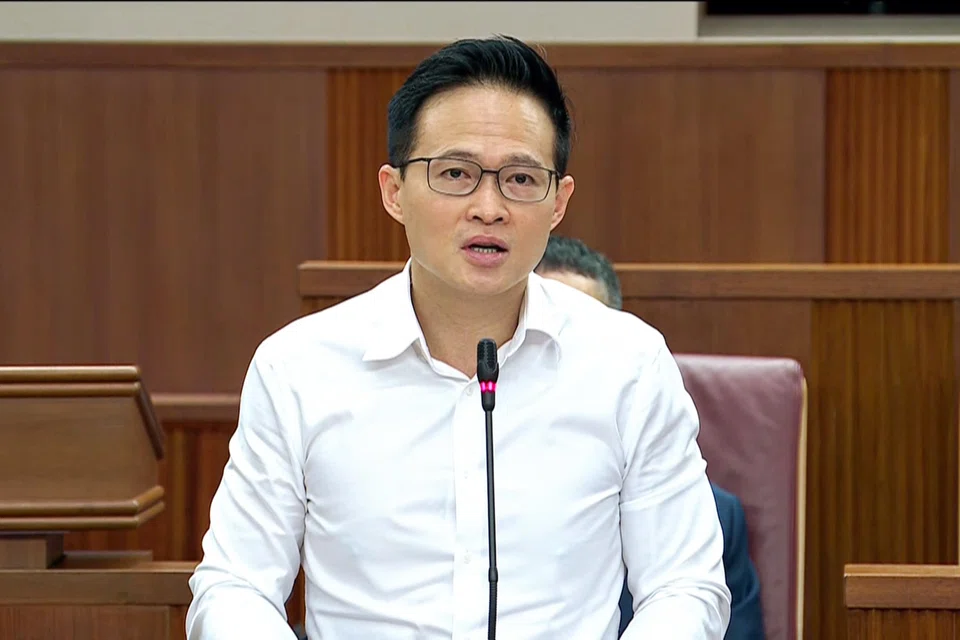
[SINGAPORE] The Republic risks a hollowing out of a generation of middle-management talent as artificial intelligence (AI) takes over the routine tasks that once trained junior workers, National Trades Union Congress’ deputy secretary-general Desmond Choo warned in Parliament on Wednesday (Feb 25).
This is because while AI can boost overall productivity, it may shrink traditional entry-level jobs as firms choose to hire fewer juniors and instead deploy AI, which performs routine tasks faster and more cheaply.
“Left entirely to market forces, firms may rationally choose fewer juniors and more AI,” said Choo on the second day of the debate on the Budget, when some 26 Members of Parliament (MPs) spoke for over seven hours.
“In the short term, that boosts margins. In the long term, it hollows out the pipeline of middle-level Singaporean talent,” said Choo, who is also Minister of State for Defence.
The result would be a workforce with powerful algorithms, but a thin layer of senior experts and too few local managers and specialists in between.
Singapore will thus need new industrial policy for entry-level jobs to prepare for this future.

First, Choo called for an apprenticeship system which would encourage firms to hire graduates to audit AI-generated work, rather than simply deploy AI outright. The government can provide co-funding for a period to de-risk hiring decisions.
Second, universities and polytechnics should make AI literacy foundational for every student, and prepare graduates for “semi-senior” responsibilities from Day One. Schools should also focus on “uniquely human capabilities” such as communication, collaboration, leadership and ethical reasoning.
Lastly, reskilling timelines should be accelerated by opening up access to SkillsFuture support at an earlier age. Place-and-train programmes and career bridges must also be expanded for those who cannot afford pauses in their careers.
SEE ALSO

Job anxieties
The impact of AI on jobs was one of several concerns raised by MPs on Wednesday, as job anxieties and support for workers emerged as a key theme.
Several MPs called for stronger safeguards for retrenched workers; others flagged the prevalence of fixed-term contracts – particularly among older workers – and called for clearer pathways to permanent employment.
Nominated Member of Parliament Sanjeev Kumar Tiwari called on the government to publish more granular data on contract-to-permanent pathways to set an example for the broader labour market.
Labour MP Patrick Tay urged the government to encourage employers to convert fixed-term contract workers to permanent roles after two cycles of renewals.
He also suggested that successive contracts renewed within two months be regarded as continuous service; the existing tripartite guidelines provide for only a one-month window.
For younger workers, Tay – warning against a mismatch between skills and jobs – called for the Graduate Industry Traineeships programme in high-growth sectors to be expanded. He also called for traineeship allowances to be on par with starting salaries, and for host organisations to be required to convert trainees into permanent hires.
More resources should be put into grooming early-career professionals through overseas postings as Singapore pushes more companies to internationalise, he also said.
Taxing wealth
Other suggestions raised during the debate included calls for higher asset- and wealth-based taxes.
Xie Yao Quan (Jurong Central), noting that property taxes account for only an estimated 0.9 per cent of Singapore’s gross domestic product in Budget 2026, suggested that it be raised to 1.2 per cent, with a focus on the top tier of residential properties.
He also pointed out that stamp duty collections, at about 0.8 per cent of GDP, have stayed at roughly that level for the past decade.
He proposed making stamp duties “more progressive” in the longer term; for example, a 15 per cent marginal tier for residential properties above S$5 million – about 2.5 times the current top marginal rate – could be introduced.
Raising asset-related taxes “quite a bit more”, he reasoned, would help to meet Singapore’s future spending needs.
In a similar vein, Louis Chua (Sengkang GRC) from the Workers’ Party called for a more comprehensive approach to wealth taxation. It was a reiteration of his proposal from Budget 2023 – to reinstate a Net Annual Value tax on high-end properties and to reintroduce estate duty with thresholds targeting only the truly wealthy.
Noting the absence of capital gains or dividend taxes in Singapore, he said Singapore’s tax system should more directly address the concentration of wealth.
Chua also suggested studying wealth tax models in countries such as Norway and Switzerland, and warned that existing asset-based taxes – including recent changes to vehicle-related rebates – risk burdening the middle class if not carefully calibrated.
Fiscal marksmanship
The issue of Singapore’s S$15.1 billion surplus also returned to the spotlight on Wednesday, prompting a brief exchange between PAP’s Xie and WP MPs Gerald Giam (Aljunied GRC) and Jamus Lim (Sengkang GRC).
The day before, Giam had questioned whether the repeated outperformance pointed to “overly conservative revenue projections”, and asked if the government was “unnecessarily hoarding funds”. He also called for a review of the increase in the goods and services tax.
Xie argued that fiscal marksmanship on a single-year basis was not meaningful, because a surplus could quickly swing into a deficit in a crisis.
He noted, for example, that Singapore ran consecutive surpluses between FY2016 and FY2019, only to record a S$51.6 billion deficit – equivalent to 10.8 per cent of its GDP – in FY2020, at the height of the Covid-19 pandemic.
What matters, he said, is balance over a full term of government.
Surpluses in some years are a deliberate feature of Singapore’s fiscal framework, providing buffers for the country to respond to downturns without immediately turning “to the president… (and) our past reserves” to fight the crisis.
Pushing back against claims that recent surpluses reflected GST over-collection, he argued that offsets such as the GST Voucher scheme and Assurance Package have deferred or cushioned the impact of the rate hike for lower- and middle-income households, making the overall system progressive.
Xie outlined two proposals to redeploy part of the surplus: extending transitional GST offsets by a year at a cost of about S$1.5 billion, and investing S$5 billion over a decade to groom 50,000 Singaporean C-suite leaders through grants of up to S$100,000 each.
The two WP MPs later sought clarifications on the opportunity cost of year-to-year fiscal variances and whether running surpluses imposed disproportionate burdens on households facing high living costs.
Xie reiterated that fiscal balance should be assessed over a full term of government, and maintained that surpluses within a term served as buffers against shocks.
The Budget debate wraps up on Thursday, with Prime Minister Lawrence Wong expected to respond to the issues raised.
Decoding Asia newsletter: your guide to navigating Asia in a new global order. Sign up here to get Decoding Asia newsletter. Delivered to your inbox. Free.
Copyright SPH Media. All rights reserved.
TRENDING NOW

Britain’s mansion tax shows the difficulty of targeting wealth

Once staunchly pro-China, Malaysian Chinese businesses are now distancing themselves from Beijing

The only common thing in S-E Asia is that we all eat rice: Cisco’s Asean president
Singapore data centre operator DayOne opts for US IPO at likely US$20 billion valuation

