

AI adoption, S$15.1 billion surplus dominate first day of Budget debate
Some MPs call for CDC Vouchers scheme to be refined into a recurring one to better reflect household needs


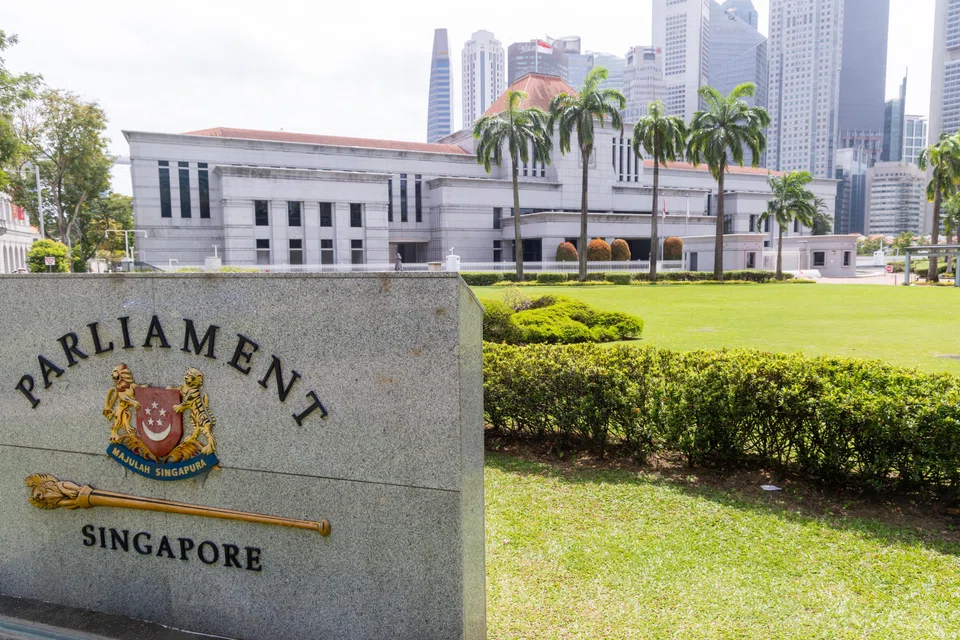
[SINGAPORE] Artificial intelligence (AI) transformation and how to deploy Singapore’s stronger-than-expected fiscal surplus were among the dominant themes on the first day of the Budget debate, alongside concerns over cost pressures and global uncertainty.
Of the 31 MPs who spoke for more than seven hours in Parliament on Tuesday (Feb 24), several highlighted barriers to AI adoption and proposed measures to ease the transition.
One recurring message was the need to better support small and medium-sized enterprises (SMEs), which may lack the capacity to implement AI. Several MPs focused on improving funding clarity and accessibility.
Nominated MP (NMP) Mark Lee welcomed the funding support, such as through the expanded Enterprise Innovation Scheme, but cautioned that the qualifying expense criteria had to be made clear to prevent companies from misallocating resources.
Lee, who is the chief executive officer of Sing Lun, suggested that further incentives should be linked to the companies’ outcomes, such as higher worker output and reduced energy use.
Henry Kwek (Kebun Baru) noted that the approved vendor list for the Productivity Solutions Grant, which comprises traditional technology companies, should be expanded to include AI-centric firms delivering accounting, payroll and marketing services to help SMEs access them quickly.

Some MPs also agreed that the support for SMEs should be targeted.
Denise Phua (Jalan Besar GRC) proposed the introduction of a “credible, simple national diagnostic that classifies firms into foundational, emerging or advanced stages of AI-readiness”.
She also recommended that government-funded advisers embedded in companies help to structure data, redesign workflows and ensure proper implementation.
SEE ALSO


Jackson Lam (Nee Soon GRC) suggested that sector-specific playbooks could be developed in partnership with trade associations, for practical step-by-step road maps.
Lee similarly suggested that the government work with trade associations to strengthen sector-specific management upgrading programmes tied directly to AI integration, job redesign and workforce planning, which would make adoption “less risky”.
Noting their role in SMEs’ AI transformations, Phua called on the government to equip intermediaries, including associations and agencies, with deeper technical capabilities, diagnostic tools and specialist talent and funding.
More broadly, Yip Hon Weng (Yio Chu Kang) said the government should set key performance indicators to track and publish, while Lee suggested the implementation of outcome-linked incentives for companies that deliver sustained productivity improvements.
But beyond adopting technologies at the company level, some MPs were also concerned about protecting workers.
“The doomsday scenario is not robots overnight. It is a broken ladder,” said Phua.
She suggested identifying roles at high automation risk early and intervening before displacement occurs, and making workforce transition road maps mandatory for firms that receive significant AI incentives.
Both Phua and Yip also emphasised the importance of entry-level pathways.
It is important that young Singaporeans “still get a real first job, real mentorship, and real responsibility” as they learn to curate, steer and verify AI outputs, Yip said.
Phua agreed that entry points must be redesigned, not removed, adding: “Protecting the first rung protects mobility.”
For workers to benefit from the AI transformation, employer-led training and apprenticeships should be scaled, human resources capabilities for workforce transformation management should be strengthened, and modular employer-recognised micro-credentials should be expanded, said Jessica Tan (East Coast GRC).
Significant interest in how surpluses are deployed: Pritam Singh
Another recurring thread throughout the debate was the government’s sizeable fiscal surplus and what it signals about Singapore’s tax and spending strategy.
During his Budget speech on Feb 12, Prime Minister and Finance Minister Lawrence Wong said the government expects to end the 2025 financial year with an overall fiscal surplus of S$15.1 billion, or 1.9 per cent of gross domestic product – more than double the estimated surplus of S$6.81 billion.
While Alex Yam (Marsiling-Yew Tee GRC) defended the surplus as prudent fiscal planning, his fellow People’s Action Party (PAP) MP Yip said that given the current fiscal space, the government could signal stability by avoiding further tax increases, stressing that revenue adjustments should be carefully calibrated and progressive.
Workers’ Party (WP) secretary-general Pritam Singh noted in his speech that the government begins the new term “on a firm footing”, with the projected surplus of S$15.1 billion for FY2025 and a further S$8 billion expected in FY2026.
These surpluses, he pointed out, already far exceed the S$2 billion to S$3 billion in additional annual revenue that the goods and services tax (GST) hikes in 2023 and 2024 were expected to generate.
“There will be significant public interest in how these surpluses are ultimately deployed, especially given the pressures of an ageing population and the persistent concern over inequality,” he said.
He also urged the government to institutionalise public “report cards” for major multi-year spending programmes, to track how the billions committed to key national initiatives have translated into results.
Gerald Giam (Aljunied GRC) questioned if the repeated outperformance pointed to “overly conservative revenue projections”, and asked if the government was “unnecessarily hoarding funds”.
He called for a review of the GST increase, noting that the government said it was meant to fund increases in healthcare spending in an ageing society.
However, he pointed out that the Ministry of Health’s revised FY2025 operating expenditure was S$305 million lower than estimated, due mainly to lower-than-projected funding needs for public healthcare institutions.
He also argued that fiscal support should be more proactive, citing what he described as a modest 0.6 per cent fiscal impulse, despite risks from AI disruption and global trade tensions.
Shawn Loh (Jalan Besar GRC), meanwhile, proposed using the “extra money” to strengthen redistribution schemes, including enhanced support for seniors, more sustained wage support and bolder family policies.
“We should assure Singaporeans that when Singapore does well, all Singaporeans will benefit,” he said.
For example, he said that any fiscal surpluses above 2 per cent of GDP should be given back to all Singaporeans in the following year through extra Community Development Council (CDC) Vouchers, Central Provident Fund top-ups, or other rebates for government services.
Social dividends
On the topic of CDC Vouchers, WP’s Singh argued that the scheme now risks being treated as permanent and should be refined to better reflect household needs.
He noted that vouchers are distributed on a per-household basis regardless of size, and proposed retaining the base S$500 for households of three members or fewer, while providing an additional S$150 per person for larger families to better reflect their cost-of-living burdens.
NMP Terence Ho, however, took a different tack.
Rather than treating the vouchers as ad hoc relief, Associate Professor Ho suggested repositioning them as a form of social dividend – an annual sum given to citizens that “signifies that they have a stake in the country and its collective wealth”.
He said the government could determine the size of the dividend each year based on prevailing fiscal and economic conditions. Under this proposal, all Singaporeans will receive something, with lower-income households receiving more.
Going further, he proposed that part of the dividend for lower-income households could be distributed in income-generating assets and securities, rather than purely in cash or vouchers, building on Singapore’s existing asset-based social policies.
Even as ideas were floated on how to share the surplus, PAP’s Loh cautioned that revenue volatility could rise as new tax measures, such as a top-up tax under Pillar Two of the Base Erosion and Profit Shifting 2.0 framework.
While these may bring a short-term bump, he warned their durability is uncertain and said it is “better to find ourselves in a Budget surplus position than struggling to reduce deficits”, as many other countries are.
The Budget debate continues on Wednesday, with PM Wong expected to respond to the issues raised later this week.
Decoding Asia newsletter: your guide to navigating Asia in a new global order. Sign up here to get Decoding Asia newsletter. Delivered to your inbox. Free.
Copyright SPH Media. All rights reserved.
TRENDING NOW

Once staunchly pro-China, Malaysian Chinese businesses are now distancing themselves from Beijing

Looking beyond looming CEO succession, should UOB potentially pursue a transformative merger?

Could stablecoins be the future of money?

Grab CEO’s wife Chloe Tong on life with Anthony Tan and finding her purpose

