

‘Come to us first’, new SBF chairman Mark Lee tells businesses seeking help
He wants to make it easier for companies to access support for financing, technology and overseas growth

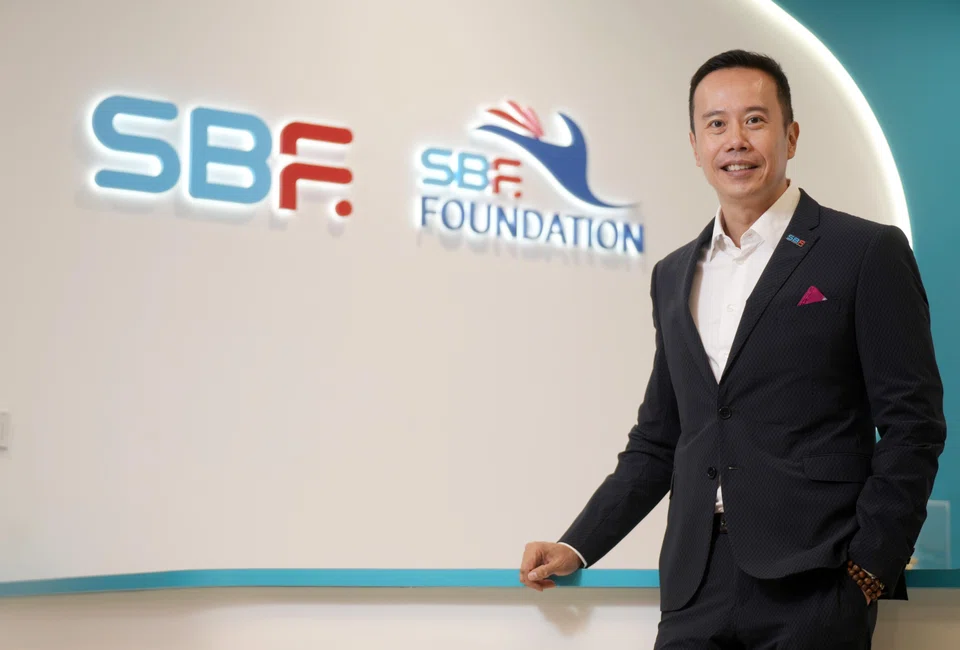
[SINGAPORE] When a company needs financing, wants to adopt artificial intelligence, or is looking to expand overseas, Mark Lee wants the Singapore Business Federation (SBF) to be the first “port of call” for help.
Just over a month into his term as chairman of the apex business chamber, Lee – the CEO of Sing Lun and a second-term Nominated Member of Parliament (NMP) – is seeking to deepen SBF’s role in helping companies grow and navigate change.
The 53-year-old served as SBF’s vice-chairman and honorary treasurer for over two years before assuming the chairman’s duties on an interim basis in early June. His predecessor, Teo Siong Seng, had taken leave to address a US indictment over an alleged container price-fixing conspiracy.
Teo eventually did not seek re-election, and Lee was elected chairman on Jun 24.
Lee said Teo’s legal case had not affected SBF’s operations, and that no internal review or changes to its processes were needed.
He also acknowledged that his appointment does not represent a departure from SBF’s existing direction, stressing that its priorities are shaped collectively by the federation’s council and executive committee.
“What we want is to continue the good work that we have laid out over the last few years,” he said during a media roundtable on Monday (Aug 3), where he shared his own experiences running and expanding the family-owned Sing Lun.
After joining the business in 1999, when it was still an apparel manufacturer, Lee tapped government-led business missions to explore markets in the US, Europe and South-east Asia.
Sing Lun subsequently expanded its manufacturing footprint to six markets, including Vietnam, Cambodia and China, he said.
SEE ALSO

The journey also showed how quickly a business could come under threat.
During the global financial crisis in 2008, banks withdrew the company’s unused credit lines as they conserved lending capacity for other borrowers. A major customer accounting for 40 per cent of Sing Lun’s profit then pulled out in 2009, forcing the company to close its factories in Singapore and Malaysia.
Not just a representation body
These experiences impressed on Lee the importance of maintaining access to financing and spreading risk across customers, markets and production bases.
They also shaped how he sees SBF’s role today.
“If we want to continue doing good work at SBF, we cannot just be a representative body,” he said, adding that there are now over 34,000 members.
“We need to be a business-building institution.”
The change Lee envisages lies less in SBF’s mandate than in how companies access its support. Instead of navigating the various advisers, programmes, government schemes and trade associations themselves, businesses should be able to bring a problem to SBF and be directed to the right source of help.
In practice, SBF offers support spanning financial advice, workforce and job redesign, technology adoption and overseas expansion. Lee said companies could approach its advisers before being directed to the appropriate programme or partner.
The federation will also launch a Future Ready Business Index in September to help companies assess their preparedness for future challenges.
It is part of a programme that includes dialogues with business leaders and visits to companies that have transformed.
“Come to us first,” he said. “We are here for you, and we want to make you successful.”
Have options
Internationalisation will be another focus for SBF as companies contend with tariffs, wars and other barriers that could disrupt established markets and supply chains.
Lee said such uncertainty made diversification more important, even if it also made companies more hesitant to invest overseas.
A survey by SBF in 2025 found that 47 per cent of businesses planned to enter or expand further overseas, down from 59 per cent a year earlier.
“The whole idea is to have options on the table,” he stressed. “You must diversify your markets, you must diversify your supply chain.”
Despite the greater caution, Asean remains the main destination for companies looking abroad. Of those planning overseas expansion, 65 per cent were looking towards the region, the same survey found.
Asean is set to take on greater importance as Singapore assumes the bloc’s chairmanship in 2027.
Lee said SBF would work with trade associations and chambers to identify non-tariff barriers faced by companies and recommend ways for Asean governments to reduce them.
It also intends to help businesses understand and tap the Asean Digital Economy Framework Agreement (Defa), which is expected to make cross-border digital trade, payments and data flows easier.
However, Lee acknowledged that SBF was still studying how the agreement would translate into practical benefits for companies.
“We are all trying to understand how Defa applies to businesses,” he said. “I don’t have an answer to that. We are going to be doing that.”
Tackling regulatory friction
On his tenure as an NMP, Lee said it has helped him understand policy trade-offs while flagging the “friction points” faced by businesses.
He intends to keep pressing for regulations to be reviewed as business conditions change. This includes allowing companies greater flexibility to deploy foreign workers across activities despite sector-specific dependency-ratio ceilings.
Lee also co-chaired the Alliance for Action on Business Competitiveness with Senior Minister of State Low Yen Ling. He said 24 of its 27 recommendations had been implemented “in some shape or form”.
Preparing workers for AI
Lee expects the effect of AI on jobs to be another issue he will continue raising in Parliament.
While he cautioned that it was too early to attribute recent retrenchments entirely to AI, he acknowledged the risk that fewer entry-level roles could disrupt the pipeline through which younger workers gain experience.
Lee said companies should redesign jobs and retrain workers as they adopt AI.
At Sing Lun, the company first identifies problems that AI can solve before examining how jobs can be redesigned to augment rather than displace employees.
SBF is working with trade associations, the government and other institutions on responsible AI adoption, although Lee acknowledged that the “rules of engagement” remained unclear.
The effect on entry-level work would require particularly close attention, he said. “For you to gain experience, you need to be on the job. But if you are not on the job because AI replaces you, then where are you going to get experience?”
Decoding Asia newsletter: your guide to navigating Asia in a new global order. Sign up here to get Decoding Asia newsletter. Delivered to your inbox. Free.
Copyright SPH Media. All rights reserved.
TRENDING NOW

Government to bring forward raising of retirement age, give employers more financial support to create flexi-load jobs

If Europe goes to war, the fallout will be felt in East Asia

Indonesia stocks suffer worst plunge in nearly 30 years as MSCI proposes standalone status

Vietnam’s northern provinces, not Hanoi or Ho Chi Minh City, are powering near 10% GDP growth

