

Economists expect broader price hikes amid Gulf war, as Singapore’s core inflation rises in March
More sectors to be hit by higher energy and input costs, with firms to pass them down to consumers

[SINGAPORE] Private-sector economists warned of broader price increases in the coming months, as they expect higher energy and input costs triggered by the Gulf war to trickle down to a wide range of sectors.
Despite higher inflation on the horizon, economists were split on the Monetary Authority of Singapore’s (MAS) next move in July, though more expect no change to policy settings.
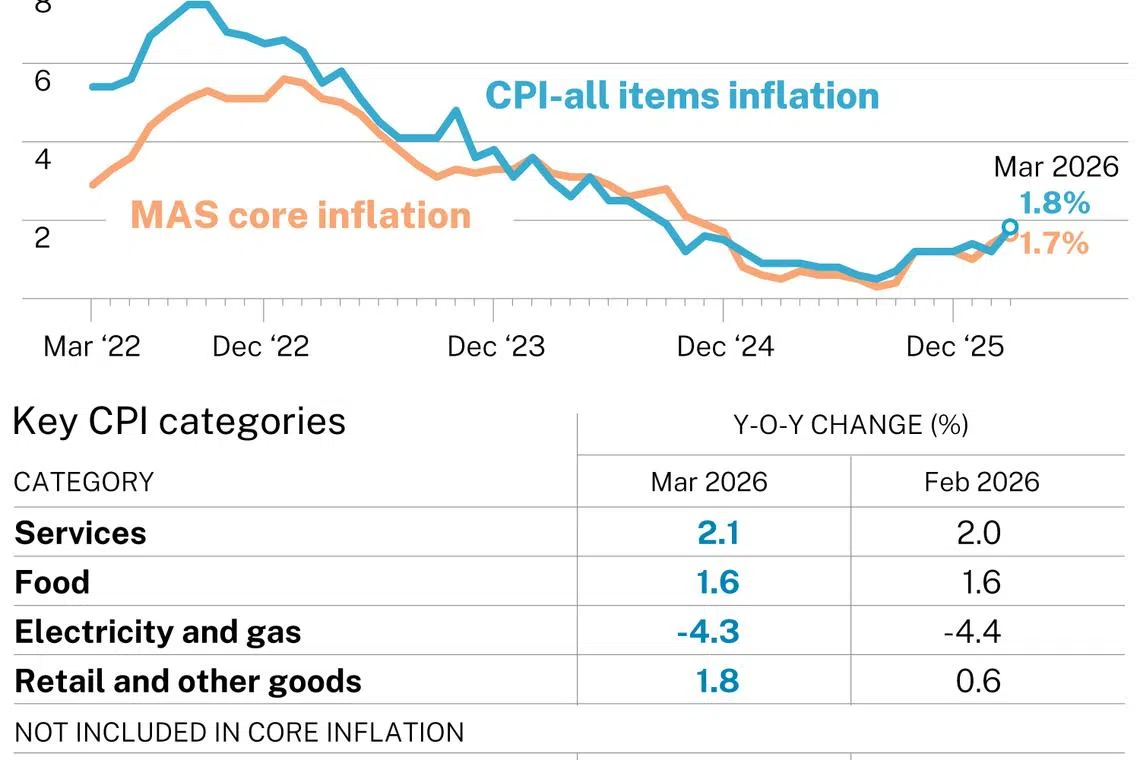
Both Singapore’s core and headline inflation rose in March, data from the Department of Statistics showed on Thursday (Apr 23).
MAS and the Ministry of Trade and Industry (MTI) maintained their official forecasts for both core and headline inflation at 1.5 to 2.5 per cent for 2026.
MAS had earlier raised its full-year forecasts to this range on Apr 14 when it released its monetary statement, up from 1 to 2 per cent in January. It also tightened monetary policy for the first time since October 2022.
March’s core inflation, which excludes accommodation and private transport, was 1.7 per cent. This was more than February’s 1.4 per cent and in line with the median forecast of 1.7 per cent by private-sector economists polled by Bloomberg.
This was due to an increase in both retail and other goods and services inflation, the authorities said.
Headline inflation rose to 1.8 per cent, up from 1.2 per cent the previous month, which the authorities attributed to higher private transport and core inflation. It was also in line with economists’ median forecast of 1.8 per cent.
On a month-on-month basis, the overall consumer price index (CPI) increased 0.5 per cent in March, while core CPI rose 0.1 per cent.
In a joint statement on Thursday, MAS and MTI flagged that Singapore’s imported cost pressures are expected to pick up and broaden in the months ahead, as higher energy and other input costs arising from developments in the Middle East pass through global supply chains.
Domestically, services unit labour costs are likely to grow at a slower pace in 2026, while domestic consumer spending could turn more cautious amid rising economic uncertainty, they said.
While the authorities pointed out that risks to the inflation outlook are tilted to the upside at this juncture, they flagged downside risks in the form of industrial production being curtailed due to supply chain disruptions or an abrupt tightening in global financial conditions.
These could lead to a slowdown in economic activity and therefore, lower inflation, they added.
More sectors to be hit by rising costs
Several economists highlighted the possibility of inflation surpassing the 2 per cent handle in the coming months.
This is as more sectors are hit by rising costs, with businesses likely passing these increases down to consumers through higher prices.
Maybank economists Chua Hak Bin and Brian Lee noted that the pass-through of higher energy prices has so far been limited primarily to fuel and transport services.
However, they expect inflation to rise further and “broaden to a wider range of products in the coming months”, including non-transport and utilities sectors, as higher energy and raw material costs from Gulf supply disruptions pass through supply chains.
As such, they said inflation could overshoot 2 per cent in the second and third quarters. But they maintained their 2026 core headline inflation forecasts of 1.9 per cent and 1.8 per cent, with risks to the upside.
OCBC chief economist Selena Ling said the Gulf War and continued closure of the Strait of Hormuz will trigger energy and petrochemical-related costs for businesses, “which could add to the inflationary pass-through into Q2, and potentially beyond”.
She expects the Middle East conflict and resulting supply chain disruptions to push up costs across private transport, utilities, air travel and food, among others.
As she sees it, core and headline inflation in Q2 will accelerate further towards 2 per cent. She maintained her full-year core and headline inflation forecasts at 2 to 3 per cent on account of upside risks to the inflation outlook.
DBS senior economist Chua Han Teng said: “The inflation increase is nascent and faces broadening upside risks.”
He noted that higher energy prices are translating to increased delivery, logistics, and electricity and gas costs domestically, with businesses possibly passing these on to consumers in the coming months.
Higher fertiliser costs from the Middle East supply shock could translate into increased agricultural prices, he added.
Economists also braced consumers for a further acceleration of prices from Q3 onwards.
UOB associate economist Jester Koh said the “first‐round effects” from the energy supply shock are already evident in March’s CPI data, through higher petrol and point‐to‐point transport services prices.
Higher electricity and gas tariffs, which have already been announced for Q2, are likely to see “even sharper increases” from Q3 onwards, he added.
However, Koh believes it is too early to assess the extent of “second‐round effects”, as firms may choose to temporarily absorb higher costs and belatedly pass on cost increases to consumers.
His baseline assumption is for core inflation to “strengthen meaningfully” from June onwards and peak at 2.5 per cent in August to September, before moderating towards 2 per cent in Q4.
He maintained his full-year core inflation forecast at 1.9 per cent, but raised his headline inflation forecast to 2.2 per cent.
Similarly, Standard Chartered’s chief economist and head of foreign exchange for Asean and South Asia Edward Lee said inflation may only step up in Q3, when electricity prices reflect higher fuel prices.
Split views on MAS’ July move
Amid rising inflation, economists were split on the central bank’s next move in July.
Barclays economist Brian Tan’s base case is for no further adjustments to the S$NEER policy band in the near term, even as he raised his 2026 core inflation forecast to 1.9 per cent, from 1.5 per cent.
But “risks are tilted towards more tightening”, he said.
As he sees it, MAS’ tightening move in April was intended to “pre-emptively buttress” its “inflation-fighting credibility” so as to keep inflation expectations anchored, as CPI readings rise. This reduces the need for “more aggressive action later”, he said.
Edward Lee said the authorities’ statement – when taken together – suggests that MAS “is not pre-committed to any monetary policy path at the moment, given the currently complex situation”.
He also maintains his call for MAS to keep settings unchanged in July, but, like Tan, said the balance of risks is tilted towards further tightening.
While Koh expects MAS to tighten monetary policy further only in October, risks are tilted towards an earlier move in July “should second‐round effects prove stronger than anticipated, or inflation expectations show signs of accelerating”.
DBS’ Chua said that the central bank “would want to maintain policy flexibility” against a backdrop of elevated uncertainties from fluid developments in the Middle East and “considerable risks to inflation and the economy”.
On the other hand, the Maybank duo sees “higher-than-even” odds of the MAS steepening the S$NEER slope by another 50 basis points in July.
Citing the authorities’ statement on risks to the inflation outlook tilted to the upside, as well as the likelihood of dampened demand, they said: “We think a slightly tighter S$NEER appreciation stance may be warranted to cushion the imported inflation shock on households and firms.”
TRENDING NOW

Once staunchly pro-China, Malaysian Chinese businesses are now distancing themselves from Beijing

Cliff Tan has 7 million followers and a 4-month waitlist. Why won’t he expand his business?

Grab CEO’s wife Chloe Tong on life with Anthony Tan and finding her purpose
Singapore F1 to proceed despite haze; no changes planned to outdoor entertainment

