Economists ponder if Singapore’s trade growth upgrade driven by inflation or external demand

Sharon See
IT HAD seemed like an oddity that Singapore posted a significant upgrade to its full-year trade outlook – for the second time this year – even as it narrowed its economic growth forecast to a lower range.
While some economists believe the trade growth upgrade is indicative of export resilience, others believe it reflects rising prices rather than demand per se.
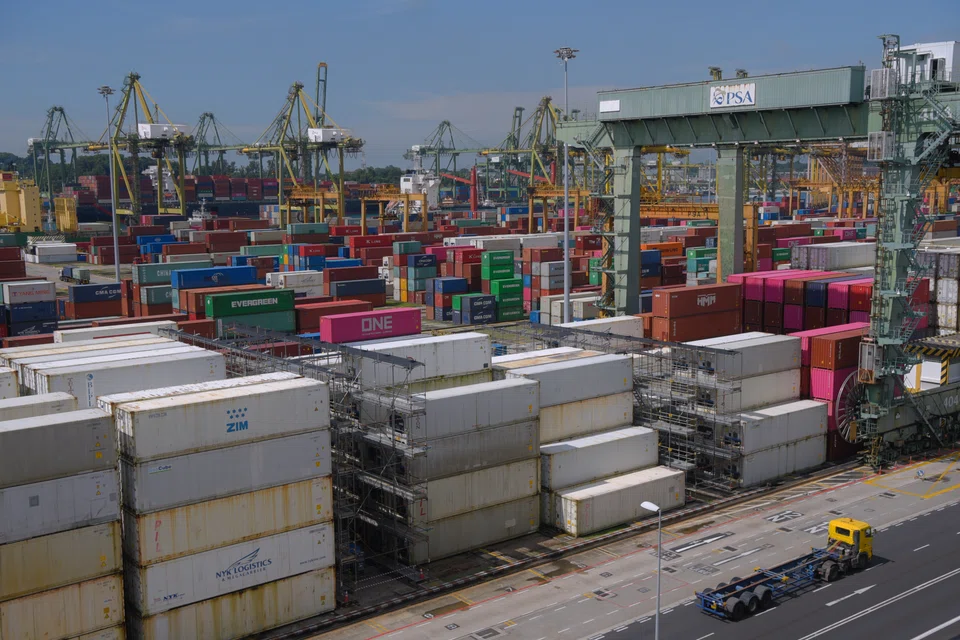
Total merchandise trade is now expected to grow 15-16 per cent, rather than the 8-10 per cent projected just 3 months ago, Enterprise Singapore (EnterpriseSG) said on Thursday (Aug 11). The updated outlook for non-oil domestic exports (NODX) is 5-6 per cent, instead of 3-5 per cent.
This comes amid better-than-expected performance from total merchandise trade and NODX in the second quarter, which Enterprise SG said was driven by higher oil prices and electronics trade.
Total merchandise trade jumped 28.1 per cent year on year in Q2, while NODX grew 9.1 per cent year on year during the same period.
At the same time however, the Ministry of Trade and Industry (MTI) narrowed its gross domestic product (GDP) forecast to 3-4 per cent, instead of the 3-5 per cent range it had held since last year. The final GDP print for Q2, at 4.4 per cent, also missed the mark by 0.4 percentage points compared with advance estimates and a poll of private-sector economists by Bloomberg.
“The contradiction is because of the divergence and distinction between the real versus nominal aggregates,” said Maybank senior economist Chua Hak Bin. “The MTI GDP downgrade is on the real economy. The EnterpriseSG NODX upgrade is because exports have been flattered by rising prices rather than volumes. The NODX upgrade is therefore deceptive and does not really represent a real improvement,” he told The Business Times.
Noting that total trade volumes are “significantly softer” than value terms, he added NODX likely contracted 1.7 per cent in volume terms in the first half of 2022, a “stark contrast” to the 10.2 per cent surge in value terms.
To be sure, Enterprise SG also noted the higher oil prices this year, which should support growth in oil trade in nominal terms.
The agency pointed out that the oil price forecast in 2022, at US$105 per barrel, is close to 50 per cent higher than last year’s price at US$71 per barrel, and prices are expected to stay elevated for the rest of the year with global energy supply remaining uncertain.
It added that global semiconductor demand is likely to stay robust, with global revenue expected to be 7.4 per cent higher year on year, based on Gartner’s July estimates.
OCBC chief economist Selena Ling said MTI’s narrowing of the GDP growth forecast is a better reflection of how the external growth environment has “deteriorated significantly”.
“The EnterpriseSG NODX upgrade is water under the bridge and more a reflection that H1 NODX performance has exceeded their expectations, but even after their upgraded forecast, it is still slightly below our NODX forecast,” she said.
OCBC’s NODX growth forecast is 6-8 per cent, but Ling said the risk of policy mistakes by major central banks driving global growth prospects south and heightened financial market volatility is one key external headwind to watch for, even if domestic and regional consumption actually remains resilient.
Other economists held a more sanguine view, believing that the improved trade outlook reflects buoyancy in Singapore’s exports.
Noting that Q2 trade had surprised on the upside, ANZ head of research Khoon Goh said: “The outlook for the rest of the year remain uncertain due to external headwinds, but the upward forecast revision highlights the resilience in Singapore’s exports.”
Moody’s Analytics economist Denise Cheok said the upgrade is “certainly encouraging, especially in the face of the current geopolitical uncertainty”.
“In particular, the strong growth expected of the electronics sector is a welcome sign after a weak performance of the semiconductor segment in June’s industrial production numbers,” said Moody’s Analytics economist Denise Cheok.
“Nonetheless, some of the upgrade in the outlook for total trade was due to high oil prices, rather than purely demand-driven. Surging consumer prices, driven by this increase in commodity prices, will cut into disposable income and weigh on consumer spending,” she said.
Another interpretation is that the earlier forecast was overly conservative, said DBS senior economist Irvin Seah and UOB senior economist Alvin Liew.
“With H1 NODX growth already at slightly more than 10 per cent, it makes sense to revise the range higher,” Liew said.