

MAS has breathing room to react to sudden shocks in 2026: economists
Tariffs, fading AI chip demand or a sharper-than-forecast global slowdown could prompt looser policy – but tightening is possible too

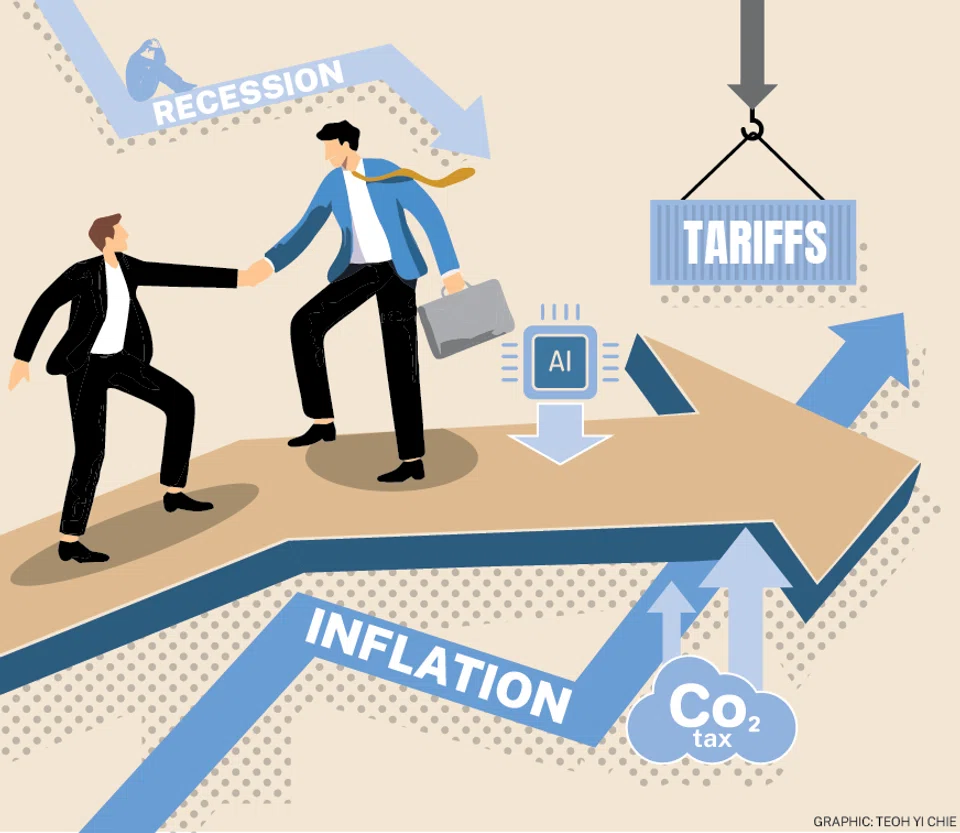
[SINGAPORE] Low inflation should give the Monetary Authority of Singapore (MAS) breathing room to loosen policy in 2026 if growth is unexpectedly hit, said economists.
Yet, resilient growth also means tighter policy is not off the table.
The baseline expectation is for MAS to hold policy steady throughout 2026, after two slight easings in early 2025.
But economists flagged that renewed tariff shocks, fading demand for artificial intelligence (AI) chips or a sharper slowdown in global demand could require further loosening.
Current settings put the Singapore dollar nominal effective exchange rate (S$NEER) policy band on “a modest and gradual appreciation path”.
Most private-sector economists estimate that it is one or two slight moves away from being flattened, but few expect this flattening to happen in 2026.
In MAS’ latest survey of professional forecasters, released on Dec 17, none of the 20 respondents expect any move in January.
But for April, one respondent expects the policy band’s slope to be reduced, while another expects it to be increased instead. For July, two respondents expect policy to be tightened with an increase in slope.
Easing, then holding
The central bank’s two easing moves in 2025 came amid US President Donald Trump’s tariff threats. On Jan 20, upon being sworn in as president, Trump promised tariffs on trading partners.
Days later, on Jan 24, MAS slightly reduced the slope of the S$NEER policy band, in its first easing move after holding policy steady since October 2022.
At its next meeting in April, it reduced the slope slightly again, saying that the global trade and growth outlook had “dimmed in early April” as Trump made good on his tariff threats.
DBS senior economist Chua Han Teng said these two “proactive” easings supported growth and “helped to counter negative external growth shocks”.
Moody’s Analytics economist Denise Cheok, however, noted that MAS was able to ease only because core inflation had dropped to unusually low levels, so that easing would not risk a sharp rise in imported prices.
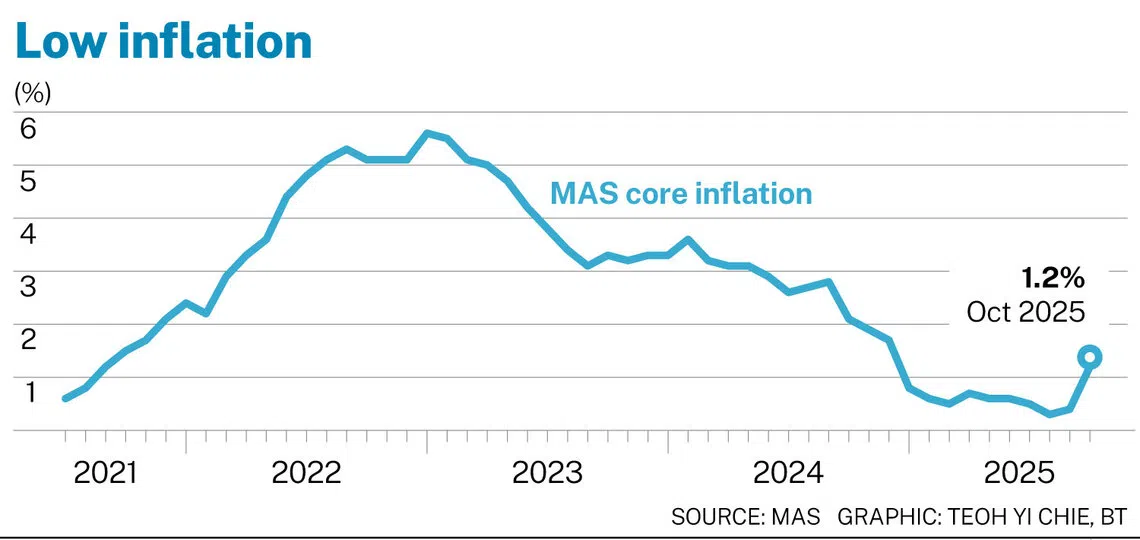
Having steadily fallen since 2023, core inflation reached 1.8 per cent – then a three-year low – in December, ahead of January’s MAS decision.
It reached a four-year low of 0.3 per cent in August, then inched up to 0.4 per cent in September. In October, it shot up to 1.2 per cent, but did not shake the authorities’ full-year core inflation forecast of 0.5 per cent.
Despite lower inflation, the MAS kept policy unchanged in July and October. This gave the earlier easing moves “time to feed through to the real economy without risking a flare-up in prices”, said Tay Qi Hang, Asia analyst at the Economist Intelligence Unit (EIU).
Nor did policy have to be eased to boost growth. Tay noted that growth stayed firm in the third quarter, on the back of front-loading ahead of tariffs and strong AI-related demand.
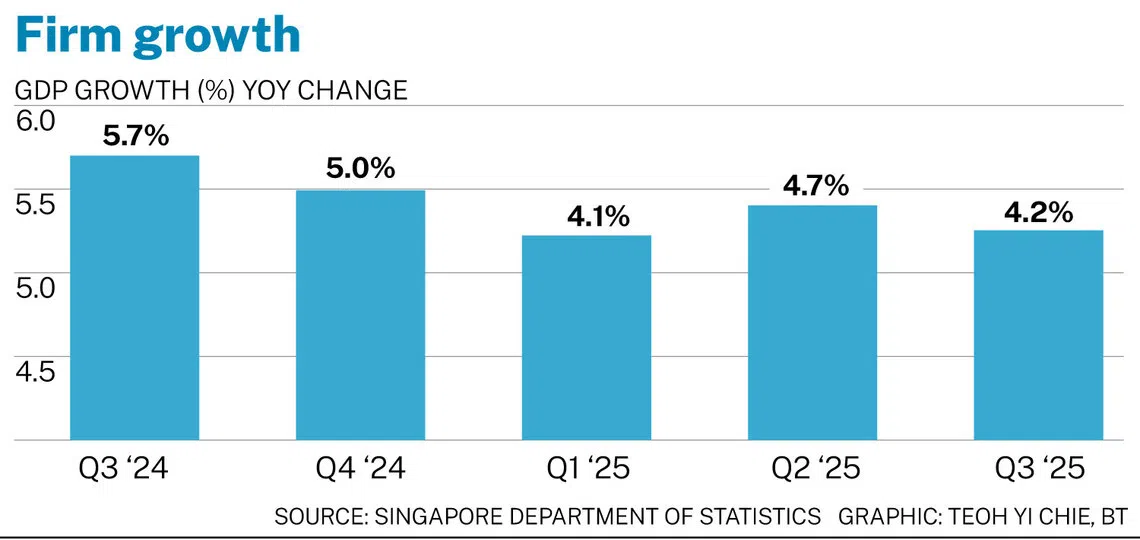
Gross domestic product growth was 4.2 per cent in Q3, revised up from the 2.9 per cent advance estimate.
With the revised figure, the Ministry of Trade and Industry upgraded its full-year 2025 growth forecast to “around 4 per cent”, from an earlier range of 1.5 to 2.5 per cent.
The 2026 view
For 2026, the official forecast ranges are 1 to 3 per cent for GDP growth, and 0.5 to 1.5 per cent for core inflation.
The combination of firm growth and benign inflation should allow MAS to maintain its modest appreciation stance in 2026, said Maybank economists Brian Lee and Chua Hak Bin – a view that is broadly consistent across the economists whom BT interviewed.
DBS, OCBC, UOB, RHB and Moody’s similarly expect no change to monetary policy settings next year, barring a significant surprise from inflation or global growth.
“We expect MAS to keep the powder dry in 2026, maintaining its three policy parameters and retaining the flexibility for an insurance easing in a highly uncertain global landscape,” said DBS’ Chua, referring to the slope, width and midpoint of the S$NEER band.
In contrast, the EIU’s Tay expects the slope to be lowered. But this will be a “gradual move towards a more neutral stance through 2026 rather than an aggressive easing cycle”.
He expects inflation to climb to between 1 and 2 per cent over the next two years, due partly to policy moves such as a 5 per cent public transport fare hike, the new sustainable aviation fuel levy and a higher carbon tax.
Triggers to watch
Economists flagged the risk of inflation shocks that could require MAS to tighten policy, but also growth slowdowns that could prompt further loosening.
While the Maybank economists’ base case is for MAS to hold steady, they see a greater risk policy being tightened rather than loosened.
EIU’s Tay said that MAS might have to tighten policy if core inflation climbs above 2 per cent, which could happen if supply shocks raise import and shipping costs.
Moody’s Cheok said such supply shocks could come from higher food prices in extreme weather or supply-chain disruptions linked to US foreign policy or geopolitical tensions – but considers them unlikely.
Instead of tightening, it is more likely that a global slowdown could prompt MAS to loosen policy further, she added, saying: “MAS has room to loosen settings if the trade landscape deteriorates more than expected next year.”
Tariffs remain the key growth risk, as the payback from front-loading of exports will likely start kicking in next year, she said.
While tariff-driven higher prices might hurt demand, this could be mitigated if MAS eases the Singdollar’s rate of appreciation or brings down the midpoint of the S$NEER, thus making Singapore’s exports cheaper, she added.
As for China, if Beijing announces significant fiscal support, this “might go some way to offset the drag in growth from US tariffs, providing MAS room to hold steady for longer”.
Cheok sees the AI boom – which underpinned Singapore’s strong export numbers in October – as a possible tailwind to growth that reduces the need for looser policy.
In contrast, Tay flagged “a correction in the AI cycle” as a possible shock that could “tilt MAS towards loosening”. Other risks are US tariffs dampening global demand and sector-specific tariffs on pharmaceuticals and semiconductors.
Possible tariffs on semiconductors were also cited by DBS’ Chua, alongside the risk of re-escalating US-China trade tensions and a sharp correction in stretched global financial markets.
These factors, he said, could “severely dent investor sentiment” and heighten the risk of a sharper-than-expected slowdown.
In an outright recession, MAS would be ready to flatten the slope or even re-centre the S$NEER midpoint downwards, said the Maybank economists – though a recession is not their base case for 2026.
Even if the MAS tweaks policy, however, it is unlikely to do so off-cycle. As the central bank now reviews policy quarterly rather than twice a year, it has more frequent opportunities to respond to evolving conditions, said economists.
“For an off-cycle move to materialise would require an unexpected or significant shock,” said OCBC chief economist Selena Ling, citing the Covid-19 pandemic and the 2008 global financial crisis as examples.
As MAS policy is driven by medium-term price pressures, a single month of inflation data is unlikely to be decisive, noted EIU’s Tay. “Of course, there is still a small chance of an off-cycle adjustment, but it would require a major geopolitical flare-up or supply disruption.”
TRENDING NOW

Once staunchly pro-China, Malaysian Chinese businesses are now distancing themselves from Beijing

Stocks to watch: HPL, Aims Apac Reit, Zico, Advanced Systems Automation, ComfortDelGro

‘How many will survive?’: Bubble fears arise as China’s humanoid robotics face reality check

Smaller board lots can’t fix a market run by three banks

