May Day Rally: NTUC to commit S$37 million in 2026 to help workers with everyday needs
The amount will go to funds for childcare and eldercare support, among others, says labour chief Ng Chee Meng

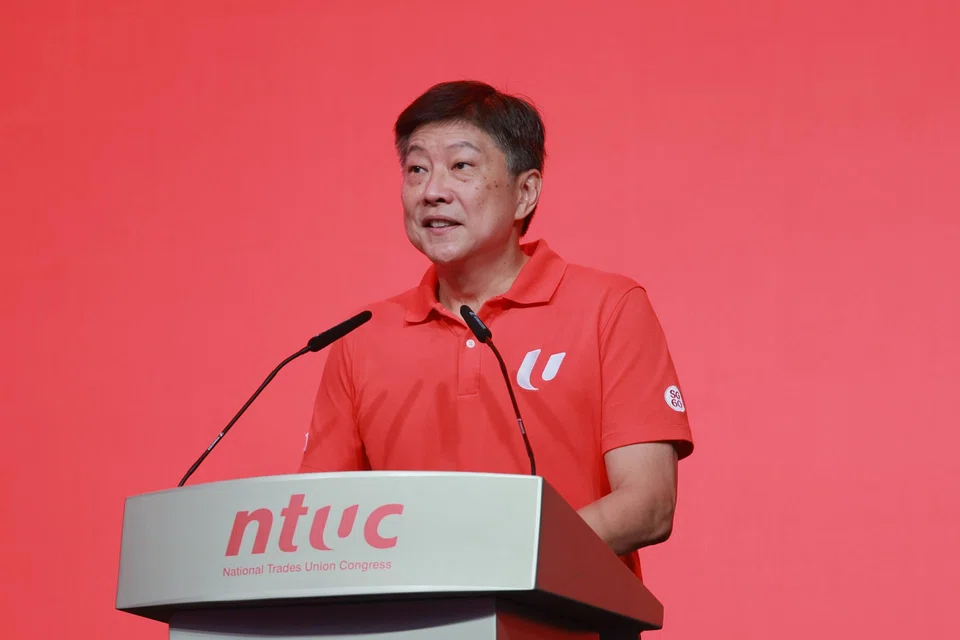
[SINGAPORE] Amid economic disruption, the labour movement is committing S$37 million in 2026 to help workers and their families with everyday needs.
This is part of its “care-in-action” approach in supporting workers, said National Trades Union Congress (NTUC) secretary-general Ng Chee Meng at the May Day Rally on Friday (May 1).
When there is “great disruption”, some workers may be left behind and societies can fracture, he noted.
This S$37 million aims to provide extra support.
Among other things, it will go to existing efforts such as the recently launched NTUC Community Fund for childcare and eldercare support, which aims to raise S$500 million over the next five years.
Funding will also go to the NTUC Care Fund that provides financial assistance to lower-income members; the FairPrice Foundation, the charity arm of supermarket operator FairPrice Group; and Income OrangeAid, which provides financial education and care.
Unstable world
The ongoing Middle East conflict is putting pressure on businesses and jobs, said Ng, citing layoffs and strikes elsewhere. “The world around us has shifted and has become more unstable than ever – and our workers, blue and white collars, are feeling it.”
He added that Singapore also faces two structural shifts – disruption from artificial intelligence, and a “super-aged society”.
While Singapore’s economy remains resilient, there are dark clouds ahead, with some fresh graduates finding it harder to get jobs and retrenchments on the rise, he noted.


“AI disruption will not be short-term or cyclical,” warned the labour chief. It will reshape jobs across every sector, including professional, managerial and executive (PME) roles such as doctors, lawyers and accountants.
It also risks “hollowing out the first rung of the career ladder”, depriving younger workers of the chance to build basic skills.
Amid global instability, workers thus face twin pressures of less job security and a higher cost of living, he pointed out.
Helping workers
Yet, there is opportunity in crisis, said Ng. “This moment, disruptive as it is, anxious as we are, will also open new doors of opportunities.”
Noting how the labour movement has helped workers in past economic disruptions, he said: “The AI era will demand the same, if not more, for tripartite collaboration.”
One such move is the new Tripartite Jobs Council, formed by the labour movement, the government and employers. It brings together their efforts in giving workers tailored guidance to become AI-ready, noted Ng.
Besides helping workers, the council will build “better businesses and better jobs”, he added, citing existing initiatives such as NTUC’s Company Training Committees (CTCs) and job-matching schemes.
There are currently more than 3,800 CTCs that benefit over 300,000 workers through skills training, wage increases, job redesign and structured career pathways, said Ng.
The Tripartite Jobs Council aims for greater outreach, quicker implementation and better outcomes for workers and businesses, he summed up.
For young graduates, the council will help them connect their education to real opportunities, and guide them not just into their first jobs, but also through the career pivots that follow, he explained.
For mid-career PMEs or older workers anxious about AI disruption, the council will partner companies so that transformation improves workers’ value, rather than replacing them.
“We will help you transition into roles that value you and the skillsets you bring,” he said.
To rank-and-file workers, Ng said: “We will make sure that you will have pathways to upskilling and better work prospects, and that your wages will grow with productivity gains.”
He added: “And if you are our NTUC partner, a business – especially an SME (small and medium-sized enterprise) – trying your hardest to transform but unsure where to start, the Tripartite Jobs Council can come alongside you and provide the support you need.”
Decoding Asia newsletter: your guide to navigating Asia in a new global order. Sign up here to get Decoding Asia newsletter. Delivered to your inbox. Free.
Copyright SPH Media. All rights reserved.