

NDR 2026: Bigger childcare subsidies can drive consolidation in pre-school market
Independent operators cannot compete on price; sector also faces labour crunch
Annabeth Leow

[SINGAPORE] Heftier subsidies for pre-school fees may spur consolidation in the early childhood education sector, as the widening price difference deepens the split between government-supported and premium private segments of the market.
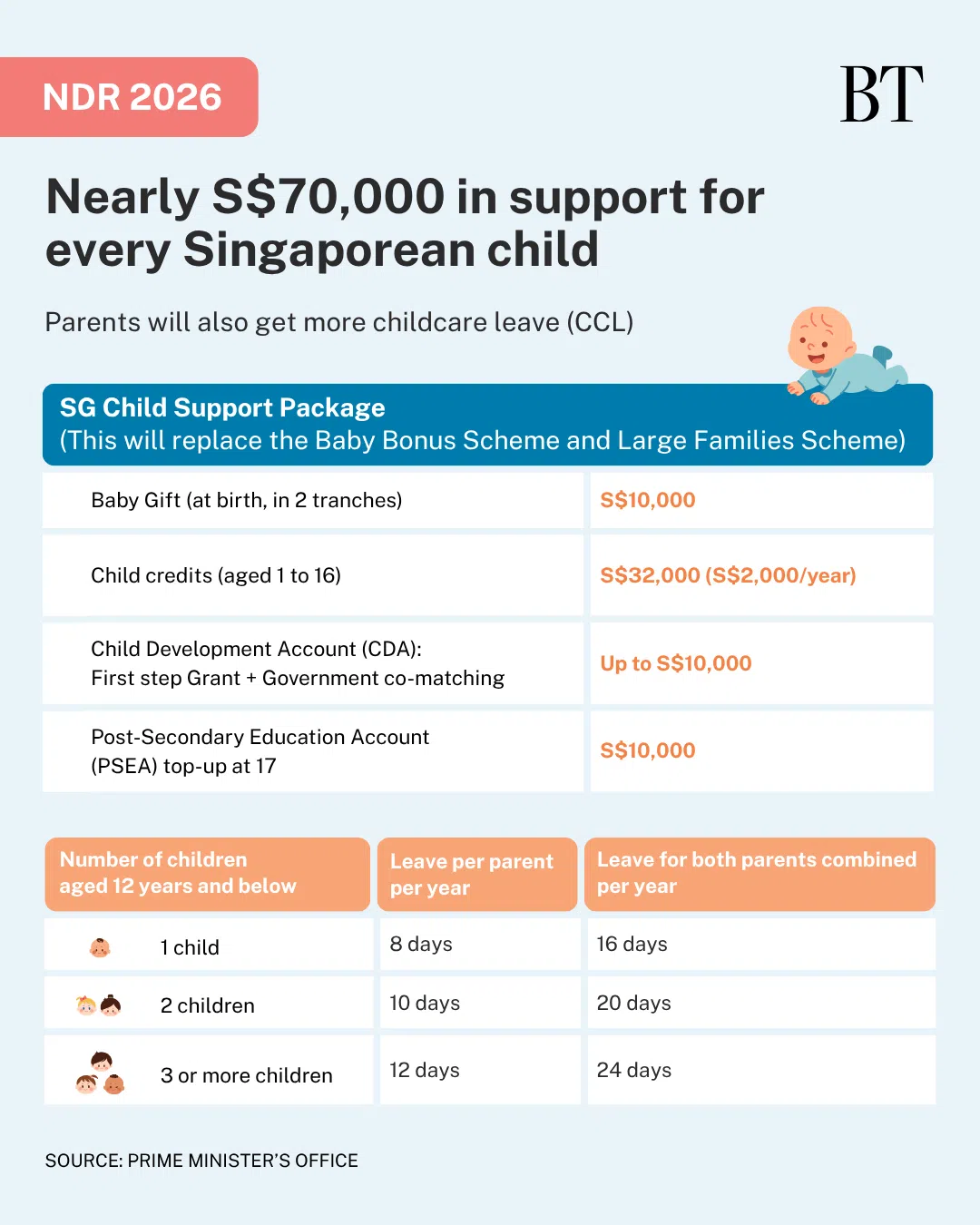
Prime Minister Lawrence Wong announced on Sunday (Aug 23) that full-day fees will be slashed to as low as S$150 a month, as part of a slew of measures to promote parenthood.
With the fee cuts to take place only in steps from 2028 to 2030, several large operators indicated that they are awaiting more information before they can publicly discuss plans.
But Gary Beh, corporate partner at law firm Withers KhattarWong, told The Business Times that the latest measures will likely increase competition and may accelerate consolidation.
“Private operators that lack scale, or a clearly differentiated offering, may increasingly explore mergers, acquisitions or strategic partnerships as a way to remain competitive and achieve greater operational efficiency,” he said.
The big divide
Beh tipped smaller independent operators, founder-led groups and businesses under pressure as potential acquisition targets.
Meanwhile, buyers could include larger chains seeking to expand their footprint, or regional education groups building their presence in Singapore.
Morgane Tomassone, director of independent early childhood operator Adventure Tree Preschool, also expected further consolidation, remarking: “A number of schools have closed over the past few years, and what’s increasingly emerging is a dual model.”
At stake is the business sustainability of independent operators – such as Adventure Tree, which has four branches – that charge higher fees and are not eligible for the enhanced subsidies.
SEE ALSO





Government subsidies apply to infant care and childcare at pre-schools in the Early Childhood Development Agency’s Anchor Operator (AOP) and Partner Operator (POP) schemes, which impose requirements such as monthly fee caps for Singaporean children.
The five operators under the AOP scheme include the PAP Community Foundation’s PCF Sparkletots and the National Trades Union Congress-affiliated My First Skool, while the POP scheme supports 380 centres run by a variety of commercial and not-for-profit outfits.
UOB head of research Suan Teck Kin observed in a recent note that non-partner operators “may face pricing pressure, unless they can differentiate” through premium services.
Said Beh: “Government-supported operators will continue to capture a larger share of families seeking affordable, quality childcare, while premium private operators with a distinctive curriculum, educational philosophy or brand proposition will continue to perform well. The greatest pressure may fall on operators positioned between these segments.”
Finding a niche
While some parents and operators have also called for independent pre-schools to be made more affordable through childcare vouchers or income tax rebates, UOB’s Suan told BT that the AOP and POP model exists “to provide for all Singaporeans, regardless of income”.
At Adventure Tree, where fees range from S$1,700 to $2,200 a month, matching the subsidised rates “simply isn’t realistic for an independent operator like us”, said Tomassone.
But she ruled out joining the POP scheme because of its mandated fee cap, which she sees as a cost barrier on the facilities that her centres would be able to provide.
She preferred to instead compete on factors such as smaller class sizes and a lower teacher-to-child ratio.
On the other hand, Islamic pre-school operator Ilham Child Care, which has two branches, is now considering applying for the POP scheme.
The management noted in an e-mail to BT that the move could assist the school in better offering accessible and affordable childcare services, as its own fee structure already lets families with financial difficulties pay as little as S$5 a month for childcare.
Bigger players in the industry have another strategic advantage in their arsenal: portfolios that include AOP or POP brands, alongside non-partner operator centres.
For instance, Singapore-based EtonHouse International Education Group manages both the anchor operator chain E-Bridge Pre-School and the non-partner brand EtonHouse.
Its spokesperson told BT that the higher subsidies are not expected to exert downward pressure on EtonHouse’s fees or growth, due to parents’ continued strong demand for premium offerings such as full Mandarin immersion programmes or international curricula.
“As the Singapore pre-school landscape evolves, having presence in both the AOP and premium segments positions our group to capture growth across diverse market demographics, while offering parents genuine choice,” she added.
Manpower squeeze
The greater support for parents is also expected to drive up hiring demand – and possibly put upward pressure on wages – in an industry that is already tight on labour supply.
Anarane Thng, senior manager at recruitment company Robert Walters, said that employers will likely try a mix of strategies, including hiring new local graduates, as well as encouraging midcareer individuals to make the switch.
The EtonHouse group is one employer that has already seen more than 60 individuals join through the Career Conversion Programme.
“At the same time, attracting new educators is only part of the equation,” noted Linda Teo, country manager of staffing-solutions provider ManpowerGroup Singapore.
“Retention will remain equally important, as workforce growth becomes more challenging if experienced educators leave the profession as quickly as new entrants are recruited and trained.”
Thng added: “Pre-school operators may need to improve salaries, career progression and working conditions to attract and retain enough educators.”
Yet, Tomassone told BT: “Salaries have risen significantly over the past few years, and we’re not sure that pace of increase is sustainable… at some point, it becomes a question of what the sector and individual operators can sustainably absorb.”
She noted that the early childhood sector has already benefited from sectoral training subsidies, “but any additional manpower-related relief would make a difference” too.
Besides local hires, Ilham Child Care directors Shahidah Ayoob Angullia and Shaik Mohamed Basrawi also suggested looking to neighbouring countries – such as Indonesia – for qualified foreign educators.
These educators “could potentially undergo recognised bridging programmes, qualification assessments, language requirements and Singapore-specific training”, they said.
Decoding Asia newsletter: your guide to navigating Asia in a new global order. Sign up here to get Decoding Asia newsletter. Delivered to your inbox. Free.
Share with us your feedback on BT's products and services
TRENDING NOW

DBS, OCBC, UOB rout lops billions off STI as inflation, rate concerns spook investors

Grab CEO’s wife Chloe Tong on life with Anthony Tan and finding her purpose

OCBC sheds S$8 billion in value as shares close nearly 6% down; analysts cautious on banks

Deal between tycoon friends sparks scrutiny of Philippine power sector

