Rate hikes unlikely despite hot inflation and strong jobs in US: Amundi
Former Fed chair Janet Yellen also does not expect rate increases soon, due to uncertainty over oil prices
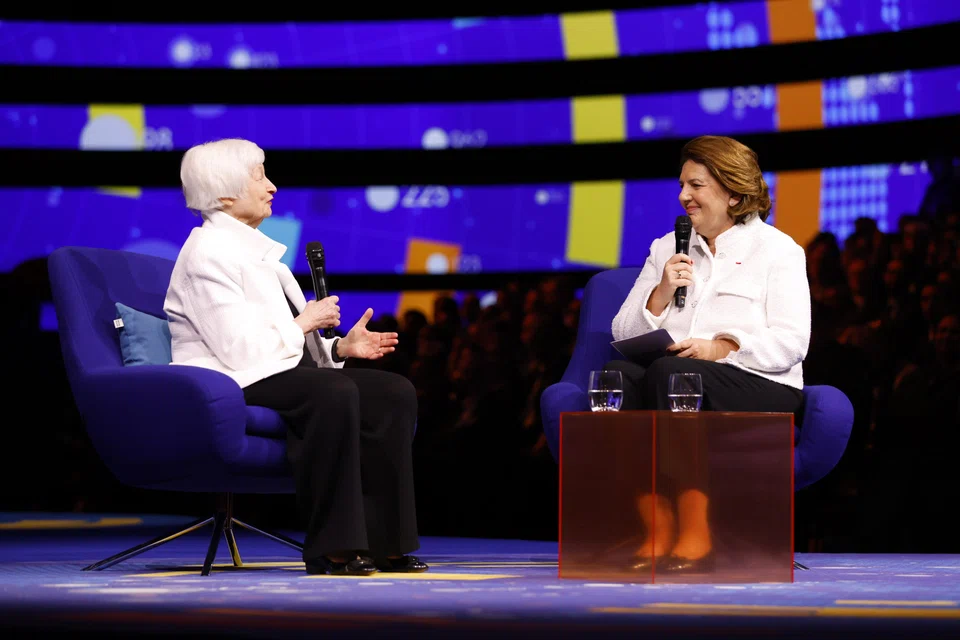
[PARIS] Interest rate hikes in the US might not come in the next few months despite recent overwhelming market consensus that they will, said participants at the Amundi World Investment Forum 2026 on Thursday (Jun 11).
That is contrary to rising expectations and markets pricing in rate hikes this year after jobs data in the US last week topped forecasts. Stocks had fallen after the jobs report.
Janet Yellen, former chairman of the US Federal Reserve, said at the conference: “I would say in the US, I wouldn’t expect an interest rate increase in… the next several months. I think that would be very unlikely, especially with uncertainty about oil.”
US President Donald Trump also said this week there was “no reason” to raise interest rates, saying he “doesn’t want to kill success”, according to media reports.
The European Central Bank on Thursday announced that it will raise rates for the first time since 2023, with the Iran war ramping up energy costs. But Yellen noted that “there is some difference, (in) that growth is somewhat stronger in the US”.
“The outlook is for somewhat stronger growth than in the EU, in the UK, in Japan,” she added.
Amundi representatives at the conference also told The Business Times they do not expect rate hikes, with the Fed holding for at least the second half of 2026, given the uncertainty.
John O’Toole, chief investment officer of multi-asset solutions at Amundi, said: “Markets reacted and began to price in two or three hikes… The reason we’re different is (that) we think that, with all of the uncertainty, you have a reasonable job market, you have inflationary pressures – (but) it’s not that much of a structural inflation problem.
“We think there’s a lot of uncertainty. The US is unlikely to increase rates in the kind of environment that we have.”

Aidan Yao, senior investment strategist (Asia) at the Amundi Investment Institute, noted: “I think over the next six months, what’s going to drive the path of monetary policy is going to be how the US economy copes with the stagflation, inflation moving higher, and potentially (lower) growth momentum.”
He said there can be three scenarios:
1. Rate hike: The economy holds up but with a prolonged inflation shock. 2. Rate cut: Growth is alright, and inflation does not really register or even fall back. 3. Rate cut: Stagflation ends up hurting the economy, and demands a rate cut over the medium term. There is a case for the Fed to ease policy.
But ultimately, he believes that the Fed will hold policy at least over the next two meetings.
“Just the sheer amount of uncertainty prevents (it) from making a decision. As Jerome Powell made the analogy: Making policy in this highly uncertain environment is like driving a car in a foggy night,” said Yao, referring to the former Fed chair, who ended his two-term tenure in May.
Iran war, inflation
Markets are generally also expecting rate hikes due to the Iran war, which is escalating energy costs – and hence, inflation.
Yellen also pointed to the “huge energy shock”, and said that it is uncertain how long elevated inflation will last.
Alongside the oil shock from the Middle East conflict, there is also “massive” investment in artificial intelligence. This pushes up electricity and semiconductor prices, which will likely continue for a while, added Yellen.
Big risks that markets are underestimating
Low interest rates in the past few years have led to rising debt levels, for both sovereign and private debt alike, Yellen pointed out. But with higher rates, there is now a lot of duration risk and refinance risk sitting on balance sheets, she said.
The world was in a zero-rate regime after the Covid pandemic hit, but several central banks have gradually raised rates since then. That includes the US Fed, which raised rates between 2022 and 2024 before a series of cuts last year. In April, it held rates steady.
“I’m particularly worried about financial stability risks from sovereign debt,” she said. “The US is running very large deficits – the largest outside of wartime and outside of a recession… and now interest rates are higher, and the debt burden is no longer at the low level that prevailed.”
Yellen said that there is “no serious discussion” of deficit reduction, which “cannot be done in a painless way”, amid longer-term interest rates that have gone up.
Governments run a deficit when it spends more than it collects in revenue. To cover the gap, it issues Treasury securities and borrows money, therefore creating interest payments which form part of future spending.
The Amundi World Investment Forum is a yearly conference held by French asset manager Amundi in Paris.
Decoding Asia newsletter: your guide to navigating Asia in a new global order. Sign up here to get Decoding Asia newsletter. Delivered to your inbox. Free.
Copyright SPH Media. All rights reserved.