

Singapore core inflation picks up to 2.2% in August; analysts mixed on MAS response
Headline inflation, which includes accommodation and private transport, rises to 2.3%
Annabeth Leow
[SINGAPORE] Central bank watchers remain cautious on the prospect of Singapore tightening monetary policy, as inflation ticked up in August in line with estimates.
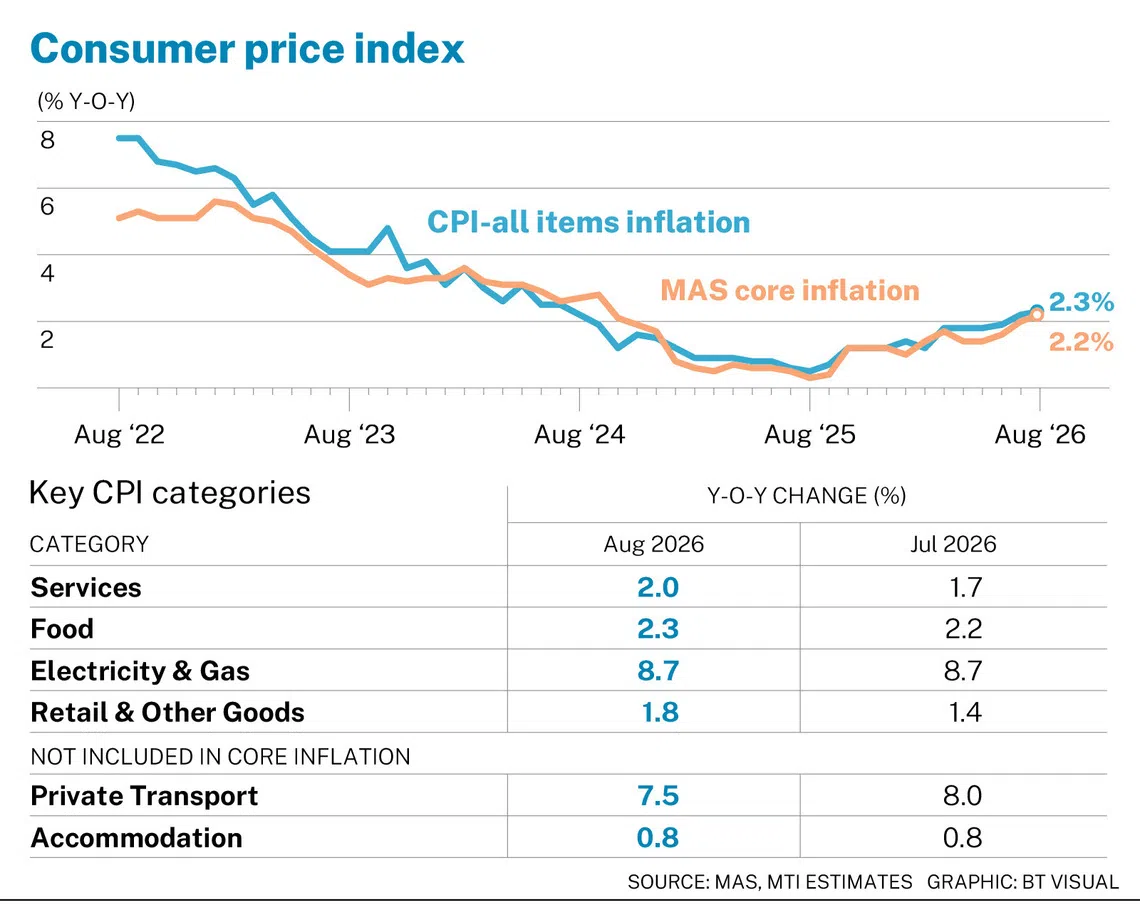
Consumer prices continued their upward creep for the third straight month as core inflation rose to 2.2 per cent, from 2 per cent in July, according to figures released on Wednesday (Sep 23).
Meanwhile, headline inflation – which includes accommodation and private transport costs – hit 2.3 per cent in August, up from 2.2 per cent in the month prior, as the increase in core inflation offset a smaller rise in car prices in the private transport segment.
“On balance, we continue to see simmering price pressures, while growth, despite all the uncertainty, continues to hold up,” Standard Chartered economists Edward Lee and Jonathan Koh wrote in a report.
Though inflation is at its highest in two years, DBS senior economist Chua Han Teng remarked: “Inflation firmed but (was) not accelerating.”
Given the pace of inflation and signs of softness in the labour market, analysts expect the Monetary Authority of Singapore (MAS) to either stand firm at its upcoming monetary policy review in October or tighten only slightly, with the decision a toss-up.
The central bank surprised the market by increasing the rate of appreciation in the Singapore dollar nominal effective exchange rate (S$NEER) policy band in July, after having already adjusted the pace of increase by a larger degree in April.
But Barclays economist Brian Tan said the latest data is likely “more benign than the MAS had expected when it tightened its monetary policy settings in July”.
“The reality that the translation of economic growth to inflation has likely proved to be milder than the MAS expected will likely continue to restrain the central bank from a more aggressive pace of tightening,” he added.


Higher global energy prices have bumped up electricity and gas tariffs and transport fares here, according to MAS and the Ministry of Trade and Industry (MTI).
Chua noted that airline ticket costs surged by 12.9 per cent – the biggest jump in nearly four years – and point-to-point transport prices also went up at a faster clip.
Such increases contributed to the inflation of 2 per cent recorded by the service segment in August, compared with 1.7 per cent a month earlier.
“With broadness of inflation rising, there are signs that the rise in oil prices may be starting to be passed on to consumers,” said StanChart’s Lee and Koh.
Pointing to heightened tensions around the Strait of Hormuz, RHB analysts Barnabas Gan and Laalitha Raveenthar warned that “energy prices remain the clearest upside risk to our inflation outlook”.
They also see food inflation as “an increasing upside risk to consumer prices into 2027”, as the extreme weather phenomenon of El Nino may hit crop production and raise commodity prices.
On the other hand, MAS and MTI predicted that services inflation would be kept in check by enhanced government subsidies, as well as by a slower rise in labour costs on the back of “sustained productivity growth and moderating nominal wage growth”.
In tandem with this outlook, Chua said: “We see restrained demand-pull price pressures amid strong economic growth that has been capital-intensive.”
Though Singapore’s economy has expanded by more than expected in the year to date, the labour market showed signs of continued softness in the second quarter.
MAS and MTI have held to their forecast for both core and headline inflation to average between 1.5 and 2.5 per cent for the full year.
Around the region, consumer prices rose by 1.9 per cent year on year in Malaysia, 2.5 per cent in Thailand, 3.2 per cent in Indonesia and 4.9 per cent in Vietnam.
Still, OCBC economists remarked in a note on Sep 15 that higher oil prices have so far had a limited pass-through effect on consumer prices in South-east Asia.
Interventions such as fuel subsidies and price controls have kept inflation in check, even as they transfer the burden onto fiscal balances and external accounts, the economists noted.
Decoding Asia newsletter: your guide to navigating Asia in a new global order. Sign up here to get Decoding Asia newsletter. Delivered to your inbox. Free.
Share with us your feedback on BT's products and services
TRENDING NOW

Malaysian king buys stake in Singapore-listed mining firm expanding into rare earths

Grab CEO’s wife Chloe Tong on life with Anthony Tan and finding her purpose

Once staunchly pro-China, Malaysian Chinese businesses are now distancing themselves from Beijing

Longer wait times expected as S’pore healthcare institutions report system disruptions

