

Singapore exports beat forecasts with 24.5% April jump; AI demand seen staying strong
Last month’s NODX expansion comes on the back of robust artificial intelligence-related demand

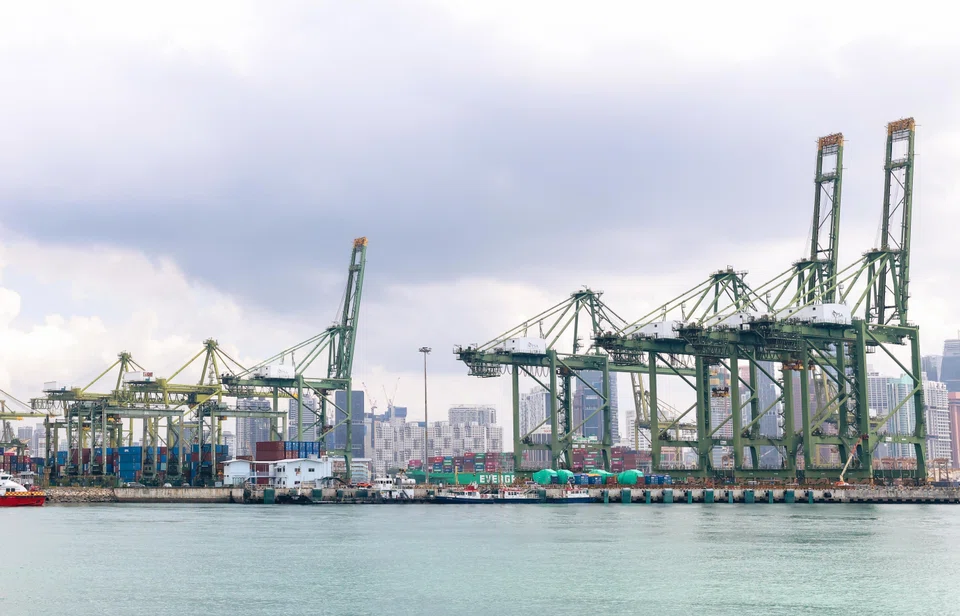
[SINGAPORE] Continued artificial intelligence-related demand is expected to support Singapore’s exports in the near term, economists said, after the Republic’s key exports sharply exceeded forecasts in April.
Non-oil domestic exports (NODX) rose 24.5 per cent year on year in April, more than double the 10.9 per cent growth forecast by private-sector economists in a Bloomberg poll, Enterprise Singapore data showed on Monday (May 18).
The expansion marked the strongest growth since February 2012 and extended March’s 15.3 per cent increase.
OCBC chief economist Selena Ling said Singapore is “highly correlated” to the North Asian semiconductor export cycle, with economies such as South Korea and Taiwan likewise posting strong semiconductor and information and communications technology export growth in April.
She added that aggressive capital expenditure plans from companies such as Nvidia and Broadcom suggested AI-related demand could remain firm.
“As such, NODX is likely to remain a dominant growth engine for the near future,” said Ling, adding that semiconductor and precision engineering-related manufacturing activities in Singapore should continue outperforming.
DBS senior economist Chua Han Teng likewise said that global AI tailwinds and stronger demand for memory chips and server-related products should continue supporting Singapore’s electronics exports in the periods ahead.
However, UOB associate economist Jester Koh said there were emerging signs that the electronics and semiconductor cycle could be approaching a peak, citing moderation in some regional export indicators.
Still, he added that it was still too early to conclude that the upcycle had ended.
Chua warned that non-tech domestic exports could continue facing headwinds from rising costs, supply chain disruptions linked to the Middle East conflict, and lingering uncertainty surrounding US trade policy.
“Although US trade policy uncertainty has eased since Liberation Day, it has not fully dissipated,” he said, noting that the Trump administration was still exploring alternative avenues to impose tariffs.
Separately, April’s non-oil re-exports eased to 29.6 per cent from March’s 60.8 per cent, with growth primarily driven by electronics.
While this “still represented strong growth for now”, Chua said it would be important to monitor whether the moderation signalled the start of a broader downtrend. He added that regional trade could face headwinds from input shortages and rising costs stemming from disruptions linked to the Middle East conflict.
Electronics exports grew 66.7 per cent, easing from March’s 73.9 per cent increase. Disk media products (148.9 per cent), integrated circuits (82.7 per cent) and PCs (35.7 per cent) contributed the most to the expansion.
Meanwhile, non-electronics shipments expanded 10.9 per cent, reversing from March’s 0.6 per cent decline. Categories that drove this growth were pharmaceuticals (97.1 per cent), measuring instruments (60.5 per cent), and specialised machinery (23.6 per cent).
Koh said the sharp rise in pharmaceutical exports “likely reflects some element of front-loading” ahead of planned US tariffs on selected patented pharmaceuticals and related ingredients, which are due to take effect later this year.
Overall, total merchandise trade grew 33.1 per cent year on year in April, down from March’s 38.3 per cent increase. This was as both exports and imports rose.
Performance by market
In April, key exports to all but one of Singapore’s top 10 markets rose.
NODX to Indonesia fell 60.8 per cent year on year, extending the previous month’s 56.8 per cent decline.
In contrast, NODX to all other markets posted growth in April. This was led by South Korea (71.2 per cent), followed by Hong Kong (63.2 per cent), and the US (59.6 per cent).
China, Taiwan and the European Union 27 posted growth of 37.8 per cent, 33.5 per cent and 33.4 per cent, respectively.
This was followed by Malaysia (19.7 per cent), India (13 per cent) and Thailand (11.2 per cent).
Decoding Asia newsletter: your guide to navigating Asia in a new global order. Sign up here to get Decoding Asia newsletter. Delivered to your inbox. Free.
Copyright SPH Media. All rights reserved.
TRENDING NOW

LTA proposes combining car COE categories, adding rebate-surcharge system

StarHub to acquire MyRepublic’s mobile business amid ongoing telco consolidation

DBS, OCBC, UOB rout lops billions off STI as inflation, rate concerns spook investors

Grab CEO’s wife Chloe Tong on life with Anthony Tan and finding her purpose

