

Singapore maintains 2026 growth forecast at 2-4% despite rising downside risks from Iran war
MTI revises Q1 GDP growth upward to 6%; UOB, Maybank raise their full-year forecasts

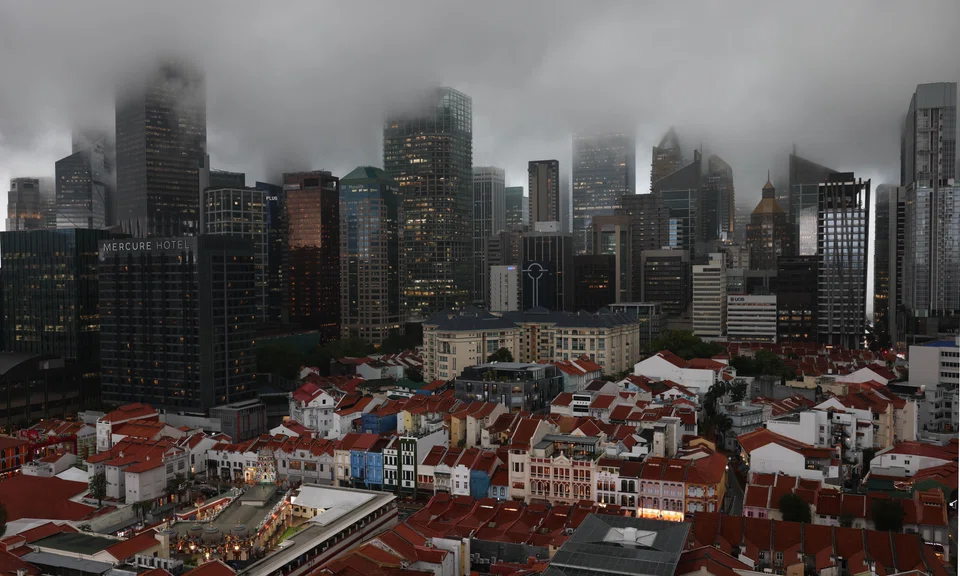
[SINGAPORE] The Ministry of Trade and Industry (MTI) kept its 2026 full-year gross domestic product growth forecast range at 2 to 4 per cent, even as it marked that “downside risks have risen significantly as a result of the US-Israel-Iran conflict”.
This is in view of the Singapore economy’s better-than-expected performance in the first quarter, the ministry said on Monday (May 25) morning. Some private-sector economists raised their own full-year forecasts after the latest release.
Q1 year-on-year growth was revised upward to 6 per cent, from the advance estimate of 4.6 per cent. It was also higher than in the previous quarter, where the economy expanded 5.7 per cent year on year.
The Q1 print marked a six-quarter high, noted Maybank analysts Chua Hak Bin and Brian Lee, who raised their growth forecast to 4.2 per cent for the full year, from 3.4 per cent previously.
UOB associate economist Jester Koh also upgraded his forecast – to 3.2 per cent, from 2.5 per cent. DBS senior economist Chua Han Teng kept his projection at 2.8 per cent.
On a quarter-on-quarter seasonally adjusted basis, the Singapore economy expanded 1 per cent, moderating from the 1.3 per cent growth in Q4 2025.
Weaker environment, rising downsides
MTI previously raised its official forecast from 1 to 3 per cent with the release of Q4 2025 and full-year figures in early February this year, before the start of the conflict.
This was on expectations of sustained strong growth momentum – largely due to the artificial intelligence investment boom – as well as global growth due to expansionary fiscal policies and accommodative global financial conditions.
But the global outlook has since deteriorated, MTI said. Energy and key input supply disruptions due to the Strait of Hormuz blockade have led to cost spikes, driving up inflationary pressures.
SEE ALSO


This is expected to erode real incomes, dampen consumption and tighten global financial conditions, weighing on global economic activity for the rest of the year, said the ministry.
However, it added that AI-related demand has remained robust, and the US tariff outlook remains broadly unchanged, with reciprocal tariff rates expected to be restored.
Downside risks for Singapore have risen significantly, added MTI.
First, if Middle East conflict-related supply disruptions are prolonged and lead to a sustained rise in energy commodity and other key input prices, global growth could slow considerably.
Second, a renewed escalation in US tariff actions could further weigh on business and household sentiments, dampening investment and spending in many economies.
Third, an escalation in risk-off sentiments – where investors turn to lower-risk assets amid uncertainty – or a sudden pullback in global AI-related capital spending “could trigger sharp corrections in global financial markets, with potential spillovers into broader economic activity”, said MTI.
Middle East drags, AI buoys
The outlook has weakened for sectors in Singapore directly dependent on natural gas, crude oil and its derivatives as feedstock, as well as outward-oriented sectors affected by energy commodity shortages and fuel cost increases, said the ministry.
MTI Permanent Secretary Beh Swan Gin said these include manufacturing’s chemicals cluster, wholesale trade’s fuels and chemicals segment, and transportation and storage’s air and water transport segments.
DBS’ Chua said that, despite Singapore’s energy diversification efforts, “there would still be wider indirect negative growth ramifications the longer the choke point is blocked”.
Even if an agreement on the Strait of Hormuz is reached, crude oil and natural gas production facilities will take time to come back on stream, Dr Beh said. “There will continue to be a supply crunch for the foreseeable future.”
Maybank’s duo noted the severe impact on energy-dependent industries, particularly petrochemicals. However, they said related sectors “are being cushioned by the diversion of demand from the Gulf region – including marine shipping and aviation”.
In contrast, MTI said sustained global AI-related capital spending should continue to drive growth for the manufacturing sector’s electronics and precision engineering clusters, with spillovers to the machinery, equipment and supplies segment of wholesale trade.
DBS’ Chua noted that Singapore has benefitted from “robust electronics exports momentum to upstream players such as Taiwan, a major beneficiary and strategic player in the AI supercycle”.
UOB’s Koh highlighted a 202 per cent jump in semiconductor exports in South Korea’s first 20-day exports data for May, confirming AI-related tailwinds. This will likely fully offset Middle East energy and petrochemical-related drags, he said.
Maybank’s Dr Chua and Lee highlighted that US hyperscaler tech firms were ramping up capex guidance further in the latest earnings season, which will drive Singapore’s production and exports of memory chips and server-related products.
Outward-oriented sectors will see a mixed performance, said MTI. Information and communications is expected to benefit from continued enterprise demand for AI-enabled and other digital solutions.
Tighter global financial conditions could drag growth for finance and insurance, though capital inflows amid persistent market volatility could provide some support, added the ministry.
Maybank’s duo and DBS’ Chua also highlighted safe haven inflows into Singapore supporting financial services.
Geopolitics-led volatilty will likely sustain trading interest in Singapore, where the equity market – which is being bolstered by reforms – has experienced a revival since the second half of 2025, DBS’ Chua added.
Meanwhile, in domestically oriented sectors, construction and real estate should remain supported by projects and launches, said MTI. It added that retail trade and F&B services could be weighed down by weaker consumer sentiments, but government support measures should help to cushion the impact.
On balance, taking into account the latest global and domestic economic developments, MTI’s assessment is that the outlook for the Singapore economy in 2026 has weakened since February.
Sectoral performance
Wholesale trade, manufacturing and finance and insurance led growth in Q1, said Dr Beh.
The manufacturing sector expanded by a slower 7.9 per cent year on year, while the wholesale trade sector grew 11.7 per cent, faster than in Q4.
They were supported by robust AI-related demand, Dr Beh said, though he noted that supply disruptions for crude oil and its derivatives affected some segments, such as the chemicals cluster.
He highlighted that growth in the finance and insurance sector (5.7 per cent) was broad-based, with the banking, fund management and security dealing segments putting up steady performances.
Decoding Asia newsletter: your guide to navigating Asia in a new global order. Sign up here to get Decoding Asia newsletter. Delivered to your inbox. Free.
Copyright SPH Media. All rights reserved.
TRENDING NOW

DBS, OCBC, UOB rout lops billions off STI as inflation, rate concerns spook investors

Grab CEO’s wife Chloe Tong on life with Anthony Tan and finding her purpose

OCBC sheds S$8 billion in value as shares close nearly 6% down; analysts cautious on banks

Deal between tycoon friends sparks scrutiny of Philippine power sector

