

Is Singapore ready for inclusive workplaces? ‘I don’t think we are’: HR institute’s chief
The Workplace Fairness Act takes effect by end-2027, with employers and workers urged to start preparing now

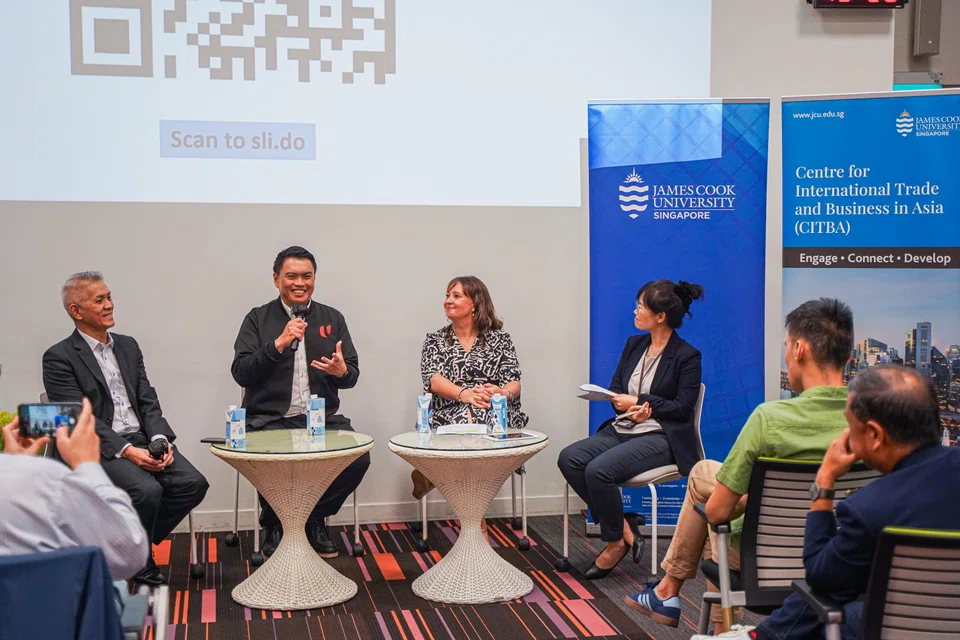
[SINGAPORE] The Republic is not ready for a truly inclusive work environment, even as employers prepare for new workplace fairness laws to take effect by end-2027, said Singapore Human Resources Institute (SHRI) CEO Alvin Goh.
Speaking at a panel discussion on Wednesday (Sep 16) night, Goh pointed to an institute survey which found that just 20 per cent of “people leaders” would speak up openly against discrimination at work, while the remaining 80 per cent would keep quiet rather than go against their employer.
“Are we ready? I don’t think we are ready,” said Goh during James Cook University in Singapore’s The Boardroom Perspective.
The discussion, themed “Fairness at Work: Are We Ready for an Inclusive Work Environment?”, saw Goh discuss the upcoming Workplace Fairness Act (WFA) alongside Patrick Tay, National Trades Union Congress assistant secretary-general, and Joyce Bijl, ManpowerGroup’s business development director for Asia-Pacific and the Middle East.
Bijl said that while Singapore still had “a journey to go”, there had also been progress, including in women’s participation in the workforce.
Nevertheless, Tay pointed out that the number of discrimination complaints was “not that high” relative to the size of Singapore’s workforce.
In response to a parliamentary question filed by Tay in February, the Ministry of Manpower said the Tripartite Alliance for Fair and Progressive Employment Practices received an average of 296 workplace discrimination complaints a year between 2021 and 2025.
Still, Tay – who has lobbied for anti-discrimination laws in Parliament for over a decade – said it was important to take a pre-emptive approach, describing the passing of the WFA last year as a “good step ahead”.
He acknowledged that legislating workplace fairness has been controversial, with employers concerned about additional obligations and compliance costs.


Broadly, the Act protects workers against discrimination based on 11 characteristics – such as age, disabilities and caregiving responsibilities – across the employment life cycle, from recruitment and hiring to promotion and termination.
Sexual orientation is not among the 11 protected characteristics, but remains covered by the Tripartite Guidelines on Fair Employment Practices, Tay said.
He said for a worker to seek recourse under the Act, the discrimination must result in an “adverse employment outcome”, such as not being hired or promoted, or being retrenched.
Given the complexity of the legislation, Tay urged employers and workers to develop at least a working knowledge of the Act before it comes into force.
“There’s still time, but time is ticking,” he said.
Where’s the evidence?
One challenge, Tay said, is that claims reaching the Employment Claims Tribunals will ultimately turn on evidence.
“So proof is very important,” he said, though he questioned the potential implications, including whether it could lead to people recording conversations with each other.
Tay also pointed out that the WFA will include provisions to protect whistle-blowers “for the very first time in the history of Singapore”, which he hopes will encourage aggrieved workers to come forward.
Asked whether the prospect of criminal liability could nevertheless deter whistle-blowers, Tay said it remained to be seen how the new protections would work in practice, though he added that the courts would interpret and take guidance from the protections set out in the legislation.
Goh said SHRI has also submitted a proposal to the tripartite partners for a form of “soft protection” for human resources professionals and leaders who encounter discriminatory practices.
Under the proposal, SHRI could provide independent advice and document when it was sought, creating a record that could later be used as evidence if a dispute reaches the Employment Claims Tribunals.
The proposal is still under discussion, Goh said, with more details to be announced.
Having moral courage
But HR practitioners also need to be willing to speak up when confronted with discriminatory practices, he said.
“We need to have the moral courage to step up and voice out our opinion,” said Goh. “We cannot be an administrative function anymore.”
He also urged HR practitioners and business leaders not to wait for complaints, but to proactively look for patterns within their organisations.
“If a particular line manager seems to only like a particular nationality, or gender, or type of employee, or candidate from a particular university, that is a pattern, isn’t it?”
“We have all the data on hand,” he added. “Is there a pattern to all these possible discriminatory hiring practices, or promotion, or development? Look at all these. Don’t wait for things to happen.”
Tay similarly warned that organisations could be undermined by individual line managers who were unfamiliar with the new requirements, even if their HR teams and senior leaders were well prepared.
In response to a question about age and nationality discrimination in hiring, Tay said these were the two most common grounds for workplace discrimination complaints.
On nationality, he pointed to measures such as the Fair Consideration Framework, job advertising requirements and Complementarity Assessment Framework, which Goh said can flag organisations that show a pattern of hiring people of a particular race or nationality.
Tay said efforts were also needed not just to weed out age discrimination, but to encourage the hiring of older workers, particularly locals.
“You’ll hear more in the coming months on how we talk (about) senior employment,” he said, without giving further details.
The hour-long discussion also touched on the use of artificial intelligence in hiring, unconscious biases that could influence hiring decisions and responsible retrenchment practices.
Retrenchments a last resort
On retrenchments, the panellists urged employers to consider alternatives before letting workers go.
“Get your senior managers and your senior leaders to take a pay cut,” said Goh, who also suggested that companies could redesign jobs to lower costs.
Tay said where it is unavoidable, employers should communicate their plans as early as possible.
While some employers may be reluctant to do so because of concerns over sensitive company information, he noted that even listed companies have communicated layoffs as much as a year in advance, giving affected workers time to prepare through career fairs, coaching and training.
Those that end up in newspaper headlines and on social media, he said, tend to be employers that “never communicate”, or do so only at the last minute or after the retrenchment.
Tay also urged multinational companies to be mindful of local practices and culture when making such decisions.
About 10 per cent of HR practitioners in Singapore are foreigners, he said, and may not be familiar with local practices and the support measures available to workers.
Goh added that employers should also pay attention to workers who remain after a retrenchment.
“Those who have been let go, let them go humanisingly,” he said. “But those who have (been) retained, there’s this thing called survivor’s guilt... Make sure you take care of them as well.”
Decoding Asia newsletter: your guide to navigating Asia in a new global order. Sign up here to get Decoding Asia newsletter. Delivered to your inbox. Free.
Copyright SPH Media. All rights reserved.
TRENDING NOW

DBS, OCBC, UOB rout lops billions off STI as inflation, rate concerns spook investors

Grab CEO’s wife Chloe Tong on life with Anthony Tan and finding her purpose

OCBC sheds S$8 billion in value as shares close nearly 6% down; analysts cautious on banks

Deal between tycoon friends sparks scrutiny of Philippine power sector

