

Singapore's January core inflation hits 10-year high at 2.4%, headline inflation flat at 4%

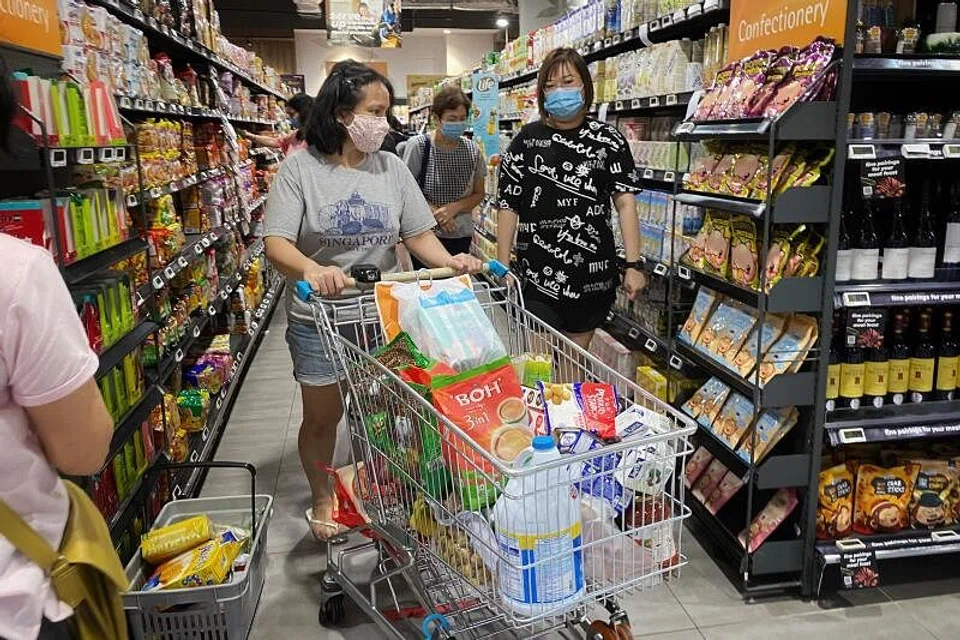
SINGAPORE'S core inflation rose to its highest level in nearly 10 years in January to 2.4 per cent year on year, on the back of rising food and energy prices, according to the Monetary Authority of Singapore (MAS) and the Ministry of Trade and Industry (MTI) on Wednesday (Feb 23).
January's core consumer price index, which excludes accommodation and private transport, comes in higher than December's 2.1 per cent. The last time this indicator hit 2.4 per cent was in September 2012.
"MAS core inflation is forecast to pick up further in the near term, and could reach 3 per cent by the middle of the year before easing in the second half of 2022 as external inflation recedes," the authorities said in a statement.
They added that rising cost of air travel is expected to account for a "significant" part of the increase.
Headline inflation stayed flat at 4 per cent year on year in January, although this is a 9-year high.
MAS and MTI said the unchanged indicator was due to a moderation in private transport inflation that offset higher core and accommodation inflation.
January's numbers have however fallen slightly short of private-sector economists' predictions - of headline inflation at 4.2 per cent and core inflation at 2.5 per cent, according to a Bloomberg poll.
For now, the authorities are keeping to their 2022 forecast of 2-3 per cent for core inflation and 2.5-3.5 per cent for headline inflation.
Last month, they revised their forecast when December's core inflation hit an 8-year high, and the central bank acted swiftly with an off-cycle monetary policy tightening the very next day.
Global inflation could stay high for some time before easing in H2, owing to elevated crude oil prices stemming from heightened geopolitical risks and persistent bottlenecks in global transportation and labour shortages, MAS and MTI said.
Domestically, the authorities expect the labour market to continue to tighten, leading to "strengthened wage pressures" over the course of the year.
Cost increases are likely to filter through to higher services, prices as private consumption picks up, they added.
Electricity and gas prices saw the biggest increase in January, with inflation hitting 17.2 per cent, up from 10.7 per cent in the previous month, due to a steeper increase in electricity and gas tariffs.
Food prices also rose by 2.6 per cent, up from December's 2.1 per cent, reflecting higher inflation for both non-cooked food and prepared meals.
Accommodation inflation inched up to 3.1 per cent in January, from 3 per cent the previous month as a result of a larger increase in housing rents.
Other categories saw falling inflation. Private transport inflation was 14 per cent in January, down from 15.5 per cent due to a smaller increase in car prices.
Services inflation dipped to 2.4 per cent from 2.6 per cent in December. MAS and MTI said this was because inflation for holiday expenses and airfares fell while telecommunication services fees declined more sharply. It added that domestic and household services costs also increased more slowly.
The prices of retail and other goods fell 0.3 per cent, compared with a drop of 0.7 per cent in December. The authorities said this was because the prices of clothing and footwear and personal care products registered smaller declines, while that of medical products and household durables picked up more strongly.
Barclays regional economist Brian Tan noted that the MAS-MTI joint statement appears to have "tilted further towards a hawkish tone" following the off-cycle tightening, and he maintains the view of an upward re-centring of the Singapore dollar nominal effective exchange rate (S$NEER) policy band in April.
He is expecting core inflation to hit 2.4 per cent and for headline inflation to hit 3.4 per cent in 2022.
READ MORE:
- Budget 2022: Economists still see further monetary policy tightening in April despite GST hike delay
- Singapore poised for further recovery in 2022 amid external headwinds, inflation
- Looking back at inflation in 2021
- BT Explains: Inflation and its effects
- BT Explains: The 3 ways that MAS might change exchange rate policy
Decoding Asia newsletter: your guide to navigating Asia in a new global order. Sign up here to get Decoding Asia newsletter. Delivered to your inbox. Free.
Copyright SPH Media. All rights reserved.
TRENDING NOW

MSCI proposes standalone status for Indonesia; Jakarta stocks plunge 8%

Palm oil stocks slide after Singapore begins looking into which firms responsible for haze

High Court rules against Julius Baer’s Singapore trust arm in US$50 million family trust dispute

Why is the haze so bad in South-east Asia this year?

