

Singapore’s revised food targets prioritise scalable, efficient production
Details on support schemes for farmers will be announced at MSE’s upcoming Committee of Supply debate

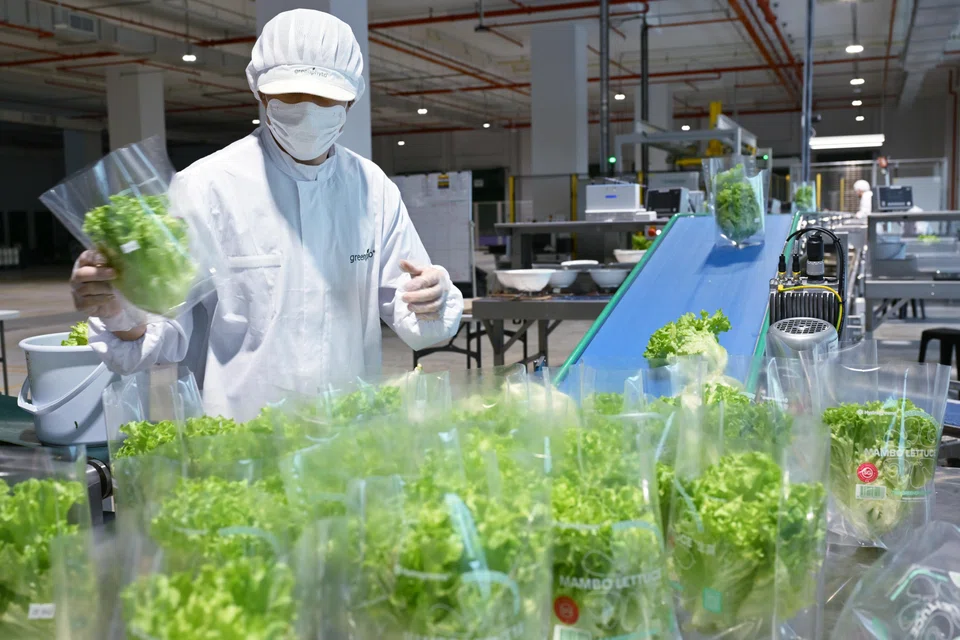
[SINGAPORE] The Republic’s revised food production goals are focused on food types that are “feasible to be produced at scale efficiently”, said Senior Minister of State for Sustainability and the Environment Zaqy Mohamad on Tuesday (Jan 13).
He told Parliament that this approach is reflected in the grants and land tenders that farmers can apply for.
While Zaqy did not cite specific schemes, the Agri-Food Cluster Transformation Fund provides co-funding for local farms to adopt new technologies and upgrade their capabilities.
Meanwhile, information on land tenders on the Singapore Food Agency’s website states that the Republic dedicates less than 1 per cent of its land to agricultural food production, “making it crucial for farms to optimise the use of these limited resources”.
Therefore, scarce agricultural land is awarded to farmers who demonstrate both strong productivity potential and innovative farming concepts.
Hurdles farmers face
Citing higher production costs and demand constraints among the hurdles farmers face, Zaqy said the government will “continue to find ways” to support new and existing farms, including by lowering production costs, building capability, ensuring reliable access to key production supplies and boosting demand for their produce.
More details on support schemes will be announced at the Ministry of Sustainability and the Environment’s (MSE) upcoming Committee of Supply debate, typically held in March after the Budget statement on Feb 12, he said.
Zaqy was responding to Members of Parliament who asked how the revised fibre and protein targets compare with the previous 30-by-30 goal, and how they fit into Singapore’s broader approach to food security.
In November, Singapore replaced its original target of producing 30 per cent of its nutritional needs – including fish, eggs and vegetables – by 2030.
SEE ALSO

Under the new framework, the Republic aims to produce 20 per cent of its fibre consumption by 2035 – covering leafy and fruited vegetables, bean sprouts and mushrooms – and 30 per cent of its consumption of eggs and seafood by the same year.
Zaqy said the revised targets take into account the role of local farms as a regenerative and assured source of fresh food, as well as the strengths of Singapore’s farming ecosystem and its potential for growth.
Protein types such as meats are not part of the revised targets due to factors such as resource efficiency, land intensity and climate conditions, while alternative protein is excluded because of the “nascency of the sector”, he said.
Food items that Singapore does not plan to produce locally, including rice and poultry, will instead be secured through import diversification and stockpiling under the Singapore Food Story 2 framework.
“The revised targets balance ambition with pragmatism, by considering what we can produce and scale locally as well as the challenges our nascent sector faces,” said Zaqy.
Collective effort
However, he stressed that food security is a “joint responsibility that requires the nation’s collective effort”, adding that strong support from local consumers and businesses is needed for farms to achieve scale and commercial viability.
Citing local farms’ disadvantage against cheaper imports, Workers’ Party MP Kenneth Tiong (Aljunied GRC) asked whether the government would consider a “modest” 1 per cent local-sourcing quota for major retailers and food operators.
In response, Zaqy said that “as a principle, we go with free market principles”, adding that it would not be in the interests of consumers or the government to fund or subsidise food products – just as it does not do so for energy or petrol.
Nevertheless, he added that the government helps connect farmers with retailers, hoteliers and restaurant caterers through organisations such as the Singapore Agro-Food Enterprises Federation.
“We hope that (by) helping our businesses build new capabilities, improve yields, lower their cost of production… (it) helps them be more competitive in the market. And I hope that our consumers (will) be able to discern the advantages of supporting local and buying local,” he said.
Decoding Asia newsletter: your guide to navigating Asia in a new global order. Sign up here to get Decoding Asia newsletter. Delivered to your inbox. Free.
Copyright SPH Media. All rights reserved.
TRENDING NOW

ComfortDelGro appoints two new independent directors

Once staunchly pro-China, Malaysian Chinese businesses are now distancing themselves from Beijing

NoonTalk needs continued financial support from CEO Dasmond Koh, auditors warn

DP Architects sets the benchmark for sustainability disclosure and design

