Tharman, IMF chief warn of structural risks from global public debt
Singapore’s president says AI-driven growth may not be the solution to high debt-to-GDP ratios

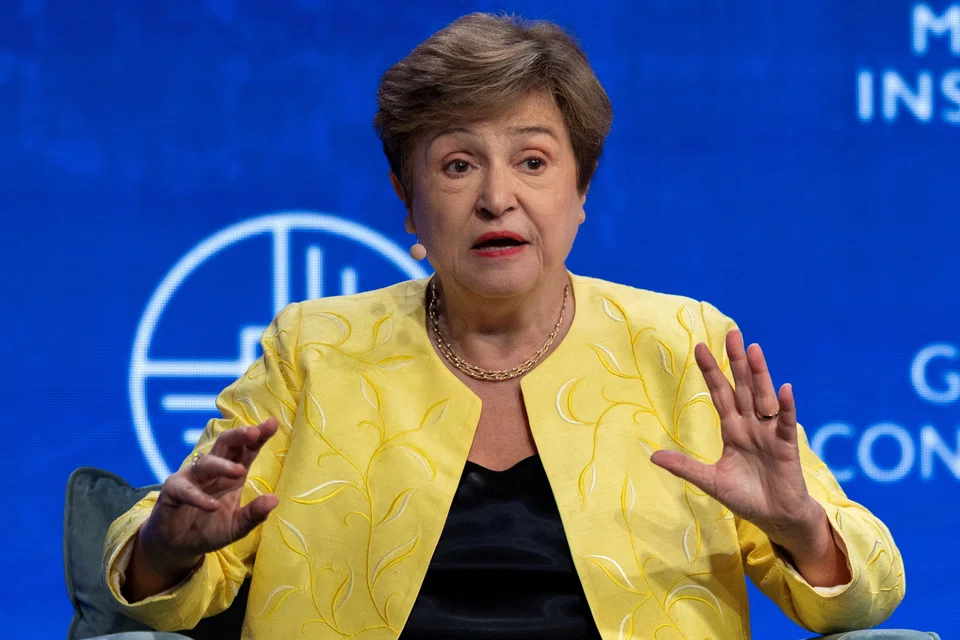
[SINGAPORE] Governments around the world are facing mounting pressure to rein in debt as higher borrowing costs leave them with less room to respond to future crises.
This was the message from President Tharman Shanmugaratnam and Kristalina Georgieva, managing director of the International Monetary Fund (IMF), in a fireside chat held at the Lee Kuan Yew School of Public Policy on Wednesday (Oct 7).
Both leaders warned that the global economy has entered a more difficult fiscal environment, in which governments can no longer assume that economic growth will comfortably outrun the cost of servicing their debts.
Fiscal risks
Georgieva, who has led the IMF since 2019, had earlier said in an opening speech that excessive fiscal deficits, record public debt and high debt-servicing costs were becoming increasingly difficult to manage as interest rates remain elevated.
“Global public debt is near its highest levels since World War II, and is on track to soon exceed 100 per cent of gross domestic product,” she noted.
At the same time, benchmark borrowing costs have risen sharply, with 10-year sovereign yields in the US, Germany and Japan at their highest levels in decades.
Developed economies have been the “worst offenders” with generally higher debt-to-GDP ratios than emerging and lower-income economies, she noted.
Tharman, who chaired the IMF’s International Monetary and Financial Committee between 2011 and 2014, said addressing larger fiscal deficits has become more structural than cyclical, with policymakers increasingly turning to debt to cushion shocks.
Such high deficits are particularly prevalent among “the largest and most systemically important economies”, where polarised electorates have pressured political leaders to avoid unpopular fiscal decisions, he said.

“Leaders in the affected countries are not going to (make these decisions) until they have no choice,” he added.
Both leaders also flagged the risk of fiscal dominance, which is when a government’s fiscal pressures dictate a country’s monetary policy.
Noting that many governments are now starting from a position of large fiscal deficits and very high debts, Tharman warned that central banks may be forced to ease monetary policy in a recession or an AI-induced shock, as governments lack the ability to intervene.
“Their ability to deal with future crises is now much more constrained,” he said.
Georgieva warned against “monetary cowboys running to the rescue of the fiscal agents” in such a scenario, adding that central banks should focus on ensuring price stability instead.
AI not a cure-all
The AI boom has brought with it surges in investment in the global economies, with infrastructure build-outs and hardware demand driving growth and trade.
But Georgieva cautioned that the boom could also push up borrowing costs. Rising long-term private bond issuance is competing with governments for savings, while expectations of faster AI-driven growth may also be contributing to higher core yields.
Tharman also warned against overestimating the potential for AI-driven economic growth to alleviate pressures from rising public debt.
“Future growth may not mean future government revenue growth,” said Tharman.
He emphasised that the global AI boom may result in a structural distribution of income that leans towards capital over labour – meaning that governments that are more dependent on taxes from employment income could see their revenues grow slower than GDP.
This makes the fiscal challenge more structural than simply hoping faster growth will reduce debt ratios, he added.
The fireside chat in Singapore was organised ahead of an annual series of meetings between the IMF and the World Bank, to be held in Bangkok from Oct 12 to 18.
Decoding Asia newsletter: your guide to navigating Asia in a new global order. Sign up here to get Decoding Asia newsletter. Delivered to your inbox. Free.
Copyright SPH Media. All rights reserved.