From finance aspirant to Asean CEO: TUV SUD’s Jonas Strahberger on finding people who believe in you
The 40-year-old talks investing for the long term – in new technologies, businesses and, most importantly, people
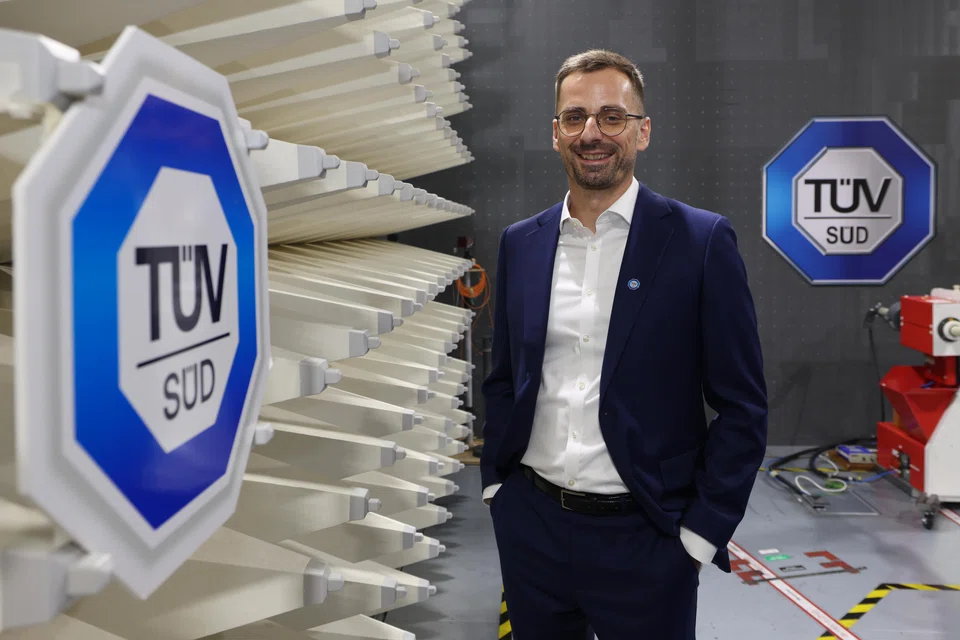
[SINGAPORE] A career at a global testing and certification organisation was not on the cards for Jonas Strahberger when he was a student, much less the one where he is its Asean CEO.
Fresh out of high school, Strahberger, who grew up in the small Bavarian town of Landshut, completed an apprenticeship as a bank clerk and went on to work part time at the Munich Stock Exchange while studying.
“I was very much on the finance track… I wanted to become a trader, or work in risk management for banks,” said the 40-year-old. “So that was on my mind back then.”
But while he was studying management and technology at the Technical University of Munich, Strahberger learned about Singapore.
“I was interested in what I heard,” said Strahberger. “I liked the intensity, the hunger of the people, and that it requires that you to be super adaptive in what you do individually as well as professionally.”
That interest began a search for an internship within the Republic that eventually led him to TUV SUD’s Singapore office in 2013 – an experience that would change the course of his career.
Reflecting on what changed his mind, he said: “It was the people who showed an interest in me as a person, and in growing me further.”
No pressure
After returning to Munich in 2014, Strahberger took on a series of roles within TUV SUD, including in corporate strategy and innovation, before eventually leading a global business unit.
Today, Strahberger has come a long way from the fresh-faced intern. In January 2025, he took on the role of TUV SUD’s Asean CEO, which saw him returning to the Republic.
Despite being relatively young for a CEO, Strahberger said he does not feel weighed down by the pressure of the title.
He attributed this partly to the support of his colleagues, as well as having taken on a new role within TUV SUD every three to four years – each with increasing responsibility.
“I have not grown up in one domain only,” he said. “I’ve seen (our) business from various different perspectives… and that certainly helps me to understand what we are doing here.”
Navigating Asean
Strahberger described TUV SUD’s Asean operations as a “mini version” of the wider group, spanning six very different markets: Singapore, Malaysia, Thailand, the Philippines, Indonesia and Vietnam.
Unlike the European Union, each has its own laws, regulations, languages and cultures. “There is no one-size-fits-all approach for this region… you have to be locally present,” he said.
That means not only travelling frequently to “be with the people”, but relying heavily on local employees who understand the regulations and customers in their respective markets.
Through his interactions in the region, Strahberger has observed two major forces driving opportunities in the region.
Sustained investments in education and infrastructure in countries such as Vietnam, Malaysia and Indonesia have created a more favourable environment for investment, he said.
At the same time, he sees South-east Asia as one of relatively few “neutral places” in an increasingly polarised world.
“So you have a lot of foreign direct investment now, a lot of manufacturing and production capacity is being built up, and I think that’s driving (progress in) South-east Asia tremendously,” he said.
Choosing where to invest
Asked how he decides which new business opportunities are worth investing in, Strahberger said an investment decision cannot be made on an Excel spreadsheet alone.
It also depends on what TUV SUD hears from its customers and technical experts, as well as “a certain sense of gut feeling”.
One example is the recent launch of its S$30 million decarbonisation centre in Singapore to help companies measure and verify emissions and other carbon data.
While sustainability-related topics have become less prominent in recent years, Strahberger does not believe the agenda has been deprioritised, describing the current mood instead as more of a “wait-and-see” approach.
Investors are more cautious about large projects such as wind parks, photovoltaics and hydrogen, he said, but the direction of travel has not changed.
“Sustainability is going to be an integrated expectation of the supply chain going forward, just as quality became an expectation more than 50 years ago, and safety did later,” he said.
Artificial intelligence is another area where Strahberger sees opportunities emerging, particularly as adaptive systems pose new challenges for testing and certification.
Unlike conventional products that can be assessed at a point in time, AI systems can continue to learn and change, potentially requiring a shift towards continuous monitoring to ensure they remain safe and within defined boundaries.
TUV SUD is already testing AI systems embedded in some products, mainly medical devices, he said.
Such investments reflect what Strahberger described as TUV SUD’s longer-term approach to business. While the firm needs to be profitable, he noted that its owners, TUV SUD e.V. and the TUV SUD Foundation, are non-profit organisations.
“The nice part about it is that (it allows us) to invest the profits back into ourselves,” said Strahberger, citing assets, infrastructure and people as examples.
This includes specialist training, with auditors in high-risk fields such as medical devices requiring around six months of training every two to three years, during which they are not productive.
Not the obvious choice
That willingness to invest in people is something Strahberger believes young jobseekers should look for when choosing where to build their careers – particularly as the “most obvious decision… is probably not the best one”.
While people may gravitate towards big brands, Strahberger said his own experience has taught him to look instead for organisations where bosses, colleagues and peers “have an interest in growing you as a person, as a professional”.
“Compensation, yes. Brand, yes. How it adds to your CV, yes,” he said. “But more importantly, do you have people in this organisation who believe in you and who want to grow you?”
Three questions with Jonas Strahberger, CEO of TUV SUD Asean
Q: Was there a pivotal moment in your career or personal life that changed your approach to leadership?
There was no one moment which fundamentally changed anything.
My approach to leadership is that it is not a sprint. It is more like a marathon.
It is a continuous learning journey where you gain more experience, you get more exposed, you get more visibility, you get more responsibility. And you grow with that. And that is still the case for me today.
Q: What is one piece of “unconventional wisdom” you swear by, but which most business schools would tell you is wrong?
If you attend management training, they would teach you that it is a lot about optimising existing processes, operational excellence, utilising assets and people. I think that is true to some extent.
But imagine you are utilising your resources to 100 per cent. From a business school perspective, that would be the optimal. But you lose all curiosity, all openness. People don’t have time to spend on innovation, on listening to the customer, on being close to the market.
Some unconventional advice: yes, productivity and operational excellence are necessary, but they optimise the past. Existing business is yesterday’s business. In a world which is changing faster and faster, where more adaptability is required, you need to give space for people to stay curious.
I honestly believe the best sort of innovations and ideas come from the bottom up. If you take the example of AI as a tool to enhance your productivity, there are two ways to approach it.
One is, you can impose from top down and set up a programme to adopt it. The other way would be from the bottom up, to empower everyone to use it or to use certain tools for increasing their productivity, and then encourage them to come up with a few smart ideas that can scale.
I believe in the second approach, but you have to empower them through tools, processes and systems and at the same time, give them the space and the freedom to do so.
Q: When you feel burnout creeping in, what is your non-business-related “panic button” activity or routine that reliably resets your focus?
I would go out into nature to clear my mind, either with my family or just for a casual run on my own.
I also swim every morning, which is something I couldn’t do in Germany, so it is super nice.
When I was still living in Germany, I was doing a lot of mountaineering, which is not possible in Singapore. But there are places like Dairy Farm and Bukit Timah, which are very green parts of the city.
I think being on the move is something which clears my mind on a daily basis. Over the weekends, I also enjoy exploring and trying out new places. There are so many in Singapore.
TRENDING NOW
Grab CEO’s wife Chloe Tong on life with Anthony Tan and finding her purpose
Can Mark Shaw bring Singapore back to Orchard Road and the movies?
Ex-Sembcorp Marine CEO Wong Weng Sun acquitted of charges in Brazil corruption case
‘Under human control’: Xi urges AI safeguards at White House summit as Trump resists curbs