Fuel cost spike, choked supply squeeze Singapore’s booming construction sector
Worsening Middle East conflict and recurrent labour shortages are driving up materials, fuel and crane operator costs

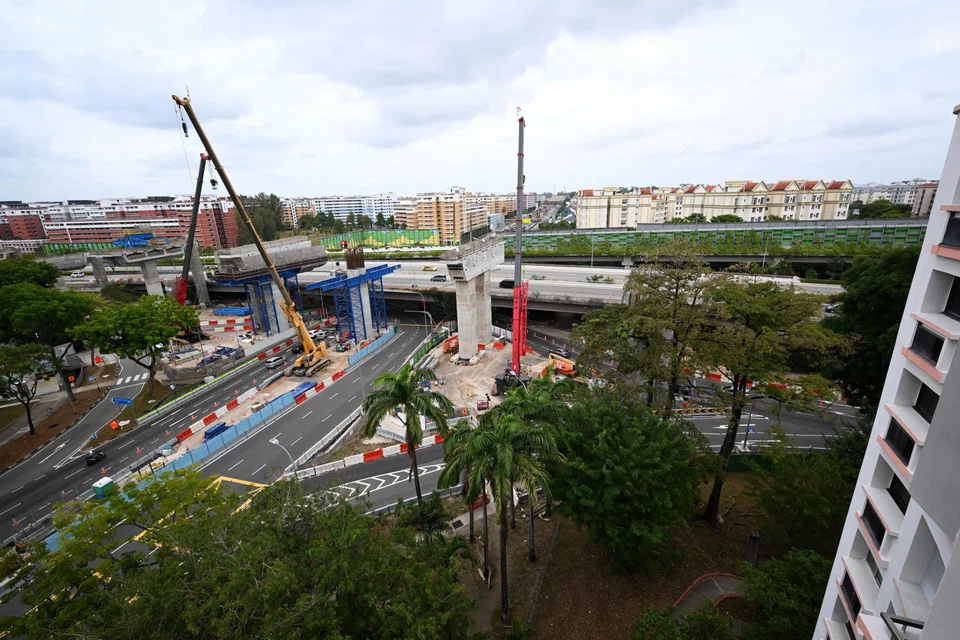
[SINGAPORE] Rising energy prices and freight disruptions are ratcheting up cost pressures in Singapore’s construction sector, which is already stretched by manpower shortages and a packed project pipeline.
With global shipping routes disrupted and oil prices swinging wildly as conflict escalates in the Middle East, materials costs are climbing while fuel prices shoot up.
The Singapore Contractors Association Limited (SCAL) noted that prices of construction materials have risen by 5 to 15 per cent or more.
Diesel prices have surged 155 per cent to S$2.30 a litre since February, before the war broke out. (*See amendment note)
Indirect costs from services, transportation and materials such as concrete, cement, aluminium and copper have also increased. Some transport and machinery companies are now expecting losses of up to S$1 million a month, said SCAL.
Scott Halyday, regional director for South-east Asia at construction consultancy Linesight, said that the conflict has increased war-risk insurance, freight rates and bunker fuel costs, disrupting logistics around chokepoints at the Strait of Hormuz and the Red Sea.
“These disruptions tighten global shipping capacity and add risk premiums to energy markets,” he added.
Kenneth Goh, UOB Kay Hian’s director of private wealth management, said the strait carries about 20 million barrels of oil per day – more than a quarter of global seaborne oil trade. Its partial closure has sent oil prices soaring.
OCBC commodity strategist Sim Moh Siong expects oil prices to remain elevated, after they climbed to US$100 per barrel from around US$69 per barrel before the conflict. He expects prices to ease to US$82 per barrel only by the year’s end, and to around US$70 per barrel in early 2027.
Goh said: “Any sustained disruption feeds into steel, cement and concrete prices across Asia.”
For an import-dependent construction market such as Singapore, Halyday said, these pressures are likely to translate into higher steel prices and potential delays or localised shortages.
Historically, such dynamics have had a major impact on costs. During the energy price spike in the first half of 2022, fuel-intensive materials such as steel rebar rose as much as 37 per cent above 2021 levels.
“However, the impact on steel may be softer this time,” said Halyday. “Global oversupply and weaker demand are acting as a buffer, unlike during the Russia-Ukraine conflict. The scale of any further movement will depend on fuel costs and the extent of the current conflict. Conditions remain volatile.”
Cost pressures
Contractors are already feeling the squeeze.
UOB Kay Hian’s Goh said public-sector contracts in Singapore offer some protection through cost fluctuation provisions in the Public Sector Standard Conditions of Contract. “But private fixed-price contracts signed before this escalation have none, and margin compression is already showing up in recent published results.”
Shekhar Jaiswal, RHB Singapore equity research head, said the ability to pass on rising costs depends on a contractor’s mix of public and private-sector projects, and when the contracts were signed.
“The smaller contractors with thinner balance sheets will absorb more,” he said. “Larger, more capable contractors with strong client relationships are better positioned to seek formal accommodation.”
These larger contractors would also have strong pricing power to pass on costs to customers, said Heidi Mo, an investment research analyst at UOB Kay Hian.
Derek Tan, DBS Group Research head of regional property research, said material suppliers such as Hong Leong Asia , Pan-United and those in the purpose-built workers accommodation sector are less likely to be affected, as they can most likely pass on the costs to customers.
Jaiswal added that the biggest – and underappreciated – risk is domestic manpower pressure.
“Rapid concurrent launches of large-scale projects across Singapore can create acute demand for skilled labour at a time when supply is constrained,” he said. “Subcontract pricing could see a rise, and this could compound into project delays that are more damaging to margins than any single materials cost spike.”
Tight crane market
The combination of rising costs and labour constraints is exacerbating an already tight operating environment.
Operators told The Business Times that demand for crane operators has risen significantly over the past five years, driven by major infrastructure projects such as Changi Airport Terminal 5 and the Marina Bay Sands expansion.
The Singapore Crane Association said demand for cranes – especially mobile cranes – has grown, with rental rates rising up to 10 per cent, though increases have been gradual due to tight competition.
Service providers such as Hiap Tong and Tiong Woon similarly reported accelerated demand starting from the latter half of 2024 and 2025, which has carried into 2026.
The most commonly deployed units remain mobile cranes of 100 tonnes or less, and tower cranes of 30 tonnes and below, said Tiong Woon. “These segments remain competitively priced, supported by steady market supply and utilisation levels.”
Crane operator costs have consequently surged 30 to 50 per cent, depending on the crane type, an industry insider said.
But stronger demand and higher rental rates have not necessarily boosted margins for service providers.
Tiong Woon said that while rental rates “may adjust in response to supply-demand dynamics, rising operating costs, project scheduling overlaps (and) competition in the market remain active”.
Hiap Tong said the primary bottleneck is now skilled manpower, with shortages of certified operators and specialised technicians driving up labour costs.
There are also stricter safety and compliance requirements, which have largely neutralised any gains from higher rental rates, it added. “As a result, while our revenue is growing, our gross margins have remained relatively stable as we balance higher top-line demand against the rising cost of labour and specialised maintenance.”
Alan Chan, chairman of the Singapore Crane Association, pointed to an ageing workforce as well as limited local interest in the profession, which is perceived as physically demanding with higher risks and longer working hours.
“It’s natural in our industry,” he said. “Our image is not as positive... With (a more educated workforce) and more options like being a Grab driver, younger workers would prefer doing that over being a crane operator.”
At the same time, Chan added, certification requirements and the need for at least five years of experience to participate in public-sector contracts limit the speed at which new operators can be deployed.
The Building and Construction Authority (BCA) has relaxed the licence registration of foreign crane operators since 2007. This allows employers to recruit foreign crane operators with prior experience in Singapore to help the built environment sector better manage manpower constraints.
Chan said such measures help, but the industry cannot depend on foreign labour forever.
He highlighted current efforts to attract more workers, such as job fairs and outreach programmes showcasing the sector’s technology and safety improvements.
Tiong Woon has also implemented structured crane specialist development programmes to address the labour shortage.
“However, in Singapore’s context, the overall talent pool remains limited,” it said. “While short-term surges in demand can intensify shortages, over the medium to long term, it remains primarily a supply-side challenge.”
Despite the headwinds, analysts remain positive on the sector, which is being supported by a robust project pipeline. The BCA projects construction demand of between S$47 billion and S$53 billion for 2026.
Mo of UOB Kay Hian noted that contract sizes are significantly larger than pre-Covid levels, which could help offset higher fuel and raw material costs. “I think this reflects the defensiveness of the sector.”
Goh added: “Revenue visibility is (also) solid. The question is earnings quality rather than top line.”
Additional reporting by Chong Xin Wei
*Amendment note: SCAL has clarified that diesel prices rose by 155 per cent, not 255 per cent.