

Global trends bring growth for S-E Asia if it can overcome risks from AI, trade tensions
Asean may need to move faster in an age of rapid technological and geopolitical shifts, say panellists and ex-DPM Heng Swee Keat

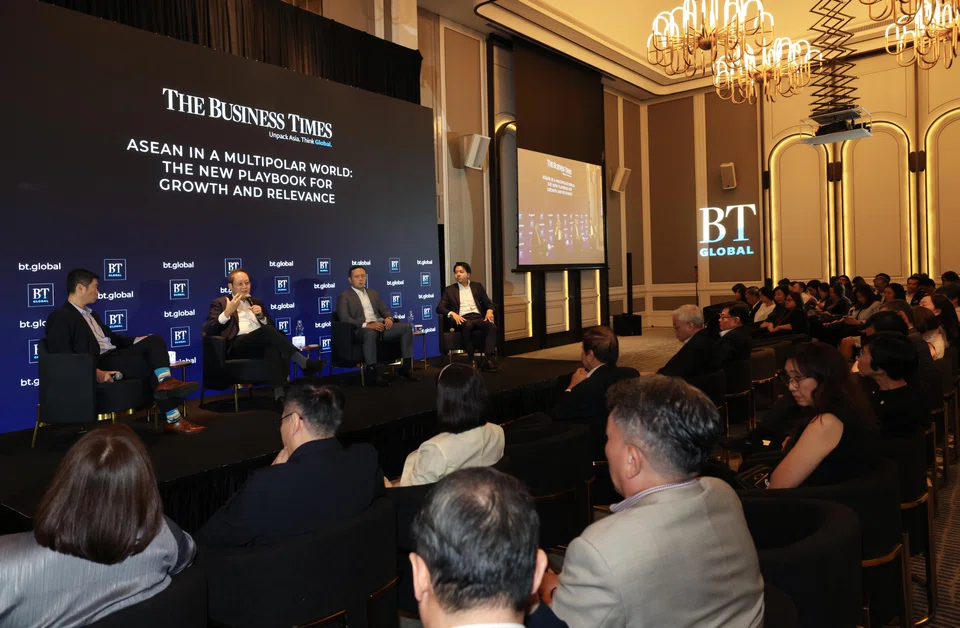
[SINGAPORE] Amid an uncertain global environment and fast-moving technological trends, South-east Asia’s businesses will need to capture opportunities in the region by riding on, rather than resisting change.
These were noted by panellists during the official launch of The Business Times Global on Monday (Jan 26).
Speaking on the panel, Singapore’s Minister for Manpower and Minister-in-charge of Energy and Science & Technology Tan See Leng said that geopolitical shifts will continue to force the region’s businesses to adapt quickly.
As these shifts, such as trade tensions between the US and China, threaten supply chains and cross-border businesses, Dr Tan said that businesses will need to build resilience through diversification.
“Markets keep changing, and not every business can turn on a dime,” said Dr Tan.
Such resilience can be built by giving oneself greater flexibility to choose between key business linkages, including in supply chains or target markets, he noted.
“If one area has a lot of friction, you have alternatives,” he said.
This was echoed by Edward Tirtanata, chief executive officer and co-founder of Indonesian coffee chain Kopi Kenangan, who noted that the company has opted for diversification within its operations – from cloud service providers to coffee suppliers – as global uncertainties mount.
Moderated by Kuek Yu Chuang, deputy CEO of SPH Media, the panel expressed optimism over South-east Asia’s growth potential, and towards regional businesses in broadening their cross-border reach.

Korawad Chearavanont, founder and executive chairman of enterprise tech firm Amity, said that given the region’s reputation for neutrality and openness to business, partners from across the globe have tended to be receptive to cooperation amid trade tensions.
He added that South-east Asia’s deep talent pools in the tech space have also been critical to enable Amity to expand globally.
“There’s so much opportunity for South-east Asian tech to go out there,” he said.
AI transformations
At the same time, such technological transformations, especially through artificial intelligence (AI), have the potential to disrupt jobs – but also to enhance their efficiency, noted Tirtanata.
He added that Kopi Kenangan uses AI to screen the resumes of potential hires, while employees can also use the technology to analyse financial information – even those who have not completed higher education.
Korawad noted that many fields continue to face difficulty in using AI systems in place of human workers, indicating that workforces can still work towards using the technology to complement humans – rather than replace them altogether.
For instance, Amity’s AI-powered voice bots are used to make 10 to 12 million calls a day, but remain unable to replace nurses in the healthcare sector making appointments over the phone.
“It turned out to be a lot more difficult than we thought to use in the hospitals,” said Korawad.
“This gives us time to adapt our workforces and to really learn how to improve productivity with AI,” he said.

Dr Tan said that rather than fear trends such as AI, regional firms will need to adapt and respond to changes to capture growth opportunities.
“I think that legacy companies who don’t want to innovate and transform will enter the sunset phase,” he said. “Such is the nature of all business.”
He acknowledged that regional authorities are continuing to support their economies through these transformative changes – whether through partnerships such as Asean’s Digital Economy Framework Agreement or by upgrading existing free trade agreements.
Building adaptation resilience to these changes, however, remains equally important, he noted.
Even so, both Amity’s Korawad and Kopi Kenangan’s Tirtanata said that they had faced challenges from the region’s lack of harmonised regulations in key areas.
The founders added that as a result, it was sometimes easier to expand to countries outside Asean than within it.
“Regulations like the Indonesian halal certification is not recognised in Malaysia, or vice versa,” said Tirtanata.
Meanwhile Korawad said that standards in legal contracts or data privacy regulations across South-east Asian borders can often limit Amity’s ability to do business internationally.
“We find that we can’t use one data set across borders,” he said. “We create one model in Thailand and we cannot actually use it in Singapore.”
Among the attendees was former deputy prime minister of Singapore Heng Swee Keat, who commented that Asean’s cooperation on such issues tends to move slowly.
However, the speed at which global trends move could prove costly for the region’s economies if Asean does not keep pace with these changes, said Heng.
“There is a risk of moving too slowly,” he said. “In this age of AI and robotics where people are concerned about jobs and transformation, Asean needs to move a lot faster.”
Decoding Asia newsletter: your guide to navigating Asia in a new global order. Sign up here to get Decoding Asia newsletter. Delivered to your inbox. Free.
Copyright SPH Media. All rights reserved.
TRENDING NOW

Government to bring forward raising of retirement age, give employers more financial support to create flexi-load jobs

If Europe goes to war, the fallout will be felt in East Asia

Indonesia stocks suffer worst plunge in nearly 30 years as MSCI proposes standalone status

Vietnam’s northern provinces, not Hanoi or Ho Chi Minh City, are powering near 10% GDP growth

