

Grab launches initiative to provide more support for its women partners in Singapore
Its co-authored study also reveals a total addressable market of 40.7 million women willing to work as driver-partners in South-east Asia

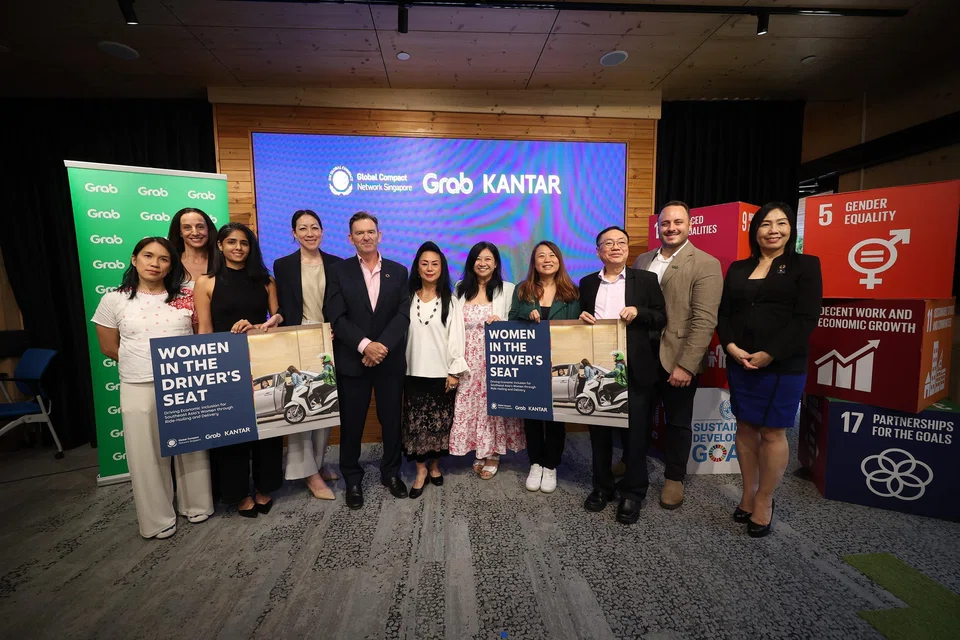
[SINGAPORE] South-east Asian superapp Grab on Tuesday (Mar 24) announced that it is rolling out a holistic support programme for its community of women partners.
This is alongside the launch of a report it co-authored with the United Nations Global Compact Network Singapore and Kantar, which found that working mothers in the region face difficulties in juggling work with family responsibilities.
Named #MoreWomenCan, the new initiative aims to address the specific needs of women at different stages of their lives.
“By providing targeted support for security and pivotal life stages like motherhood, we are ensuring every woman on our platform can thrive on her own terms,” Alejandro Osorio, managing director of Grab Singapore, said in a statement.
Under the programme, Grab’s women partners can find additional support in areas such as safety, health and maternity.
For instance, the platform will offer them fully subsidised mammograms and also introduce an opt-in feature that allows women driver-partners in Singapore to indicate a preference for female passengers.
The feature is already available in Grab’s Thailand and Malaysia markets.
For pregnant women partners, the company will maintain the Emerald Circle tier in its points-based loyalty programme – which offers benefits such as fuel discounts – for up to 15 months.
Osorio told The Business Times that this protection is applicable to all pregnancies, regardless of outcomes.



“These initiatives we are introducing today are just the starting point. They’re not the end state. While some of these steps focus on motherhood, our ambition is much broader,” he said on Tuesday at an event co-organised by Grab and the UN Global Compact Network Singapore.
“Women engage with platform work across many life stages, often while balancing diverse caregiving responsibilities. Our responsibility is to recognise that reality and to keep building a platform that supports it,” he added.
National Trades Union Congress assistant secretary-general Yeo Wan Ling was also at the event, where the joint report Women in the Driver’s Seat: Driving Economic Inclusion for Southeast Asia’s Women through Ride-Hailing and Delivery was launched.
The study surveyed 42,000 people – both men and women – across Indonesia, Malaysia, the Philippines, Singapore, Thailand and Vietnam between September 2025 and January 2026.
Across these markets, the report found that there is a total addressable market of 40.7 million “eligible and high-potential women”. This refers to prospective driver-partners among women aged between 18 and 60, who are willing to commit at least 28 hours a week.
The survey noted that 59 per cent of women driver-partners cited flexibility as their primary reason for joining Grab.
Platform workers have the autonomy to dictate their own working hours, which could appeal to women who want to balance financial independence and family care.
In addition, there is no gender pay discrimination in the platform economy, as men and women receive equal pay for equal work done.
The report also indicated that six in 10 working mothers in South-east Asia face difficulties in juggling work with family responsibilities. Underpinning this is an unequal distribution of care responsibilities, with mothers generally bearing a larger burden.
The study also found that women in the region earn 21 per cent less than their male counterparts.
Decoding Asia newsletter: your guide to navigating Asia in a new global order. Sign up here to get Decoding Asia newsletter. Delivered to your inbox. Free.
Copyright SPH Media. All rights reserved.
TRENDING NOW

LTA proposes combining car COE categories, adding rebate-surcharge system

StarHub to acquire MyRepublic’s mobile business amid ongoing telco consolidation

DBS, OCBC, UOB rout lops billions off STI as inflation, rate concerns spook investors

Grab CEO’s wife Chloe Tong on life with Anthony Tan and finding her purpose

