

Inside Singapore’s government team that kills its own products
Open Government Products founder Li Hongyi explains how things get built inside a bureaucracy
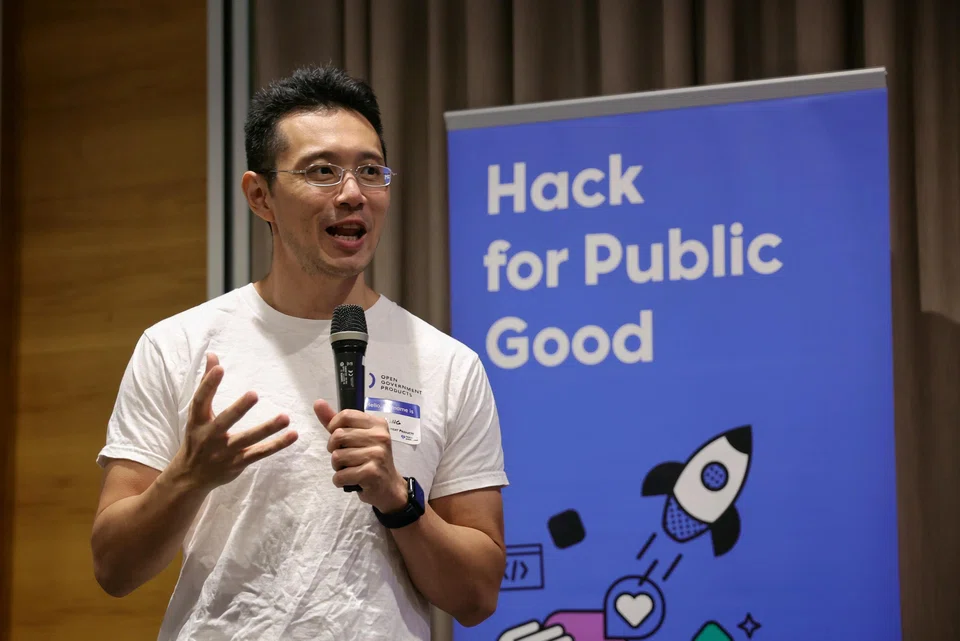
[SINGAPORE] If Li Hongyi had his way, he would run the public sector quite differently.
In some ways, he already does. Open Government Products (OGP), the experimental team he founded in 2019 to develop tech-enabled solutions for citizens and the public sector, operates more like a tech company than a government unit. It publishes detailed report cards on the products it has built, including their usage, quarterly costs, and the number of employees supporting them. This practice offers a level of disclosure that is uncommon even among private companies.
To date, OGP has developed over 40 products, including the ParkingSG app and RedeemSG, the digital voucher system used by millions of Singaporeans. Building tech products within the public sector can be a slow process. Some of the unit’s products take months to find their first user. Getting around red tape requires persistence – and sometimes ingenuity.
A few moments before our interview, Li took the stage at Tech in Asia Conference 2026 to share how almost every single one of OGP’s products exploits a “bureaucratic vulnerability” in some way. This lets them get shipped faster: ParkingSG, for instance, does not require a username or password. Personal data is stored on a user’s device rather than the application, reducing the government’s security burden.
Still, many of the team’s offerings face resistance. In 2024, an OGP-developed product drew complaints after many users reported difficulties using the web-based booking platform for public sports facilities such as badminton courts.
Yet a career in technology was not always what Li had in mind.
He may be the son of Lee Hsien Loong, Singapore’s former prime minister, but all he wanted to do as a child was “play and make video games”. Li also excelled in school, which eventually earned him a government scholarship to attend the Massachusetts Institute of Technology. The plan was to pursue physics and economics. He had largely accepted that his path would be linear: studying, getting good grades, and returning to a government ministry to “write some policies”.
A Google internship changed the course, however. Later, he swapped physics for computer science.
Li speaks fast, words and ideas spilling out. He is verbose, charismatic, and very convincing – an important trait to have when your job is, in a nutshell, to convince people there are better ways to be doing things. In this interview, Li explains how OGP gets things built inside a bureaucracy, what the public sector can learn from high-performing private companies, and why he believes culture cannot simply be built.

This interview has been edited for clarity and brevity.
Every January, OGP does a monthlong hackathon where employees identify problems to build solutions for. What is the cost of doing this and why is it worthwhile? It is everyone’s work for a month, which is very substantial for an organization of our size. The question is: How much more information does it give you?
There are different kinds of games you play. There are games where all the information is available, in which case, if you plan and think hard enough, you can find the right solution. There are also games where information is hidden, and so you need to pay for information.
That same thing is true in innovation. If you acknowledge upfront that you are working in an ambiguous space, is (spending) one month out of a year – which is maybe 7 per cent of your annual productivity – to get information valuable? Yes.
When there is not enough budget, especially, we should invest a little bit of time and resources exploring ideas so that the remaining 93 per cent of our effort is spent on the right things, versus just randomly.
A few months ago, your engineering team did an AMA (Ask Me Anything) on Reddit where it answered questions – candidly – about how it builds and prioritises ideas. How did that idea come about, and was it from you?
Absolutely not my idea. I was actually on leave at the time.
The reason why I called the team Open Government Products is that I wanted the word “open” in it. I wanted a word that would tell people we work differently, and I think “open” is not how people generally describe the government, although it is a very important part of a modern, well-functioning team and community.
In fact, if you look at high-performing teams, you will notice everyone says you must have open communication: You must be honest about what you are doing. You must have clarity and visibility. You must be accountable to the public.
And so, at OGP, I try very hard to push for an open culture where people talk and disagree openly so that we can have the right information and solve problems.
From the marketing team’s perspective, we are trying to get people to join us, and we are trying to push forward that open culture. I think it is a great idea.
I try to run the team in a way that I am not ashamed of anything we do. You can tell anyone anything about how we choose our products, how we run our performance, how we make critical decisions, and I will be happy to defend it.
The mistake a lot of government agencies make when engaging with the public is being overly defensive about how people will try to hurt them.
You were a product manager at Google. What is the biggest difference between building products for the private sector versus the public sector?
When I was working at Google, for something as simple as the shade of blue you use for ads, you would have a data scientist, a product manager, and some engineers running an experiment for a couple of weeks. You could find that a particular shade gets you a 2 per cent increase in clicks, which seems like nothing, but at Google scale, that is billions of dollars. It is tremendous.
If you were to tell your friends and family what you did today, that you made the color of ads 2 per cent lighter or something and therefore increased revenue – who cares?
In the government, you would be creating something like a subsidy scheme for single mothers or figuring out how to help social workers plan their tools. It is super important, but you do not have the data – you do not have the ability to run experiments. You are just talking to various people, getting a feel in the dark, and then moving.
At Google, you are solving really small problems with the best tools and the best resources in the world. In the government, you are solving massive problems, and you feel like you are just fighting with sticks and rocks. To me, that was the big mental shift.
Was that experience at Google what convinced you there was a different way to build things?
The key thing for me at Google was that it gave me a view of a different way of doing things. There are other ways of doing things that work just as well, and the Singaporean way is not the only way.
It is like trying to convince you that giraffes do not exist. For a long time, people thought giraffes were mythical. But having seen a giraffe, nothing in the world can convince you a giraffe does not exist.
I feel the same way about organisational design.
When you’re in Singapore, everyone will try to convince you that no, it is impossible: You cannot do this very liberal, open-communication thing. You cannot do this experimental thing.
But good organisations with modern design, open culture, and mission-driven people do exist. I have seen them.
I think the difference between Google employees or MIT students and Singapore students is that they are willing to try things, experiment, explore, and build things.
You’ve brought some of that experimentation into OGP, which operates somewhat differently from other parts of the government. Does the team have fewer constraints than other government agencies?
One of the misconceptions people have about OGP is that we operate with fewer constraints. Actually, at some level, we operate with a much bigger constraint: If we do not deliver, we do not exist.
The deal I made for OGP was like a venture capital (VC) deal. It is like saying, “look, don’t bother me with all of these procurement and compliance and sort of procedural things. Instead, every year, I’ll put together a presentation and a report to the bosses on what we spent and what we accomplished. If you like it, you can give me more (funding)”.
We started with 20 people, and I remember the first year we reported that we had done good work, and so we had 40 people the next year.
But at any point – and we have done this – if we do not deliver our outcomes, and the bosses decide to give us less funding, I will have to let people go. I think that is, to me, both scary and the right (level of) accountability.
In fact, for Halloween two years ago, our theme was “dead products”, and we put up little pins across the office for all the products we killed. We have to force efficiency so people on those products can be reallocated to products that are more promising.
OGP now employs just under 250 people. As the unit grows, how do you preserve that way of working without becoming more bureaucratic? Is there a critical size at which OGP’s bottom-up culture starts to break down?
I do not think culture is a goal. Culture is the outcome of being clear about what you want to do.
Everyone wants a good culture, but you cannot steer culture directly. What you can set are the goals, systems, accountability, incentives – and culture emerges from that.
You need to understand what lets you work well as a small organisation and make sure you enable that.
I am not trying to take the team that was successful at 50 people and make it a 500-person team. I am trying to look at what that team did and ask what I can do to have 10 of that.
Now that we have like four or five 50-person teams, I am shifting to a completely different job, where I’m running an incubator or a VC. My job is to support people doing what I was doing, even if I cannot do it myself.
Surely not all experiments work. OGP spent S$4.4 million (US$3.4 million) developing an alternative to Singapore’s electronic road pricing system (ERP) over two years, but it wasn’t ultimately rolled out. How do you decide whether an experiment like that was still worthwhile?
Therein lies the core challenge of public service. You cannot just use profit for any of these measures.
As a country, and given that the scale of ERP 2.0 is S$500 million, how much should we be spending to explore an alternative?
S$100 million is probably too much. S$50 million is still quite high. But if you say 1 per cent (of that), I think that is reasonable.
Our experiment cost over S$4 million. Maybe it does not come into play now, but in five or 10 years, you are going to have to do a replacement for ERP 2.0 again.
You are going to need to understand what your options are. You are going to need this information, and you (should) pay 1 per cent for much better information.
If we took 1 per cent of the cost of all major government infrastructure projects and allocated it to exploring alternatives, which might be better in the future, I think as a nation we would be better off, and that is the kind of calculus you have to make.
We work with the Land Transport Authority quite a lot on this, and it now understands how all these systems work. It can now use that to plan what its future objectives are.
You’ve spent years trying to build products within the government. Has that given you a different view of where the public sector still falls short – and where tech can make the biggest difference?
If what my bosses tell me is true, I have a very poor understanding of how the government operates.
I have seen what companies do to help you search the internet, watch videos, and buy shampoo – and their processes are way better than what we are doing to help people get access to healthcare and help underprivileged people get educated.
At Google, we had an internal website where you could watch videos of all the cafeterias via webcams so that you did not have to waste time walking there to get food if it was crowded. Whereas the process of helping people who cannot afford private healthcare access healthcare is ineffective. That, to me, is unconscionable.
I think the core problem with the world is that all the smartest people are working on the dumbest problems.
If you want to sell shampoo, you have got teams of PhD holders figuring this out, down to the wording and the size of the thumbnail. If you want to do a filter, you have got tons of computer vision experts, the best people in the world, getting paid hundreds of thousands of dollars a year to make it.
But if you are trying to, for example, (create a solution) so social workers (can) keep track of what (their) clients are and share data about, like, what kind of assistance they need, we are doing things on paper. We are texting each other back and forth.
I remember we were talking to some of the people who were arranging transport for children in foster care. Grab, for your bubble tea, has this sophisticated logistics system. But for children who are in foster care and need to go back and forth from schools with proper chaperones all along the way, arrangements are made on WhatsApp groups.
It is hundreds of these little WhatsApp groups texting each other and hoping that you coordinate and nothing falls through the cracks. I think that is wrong, and that is why I feel this is worth doing.
If that gap is what motivates OGP’s work, what kind of person do you look for to work on these problems?
The phrase I use when I describe the ideal OGP employee is someone who is angsty but hopeful.
If you are just pessimistic, you are useless to me because everything sucks, and nothing can be done. If you are just optimistic, you are also useless to me because if everything is very good, then you have no reason to try and fix things.
You need to see both: where the world is and where it could be, as well as the gap in between. And that gap is the tension that pulls you to do things. TECH IN ASIA
Decoding Asia newsletter: your guide to navigating Asia in a new global order. Sign up here to get Decoding Asia newsletter. Delivered to your inbox. Free.
Share with us your feedback on BT's products and services
TRENDING NOW

Once staunchly pro-China, Malaysian Chinese businesses are now distancing themselves from Beijing

New launch or resale unit? Here’s a guide for homebuyers
The lesser-known prospects in the Asian chipmaking supply chain

Cliff Tan has 7 million followers and a 4-month waitlist. Why won’t he expand his business?

