MAS tipped to ease monetary policy as Singapore’s core inflation dips further in December
Core inflation inches down to 1.8%, bringing full-year inflation for 2024 to 2.7%

SINGAPORE’S central bank may take steps to loosen monetary policy on Friday (Jan 24) for the first time in nearly five years, with the city-state’s core inflation in December remaining below the 2 per cent threshold, several economists said.
Core inflation, which excludes private transport and accommodation, eased to 1.8 per cent in December, from 1.9 per cent the previous month, data from the Singapore Department of Statistics showed on Thursday.
This is the lowest since November 2021, and came on the back of a moderation in services inflation.
Headline inflation in December remained unchanged at 1.6 per cent because lower core and accommodation inflation was offset by a milder decline in private transport costs, the Monetary Authority of Singapore (MAS) and the Ministry of Trade and Industry (MTI) said.
December’s inflation numbers are a shade higher than the levels that private-sector economists polled by Bloomberg expected.
The latest reading brings 2024’s full-year core inflation to 2.7 per cent, which is within the official forecast range of 2.5 to 3 per cent. Full-year headline inflation is at 2.4 per cent, just a notch below the official outlook of “around 2.5 per cent”.
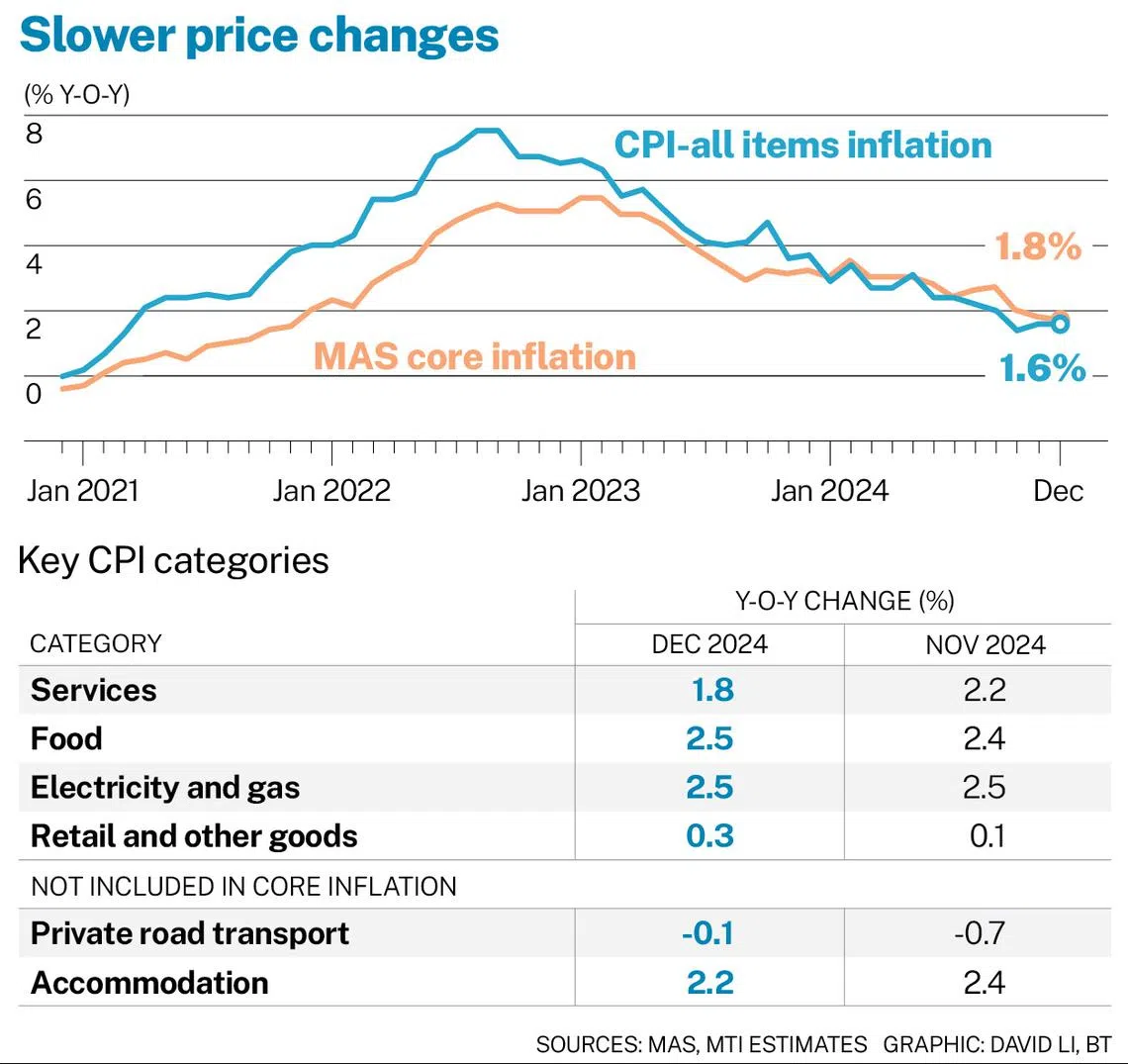
These levels are far lower than the 4.8 per cent headline inflation and 4.2 per cent core inflation observed in 2023.
In their joint statement, MAS and MTI said they expect core inflation to step down in 2025 compared with last year, owing to several factors.
Globally, these include more favourable supply conditions and a broad easing in inflation.
Domestically, meanwhile, nominal wage growth is moderating amid a more gradual rise in unit labour costs and improving productivity.
The authorities also highlighted that their forecast ranges for headline and core inflation will be updated in the central bank’s Monetary Policy Statement due at 8 am on Friday.
MAS’ 2025 forecast for headline and core inflation stands at 1.5 to 2.5 per cent.
“This is rather unusual and may portend a shift in the official inflation forecasts, possibly shaded lower to 1 to 2 per cent year on year,” said OCBC chief economist Selena Ling.
Barclays regional economist Brian Tan said this is “notably reminiscent” of the January 2022 statement, which highlighted that “MAS and MTI are reviewing the current forecast ranges”. The day after the statement was released, the central bank unexpectedly tightened monetary policy.
Several economists also said they expect MAS to slightly reduce the Singapore dollar nominal effective exchange rate (S$NEER) policy band on Friday, given authorities’ relatively “dovish” take.
“With inflation comfortably below 2 per cent, we expect MAS to ease monetary policy via a slight reduction of the S$NEER slope at its quarterly meeting,” said Maybank economists Chua Hak Bin and Brian Lee.
While UOB associate economist Jester Koh holds a similar view, he said he would “not be surprised” if MAS decides to keep the policy settings unchanged “to allow the market to ‘steer’ the S$NEER lower within the existing band parameters, tantamount to a de facto easing of monetary conditions”.
“While the recent inflation readings reflect a normalisation in core momentum and a dissipation of broad-based price pressures, upside risks to services inflation persist owing to wage pressures,” he added.
These pressures are associated with the extension of the Progressive Wage Model, especially if wage growth is not accompanied by corresponding improvements in labour productivity, he said.
Citi economist Kit Wei Zheng believes the advantage of waiting until the next quarterly meeting in April could be outweighed by MAS’ “historical propensity” to move pre-emptively, especially at “cyclical turning points”.
Thursday’s “clear hint of a forecast downgrade”, he added, is consistent with past easing.
“Historically, we note that MAS has moved even before core inflation outturns reached tolerance thresholds of 1.5 per cent, as long as their forecasts suggested that such thresholds would be reached within the policy horizon, causing policy to turn undesirably restrictive or accommodative in a tightening cycle,” he said.
Bucking the trend, however, are Standard Chartered economists Edward Lee and Jonathan Koh, who believe MAS may instead stand pat, given that there may still be price pass-throughs. They estimate that the current S$NEER slope is at a “neutral” level and still appropriate for now.
“If MAS moves now, it may be a pre-emptive move on very uncertain risk factors,” they said. “Admittedly, our slope estimate may be off and the actual slope is steeper.”
Still, with MAS’ meetings now quarterly instead of half-yearly, there may be less need to be pre-emptive, they added.