New markets, tools and skills: How S’pore firms can stay resilient amid change
Panellists at the Future of Trade Forum 2026 share how businesses can seize new opportunities amid a turbulent environment
Kareyst Lin
Why would a Singapore food company travel halfway around the world in search of its next supplier?
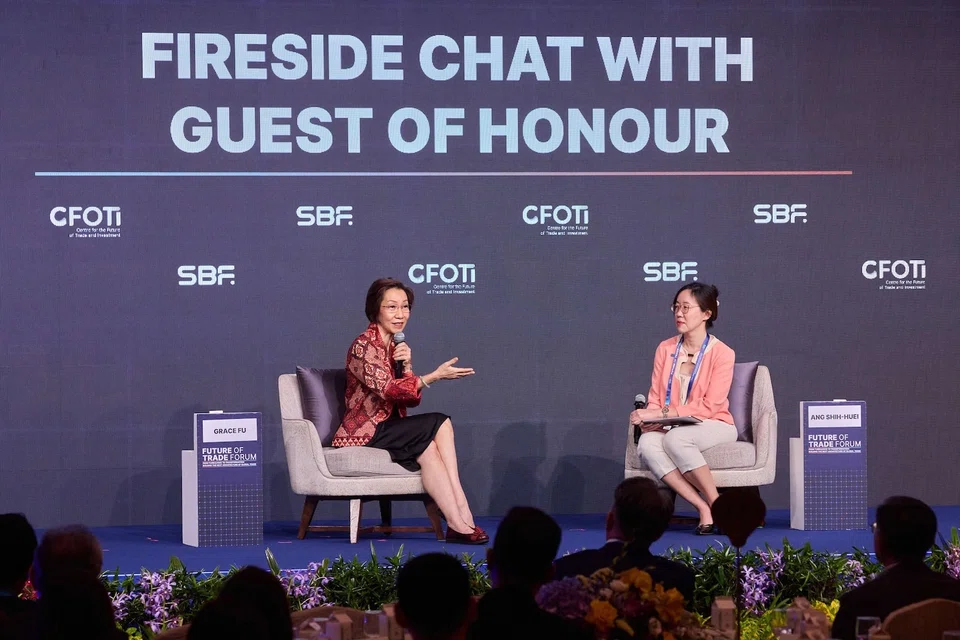
On a recent trip to Latin America, Minister-in-charge of Trade Relations Grace Fu was joined by several Singapore companies doing just that.
They were scouting for new sources of food to shore up the Republic’s food security, said Fu, who is also Minister for Sustainability and the Environment.
She was speaking at a fireside chat at the Singapore Business Federation’s Future of Trade Forum 2026 on Sept 30 at Shangri-La Singapore.
The search reflects the need for businesses to diversify their supply chains amid a volatile trade environment, Fu said.
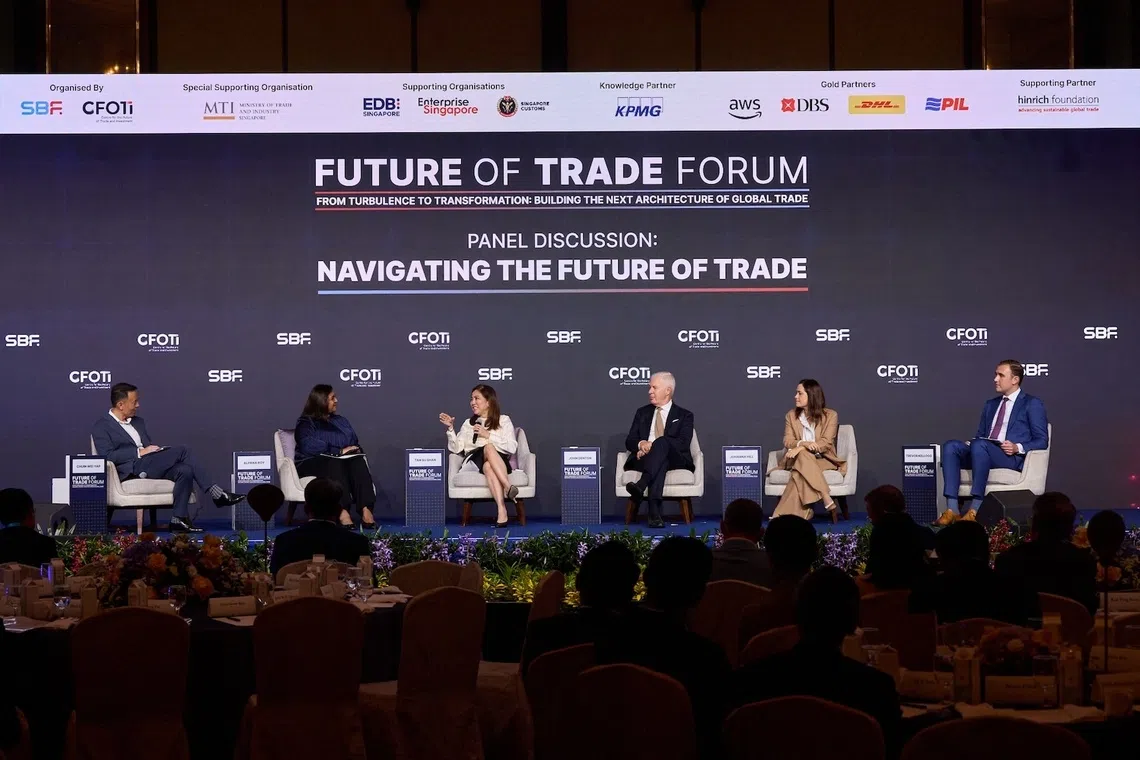
In a panel discussion that followed, Tan Su Shan, chief executive officer of Singapore-headquartered DBS Group, emphasised the need for businesses to plan ahead – to “stress-test, and think about different scenarios”.
She added: “(Upstream supply chains) used to be (about) just-in-time optimising. Today, it’s better to stock up inventory just in case.”
That shift from “just-in-time” to “just-in-case” emerged repeatedly throughout the forum.
Yet this turbulence also “creates opportunities for businesses to diversify their markets, strengthen their supply chains and capture new areas of growth”, Fu explained.
To help businesses seize these opportunities, Singapore is focusing on three fronts: trade partnerships, technology and talent, she said.
Trade meets tech
The Future of Trade Forum 2026 was held on Sept 30 at Shangri-La Singapore.
Inaugurated in 2019 and organised by the Singapore Business Federation (SBF), the forum brings together public- and private-sector players to discuss and collaborate on solutions that can address a rapidly evolving trade environment.
Minister-in-charge of Trade Relations Grace Fu was the guest of honour at this year’s event, where SBF’s Trade AI Advisor (TAIA) platform was launched.
TAIA uses artificial intelligence to give local businesses reliable, real-time guidance on navigating Singapore’s 29 free trade agreements, so they can export with greater confidence and efficiency.
At the forum, Fu also announced that the BizSG portal had gone live that day. Developed by the Ministry of Energy, Trade and Industry and EnterpriseSG, the portal recommends grants based on a company’s needs and plans.
The aim is to make government support easier to find and use, said Fu, so that small and medium-sized enterprises can spend more time growing their business.
Strengthening trade partnerships
Singapore is deepening ties with key economic partners while diversifying into new markets, said Fu.
The Republic’s free trade agreements (FTAs) with trade blocs Pacific Alliance and Mercosur, for instance, are opening doors in Latin America. Singapore is also negotiating an FTA with Bangladesh and exploring one with the East African Community.
Alpana Roy, director-general of International Trade and ASEAN, Ministry of Energy, Trade and Industry (METI), added: “The idea is to create these highways (that can) reduce speed bumps for businesses.”
Deeper partnerships also mean aligning the rules that businesses must follow – a pain point that forum attendee Daphane Loke knows well.
Loke is managing director of Saybons, a Singapore-based, halal-certified French food business looking to export its products overseas.
With US tariffs reshaping trade this year, she came to the forum to understand how other industry players were being affected.
Saybons started in 2007 as a takeaway kiosk selling crepes and homemade soups. It spent two to three years reworking its French recipes to remove alcohol and bacon, and obtained halal certification in March 2024.
Selling halal food across borders, however, remains tough. “The certifying process (in certain overseas markets) can be time-consuming and laborious,” said Loke, “especially when some of our soups and stews contain high-risk items such as poultry.”
Common standards across halal-certifying bodies in different markets would help, she said.
Going paperless, digital-first
The second front is harnessing technology to make trade more accessible and seamless.
For businesses, technology is “both a challenge and an opportunity”, said DBS Group’s Tan. Artificial intelligence is a powerful ally, particularly for time-strapped business owners, she added.
That was the thinking behind SBF’s Trade AI Advisor platform and the BizSG portal.
Fu said the ambition is for BizSG to become “a digital concierge for SMEs, so that they have more time to focus on business growth”.
Beyond tools for individual firms, governments in South-east Asia are working to digitalise trade itself. Moving away from paper cuts costs and time, and widens access to trade finance, said Fu, but it “cannot be achieved unilaterally”.
She added: “It requires working with trade partners to establish common rules and standards, and interoperable data exchange systems.”
ASEAN, for one, has concluded its Digital Economy Framework Agreement (DEFA), which will be signed at the 49th ASEAN Summit in November.
DEFA sets common rules for digital trade, cross-border e-commerce, cybersecurity, digital identity and digital payments across the region.
To put such rules into practice, said METI’s Alpana Roy, the bloc is upgrading the ASEAN Single Window with new functionalities.
The ASEAN Single Window is a platform that links the national trade systems of 10 ASEAN member states. Timor-Leste, the bloc’s newest member, is currently being onboarded.
The ASEAN Single Window allows trade documents like certificates of origin and customs declarations to be exchanged electronically.
Work is ongoing to expand the types of documents that can be exchanged, and onboard more markets – including non-ASEAN ones – onto the platform.
Human edge remains
Ultimately, “competitiveness also depends on our people”, said Fu, adding that technology and trade agreements “will only take us so far”.
“Businesses need professionals who can navigate overseas markets, trade and investment rules, compliance requirements and shifting supply chains,” Fu said.
To build these capabilities, SBF’s upcoming Trade and Investment Competency Framework aims to give professionals a structured pathway to build and certify their trade and investment capabilities. Businesses, in turn, gain a ready pool of certified trade specialists.
The framework is supported by EnterpriseSG and will be launched in 2027.
As new technology like AI reshapes work, Fu stressed that workers must not be left behind. “We don’t want to adopt AI for the sake of just doing (it),” she added.
For DBS Group’s Tan, upskilling is how Singapore stays competitive. Even with advanced manufacturing, she noted, Singapore cannot match the scale or cost per unit of manufacturing giants like China.
The Republic’s edge lies in higher-value work built on intellectual property, research and development, and innovation, Tan said.
This means that workers in Singapore need to upskill and “(not be) scared to learn new stuff”, she added.
In partnership with the Ministry of Energy, Trade and Industry
Decoding Asia newsletter: your guide to navigating Asia in a new global order. Sign up here to get Decoding Asia newsletter. Delivered to your inbox. Free.
Share with us your feedback on BT's products and services