Political salary increase works out to 3.6% a year, below wage growth for Singaporeans: Chan Chun Sing
Yearly increase still below wage growth of median and lower-income Singaporean workers
 Add BT as a preferred source
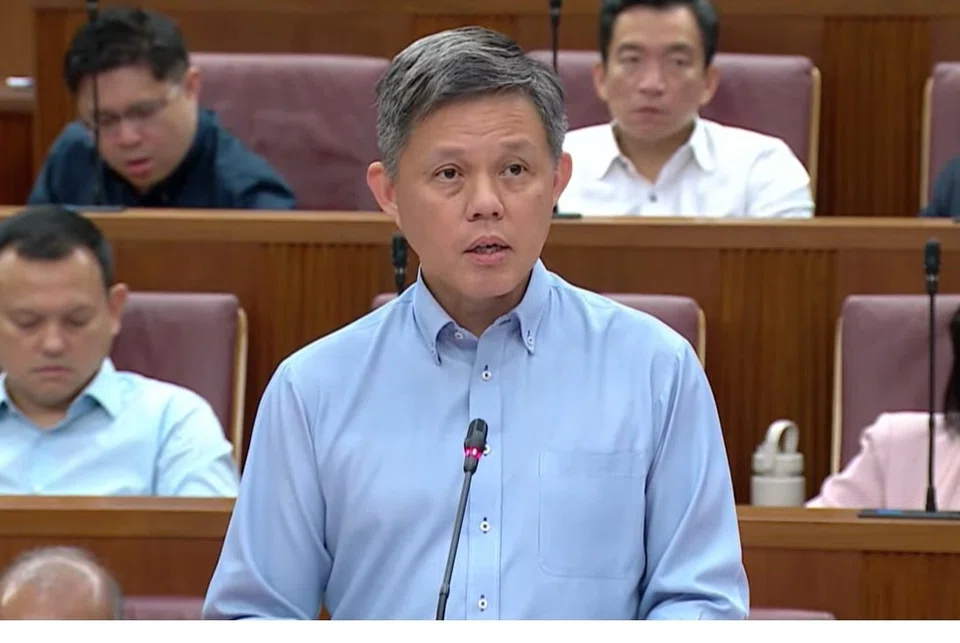
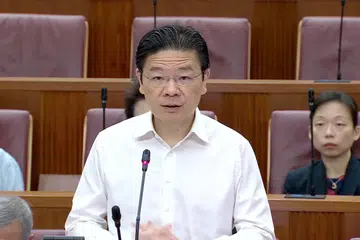
[SINGAPORE] While the benchmark to which Singapore’s political salaries are pegged will increase, the annualised adjustment of 3.6 per cent a year is still lower than the wage growth experienced by Singaporeans over the same 15-year period, said Coordinating Minister for Public Services Chan Chun Sing in Parliament on Tuesday (Sep 8).
The reference annual salary for an entry-level minister at the MR4 grade will be raised to S$1.8 million, up from S$1.1 million, after the government accepted the recommendations of an independent committee that reviewed political salaries for the first time since 2012.
The recommendations were implemented retrospectively from May 2011, when that term of government took office.
The MR4 benchmark is pegged to the median annual income of the top 1,000 Singaporean earners, with a 40 per cent discount applied to reflect the ethos of political service.
Without this discount, the reference salary would be slightly above S$3 million, said Chan.
The review committee, chaired by Singapore LNG Corporation chairman Gan Seow Kee, had examined the composition of the top 1,000 earners and affirmed that the benchmark pool reflects a diverse range of sectors, including manufacturing, healthcare, transport and real estate.
It also looked at the salaries of not just chief executives, but also those in management roles below CEO-level and professionals across various fields.
The committee also affirmed that using the median income, rather than average, of the benchmark pool is more prudent for computing the reference salary, since the median is not distorted by a small number of ultra-high earners.
Chan acknowledged that no formula would be perfect or satisfy everyone.
SEE ALSO
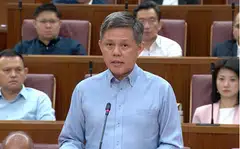
“The key question is this – what is a workable framework and range of figures that allow the PM, any PM, to reasonably assemble a team that Singapore deserves?”
Chan, who was setting out the government’s response to the 2026 salary review, said the increase appears substantial because the framework has not been updated in 15 years, since the government held back planned reviews in 2017 and 2023.
By comparison, Singaporeans saw wage growth of about 4.3 per cent a year for median income earners, and 4.6 per cent a year for lower-income earners, over the same period, he said.
Chan added that civil service pay has been adjusted three times over the same 15-year period in which political salaries have remained frozen – in 2014, 2022 and again in August 2026 – with revisions ranging from 2 to 14 per cent to close market gaps.
Existing political office holders will not move immediately to the new reference salary, said Chan. Instead, they will receive a one-off adjustment of up to 9 per cent, depending on individual circumstances, including performance and when their salary was last adjusted.
This means that an MR4 minister who is paid at the current reference salary of S$1.1 will get an increase to about S$1.2 million.
Wider bands, merged benchmarks
Beyond the MR4 benchmark, the government also accepted the committee’s recommendation to widen salary ranges for other political office holders, from the current range to 75 to 125 per cent of the relevant benchmark salary.
This will bring Singapore’s practice in line with market norms, where salary ranges tend to be wider, and gives the prime minister more flexibility to place new appointment holders according to their experience and prior remuneration, said Chan.
To simplify the grade structure, the government will also merge the MR2 and MR3 ministerial grades into a single grade, pegged at 1.3 times the MR4 reference salary – the midpoint of the current 1.2 to 1.4 times range.
Separately, the grades for mayors, senior parliamentary secretaries and parliamentary secretaries will be merged and pegged at 0.45 times the MR4 reference salary – towards the lower end of the current range of 0.38 to 0.6 times.
This merged grade will have a wider salary range of 70 to 130 per cent of the benchmark salary.
Separately, Chan said MP allowances will also be raised, from S$13,750 to S$18,500 a month, to account for inflation.
Chan said the salary adjustments would cost the government about S$5 million more annually for political officeholders, if the maximum of 9 per cent is applied to all officeholders, and about S$6.6 million more annually for MPs.
To keep the framework up-to-date, the government will review the salary framework every five years, said Chan. “Between reviews, where justified, the government may make adjustments within the framework. This will be exercised with responsibility and restraint.”
Parliament will debate the ministerial statements by Chan and Prime Minister Lawrence Wong on Thursday.
Decoding Asia newsletter: your guide to navigating Asia in a new global order. Sign up here to get Decoding Asia newsletter. Delivered to your inbox. Free.
Copyright SPH Media. All rights reserved.