

Real income growth slows, non-PMET unemployment up: MOM sees signs of Singapore’s labour market moderating
But findings point to ‘broadly positive’ outcomes with inflation-adjusted pay still up 2.2% at the median


[SINGAPORE] The Republic’s labour market shows “signs of moderation” in 2026, as real income grew at a slower pace and unemployment rose among non-PMETs (professionals, managers, executives and technicians).
Job mobility also fell, the Labour Force in Singapore Advance Release published on Friday (Nov 27) showed. The Ministry of Manpower (MOM) added: “Forward-looking indicators suggest that firms remained cautious about expanding headcount and raising wages.”
Still, the ministry called the labour market “resilient”. It remains tight, with high permanent employment (of 91 per cent among employed residents), and overqualification trending down slightly, pointed out Ang Boon Heng, director of its manpower research and statistics department.
Singapore’s overqualification rate declined to 18.7 per cent in 2026, from 19.4 per cent before, with a large majority of overqualified workers voluntarily taking roles below their qualification level.
“Overall, we continued to see a workforce characterised by relatively stable employment and an increasing share in higher-skilled roles,” the MOM said.
Moderating real income growth
Real incomes have continued to rise, while overall unemployment and time-related unemployment remain low, Ang highlighted.

The nominal median gross monthly income of full-time employed residents grew to S$6,021 in 2026, from S$5,775 in the year before. This marked the first time the indicator crossed the S$6,000 mark, and represents a record high, said Ang.
At the 20th percentile, nominal income grew to S$3,270, from S$3,164 before.
However, the pace of growth was slower in 2026 than in 2025 both in nominal terms and when inflation was taken into account. Real income growth at the median moderated from 4.1 per cent to 2.2 per cent, while growth at the 20th percentile eased from 3.6 per cent to 1.3 per cent.
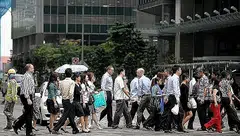
“The moderation partly reflected more cautious wage increases by firms and higher inflation,” MOM said, adding that real income growth at the 20th percentile was higher than at the median over the recent five- and ten-year periods.
More churn for non-PMETs
Resident unemployment rates stayed low overall, with the unemployment rate of PMETs holding broadly steady at 2.7 per cent in 2026, compared with 2.8 per cent in the year before.
But the unemployment rate of non-PMETs grew from 2.8 per cent in 2025 to 3.5 per cent in 2026. This increase – to levels seen in 2023 and 2024 – was largely driven by older workers, noted Ang.
The non-PMET workforce, which includes roles such as service staff and cleaners, tends to see more churn, he said.
“We don’t see that this increase in unemployment rate among non-PMETs has translated to prolonged or sustained difficulties in securing employment.”
Long-term unemployment rates edged up to 0.7 per cent for both PMETs (from 0.6 per cent in 2025) and non-PMETs (from 0.5 per cent).
“These are close to historical averages, although the PMET rate was at the higher end of the range, reflecting softer hiring in outward-oriented sectors,” MOM said.
The number of discouraged workers, who do not seek work because they believe their job search would be unsuccessful, remained low at 7,100, or 0.3 per cent of the resident labour force – the same proportion as in the two years prior.
Time-related under-employment, which measures the share of part-time workers who are willing and able to take on more work, fell to 1.7 per cent, from 1.9 per cent in the year before.
Fewer switches, higher pay
Job mobility also slipped in 2026, with fewer residents changing jobs amid lower turnover and softer hiring.
The proportion of employed residents who changed jobs in the previous year declined to 5.7 per cent in 2026, from 6.2 per cent in 2025 – extending a gradual downtrend from a job-switching peak in 2022.
Of these job switches, 94.4 per cent were voluntary, rather than due to retrenchments.
Some 65.6 per cent of resident job switchers aged 25 to 64 experienced increases to their real income after changing jobs – with more than half (57.3 per cent) posting gains of at least 5 per cent.
Pay outcomes were better for voluntary job switchers – 67 per cent reported higher income in their new role, compared with 57.5 per cent for involuntary job switchers.
The MOM found that job switchers whose real income increased were more commonly degree holders and PMETs, as they were more likely to work in sectors with above-average productivity, such as financial and insurance services or infocommunications.
Older population, lower participation
Singapore’s resident labour force participation rate (LFPR) continued to ease in 2026, extending a decline that has been recorded since 2021. The trend mainly reflected Singapore’s population ageing and retiring, rather than weaker economic conditions, MOM said.
The LFPR for residents aged 15 and over dipped to 67.8 per cent in 2026, from 67.9 per cent in 2025, despite stable or slightly higher participation rates for residents in the prime working age range of 25 to 54 years and for seniors.
As a super-aged society, the share of residents aged 65 and over among the working age population continued to grow, and this group generally has lower participation rates than younger age groups, MOM said.
Still, Singapore’s overall LFPR remained among the highest compared with Organisation for Economic Cooperation and Development countries – a fact that Ang believes may be because other countries are facing similar challenges, as well as because Singapore has been implementing measures to encourage hiring and labour force retention of senior workers.
Released annually, the Labour Force in Singapore Advance Release looks at structural indicators in the job market, rather than quarter-on-quarter movements.
Decoding Asia newsletter: your guide to navigating Asia in a new global order. Sign up here to get Decoding Asia newsletter. Delivered to your inbox. Free.
Copyright SPH Media. All rights reserved.
TRENDING NOW

New rules on gross floor area to free up building space for developers

Keppel CEO on telco merger: S$34 million StarHub dividend beats M1’s S$3 million contribution

High costs, cautious shoppers: DFI, Food Empire in favour as Sheng Siong, Delfi face margin squeeze

Morgan Stanley trims tech exposure amid tensions, flags S’pore, other Asian defensive winners

