Refreshed Food Manufacturing Industry Digital Plan to simplify digital adoption, support scaling efforts
The second iteration plan allows companies to adopt the right solutions to enhance their operations and thrive in a competitive market

[SINGAPORE] The second iteration of the Food Manufacturing Industry Digital Plan (IDP) was unveiled on Monday (Feb 9), aimed at simplifying how small and medium-sized enterprises (SMEs) in the sector identify digital solutions to their operational challenges.
Senior Minister of State for Trade and Industry Low Yen Ling, who announced the refreshed plan, said the operating landscape has continued to evolve since the roadmap was first launched in 2021.
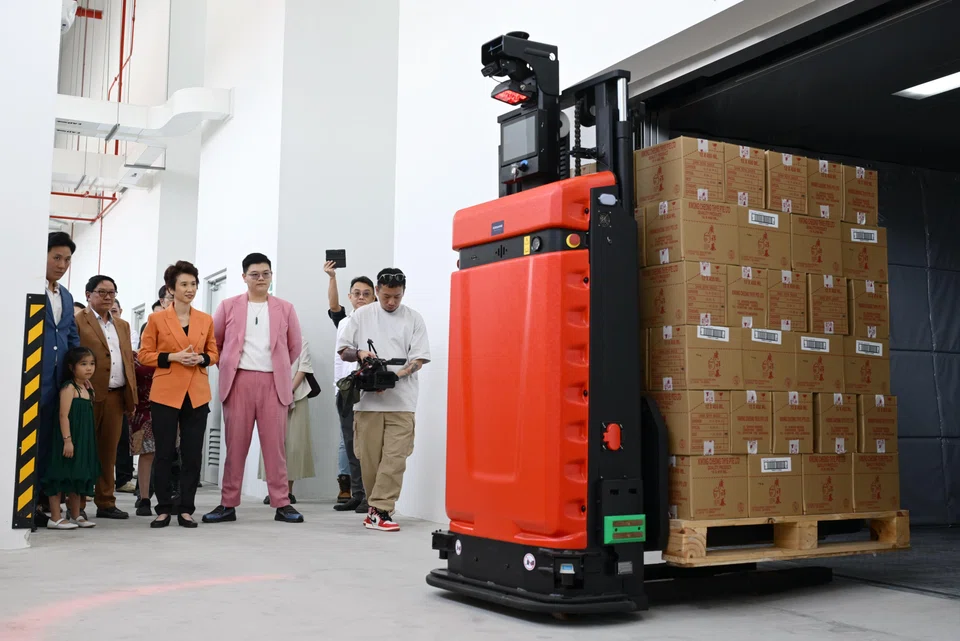
“AI has emerged as a key enabler of efficiency and innovation, alongside the ongoing need to raise productivity in traditional sectors, amid manpower constraints,” said Low, at the opening of soya sauce and condiments manufacturer Kwong Cheong Thye’s new factory along Senoko Crescent.
Enterprise Singapore (EnterpriseSG) and the Infocomm Media Development Authority (IMDA) acknowledge that businesses are facing challenges such as rising operating costs, manpower constraints and productivity pressures.
In response to these developments, Low said the agencies worked with the sector to refresh the IDP to ensure that it “remains responsive to the needs and capabilities of our food manufacturers”.
Separately, Isaac Tow, director of IMDA’s SMEs Go Digital programme, said this streamlined approach “ensures that companies can quickly and effectively adopt the right technologies, empowering them to enhance their operations and thrive in a competitive market”.
As at 2025, more than 90 per cent of food manufacturing businesses have adopted at least one sector specific digital solution, up from 75 per cent in 2023.
Alvin Choo, director of Kwong Cheong Thye, said in his opening remarks that the 134-year-old heritage brand’s newest facility, which focuses on manufacturing soya sauce, is expected to increase production capacity by six times with the aid of automation and artificial intelligence (AI).
About 30 per cent of the facility’s operations will be powered by renewable energy, such as solar, and it is twice the size of its existing factory, which is also in Senoko.
The new plan
The refreshed plan, which is expected to guide more than 1,500 food manufacturers on their digitalisation journey, organises solutions around three business outcomes.
They are: digitalising tedious processes such as routine administrative tasks; optimising manufacturing to improve production performance; and supporting firms in scaling up production and expanding overseas.
Supporting this third outcome, a newly introduced solution – the Logistics Control Tower – enables businesses to maintain real-time oversight of their global supply chain operations from their Singapore headquarters. This reduces the complexity and risks associated with international expansion.
The latest IDP also incorporates AI and generative AI solutions to “elevate customer experience, improve operational efficiency and accelerate business growth”, said the agencies.
Aside from AI chatbots that support customer service and internal operations, examples include an AI-enabled automated ordering management system that digitalises and integrates incoming customer orders into companies’ internal systems, reducing manual data entry and improving fulfilment accuracy.
It also includes manufacturing analytics that enables businesses to boost productivity and reduce downtime through AI-powered insights for production optimisation and predictive maintenance.
Manufacturing analytics tools are also available that enable businesses to boost productivity and reduce downtime through AI-powered production insights and predictive maintenance.
At Kwong Cheong Thye, such tools – including a manufacturing execution system that monitors the production process – are used to monitor critical fermentation variables such as temperature and humidity, which helps to streamline scheduling and multi-batch planning.
The company is also expected to upskill two of its soya sauce production staff to take on new roles as data control specialists. They will be trained to monitor production data using the system to ensure smooth and optimal manufacturing processes.
Low said this illustrates how the adoption of digital and AI solutions, beyond improving business efficiency, can also create new opportunities for workers in the food manufacturing industry.
To address cybersecurity risks linked to the digitalisation of operations, EnterpriseSG and IMDA said the refreshed plan also includes a Cybersecurity and Data Protection Roadmap that provides practical guidance for SMEs on safeguarding systems and data as they scale digitally.
Supportive ecosystem
Beyond digital solutions, Low said the government is also building a support ecosystem to help food manufacturers who are facing challenges in starting their digitalisation journey and may be unsure of where to seek help.
One new initiative to be launched in the second half of the year is a talent development programme that will connect computing and IT students from institutes of higher learning with food manufacturers through internships.
She said participating students will provide technical expertise to support digital solution adoption and integration, enabling businesses to build a pipeline of skilled talent while addressing digital challenges.
In addition to the new initiatives, food manufacturers can now access personalised digitalisation advisory services at the SME Centre@SMF (Singapore Manufacturing Federation), where sector-trained advisers assess firms’ digital readiness and recommend suitable solutions tailored to their needs.
Decoding Asia newsletter: your guide to navigating Asia in a new global order. Sign up here to get Decoding Asia newsletter. Delivered to your inbox. Free.
Copyright SPH Media. All rights reserved.