

Retailers go live as industry body, TikTok Shop, WSG launch training push
Singapore Retailers Association president Ernie Koh says government funding will subsidise course fees

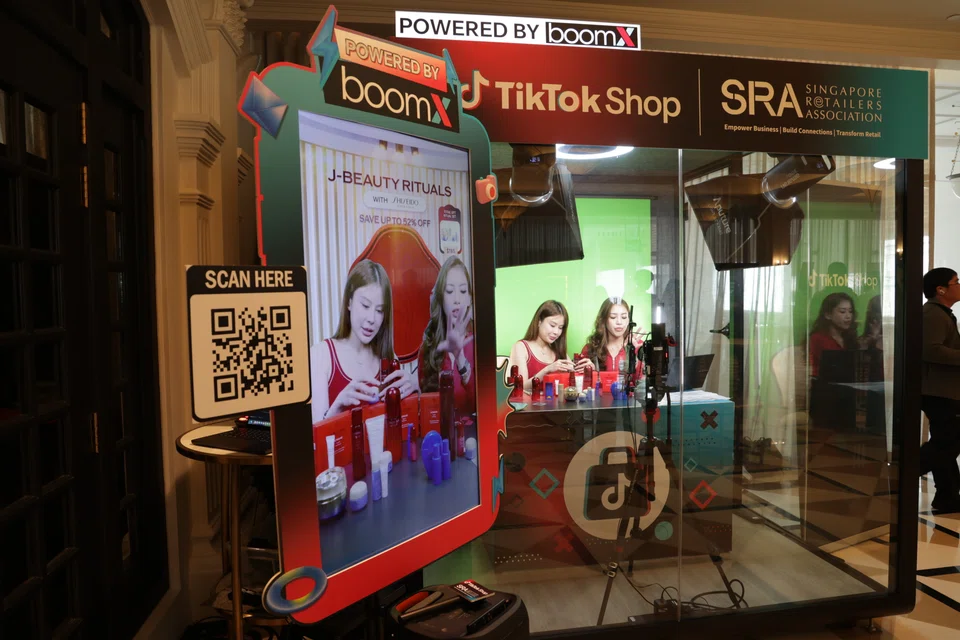
[SINGAPORE] Retailers in Singapore can tap a new industry initiative led by the Singapore Retailers Association (SRA), TikTok Shop and Workforce Singapore (WSG) to train workers for roles such as livestream hosts and technical operators, as they look to build capabilities in social commerce.
The three parties signed a memorandum of understanding on Monday (Mar 30) to develop training programmes and supporting infrastructure for livestream commerce. These will cover areas from content planning and technical setup to live sales and post-stream analysis, under broader efforts to digitalise the retail sector.
Under the collaboration, WSG will support training programmes, while TikTok will provide platform capabilities.
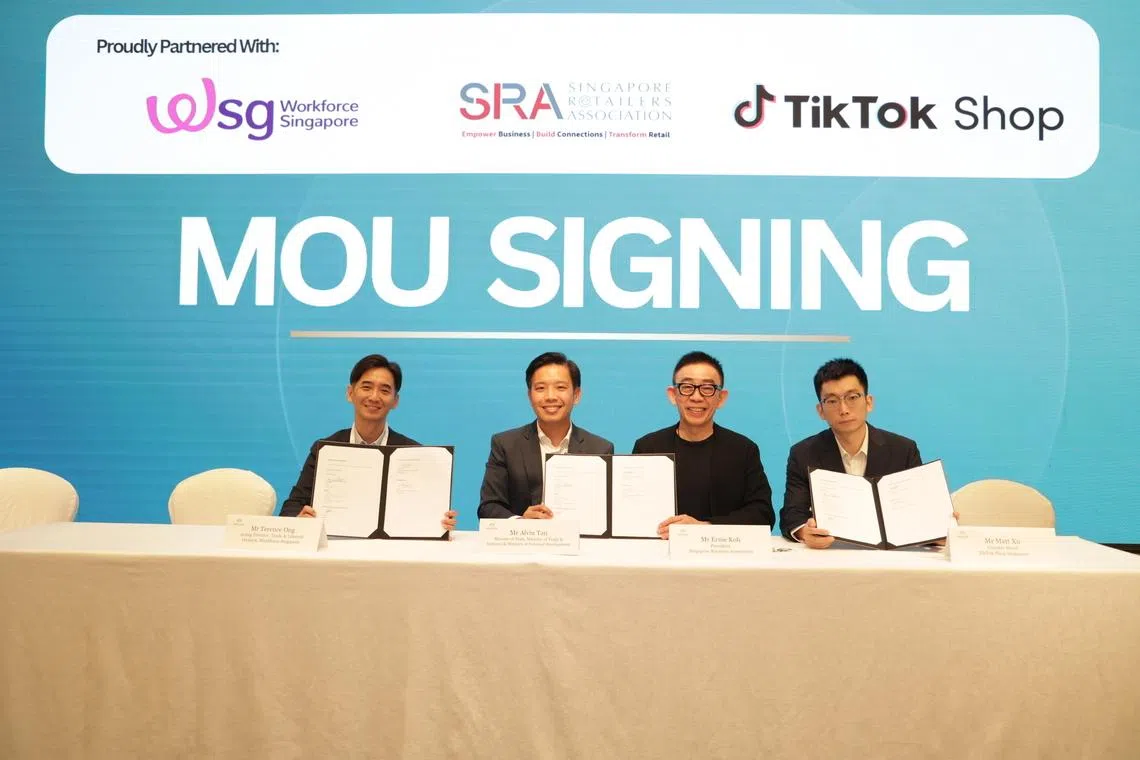
Minister of State for Trade and Industry Alvin Tan, who witnessed the signing, said the retail landscape has undergone rapid changes, and that businesses now face tighter margins and more demanding customers.
Customers today often begin their shopping journey online – browsing, comparing products and watching reviews or livestreams – and expect a smooth, responsive and seamless experience across channels, said Tan, who is also minister of state for national development.
“To keep up, retailers must go digital,” he said, adding that social commerce is a structural shift that brings together content, community and commerce; this trend of buying and selling directly within social-media platforms also enables brands to reach customers beyond their physical stores.
To that end, the collaboration will focus on developing training programmes for three social commerce roles: hosts, leads and engineers.
The host serves as the on-camera presenter, the lead manages pricing, promotions and inventory in real time, and the engineer oversees technical setup and stream quality.
Under the initiative, SRA president Ernie Koh told The Business Times, interested retailers can tap funding support from the government to subsidise course fees. This includes the SkillsFuture Workforce Development Grant (Job Redesign+), which funds up to 70 per cent of the costs.



A one-day course for the social commerce lead programme is slated to run monthly from April at S$750; details of the other two courses are yet to be finalised.
Pivoting due to competition
Koh said the SRA came up with the idea for the programme based on embarked feedback from members keen to try livestreaming but were unsure how to get started, particularly given the need for skills in content, operations and technical execution.
He added that the move comes as physical retailers face growing competition from online platforms, with many needing to adapt as sales shift online.
“The relevance of retail is being questioned nowadays. You need your staff to pivot,” he said.
Livestreaming can also complement physical retail by driving both online sales and in-store traffic, Koh added.
For instance, while customers may be less likely to purchase higher-value items such as furniture through livestreams, he said such content can still generate interest and encourage store visits.
Retailers that have adopted livestreaming told BT that it can also help extend their reach and engage new customer segments.
Christine Goh, senior general manager for commercial at Shiseido, said the company began exploring livestreaming last year as more consumers were discovering products through video content on platforms such as TikTok Shop. She said livestreaming helps the brand “reach customers beyond store operating hours” and tap new audiences through content creators.
However, Goh said that Shiseido’s efforts are still in the early stages, with the costs of engaging content creators and a lack of familiarity with the channel posing challenges in its trial-and-learn approach.
Winnie Ong, founder of the online fashion label Young Hungry Free, said the brand began livestreaming in 2023 as shopping behaviour shifted to social media platforms, where users browse and discover new products.
She added that livestreaming enables a more interactive experience by creating a “two-way conversation” with customers that is hard to replicate on traditional e-commerce sites.
While it sits within a broader multi-channel strategy, which includes its website, the brand’s general manager Mizushima Emi said livestreaming has also boosted both traffic and sales by reaching new customer segments on discovery-led platforms such as TikTok Shop.
Decoding Asia newsletter: your guide to navigating Asia in a new global order. Sign up here to get Decoding Asia newsletter. Delivered to your inbox. Free.
Copyright SPH Media. All rights reserved.
TRENDING NOW

Malaysian king buys stake in Singapore-listed mining firm expanding into rare earths

Family offices ‘kept captive’ by relationship managers turn to independent advisers, direct deals

Once staunchly pro-China, Malaysian Chinese businesses are now distancing themselves from Beijing

Could stablecoins be the future of money?

